
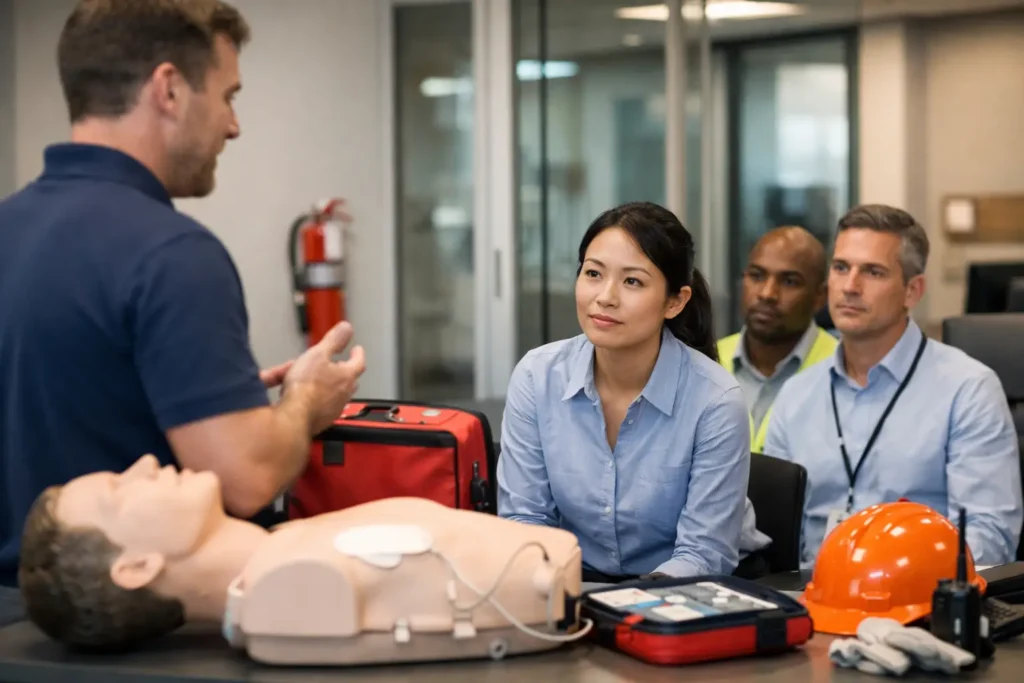
A medical emergency in an office rarely starts with a dramatic warning. More often, it looks like an employee who suddenly collapses in a hallway, a visitor with chest pain in reception, or a staff member choking during lunch. That is why knowing how to train office emergency teams matters. The goal is not to turn employees into paramedics. It is to make sure the right people can recognize an emergency, start the first critical actions, and use lifesaving equipment with confidence until EMS arrives.
In many workplaces, emergency response planning gets treated like a binder on a shelf. Real response is different. Your office emergency team needs clear responsibilities that fit your layout, staffing, and risk level.
For one office, that may mean designated responders who can begin CPR, retrieve an AED, direct EMS to the right entrance, and manage the surrounding area. In another setting, it may also include support for severe bleeding, opioid overdose response, or coordinating evacuation during a fire alarm that happens at the same time as a medical event. The right plan depends on your people and your facility.
The most effective teams are not built around job titles alone. They are built around coverage. You need trained responders on different shifts, in different departments, and near higher-traffic areas. A strong program also accounts for vacations, turnover, hybrid schedules, and large meetings where visitors are present.
Training works best when it follows the real conditions your staff will face. That means moving beyond a basic lecture and focusing on skill retention, role clarity, and repetition.
Start with the core medical response skills. In most offices, that includes CPR, AED use, choking response, and basic first aid. If your workplace has elevated risk factors, you may need trauma response or overdose response as well. The training should be practical and hands-on, not just informational. When someone has to place AED pads or start compressions, muscle memory matters.
Next, connect those medical skills to your site-specific response plan. Team members should know where the AED is located, who calls 911, who meets EMS at the entrance, and how internal communication works during an emergency. Many organizations miss this step. Staff may pass a certification course and still be unsure what to do in their own building.
That is why drills are just as important as class time. A short, realistic scenario in your actual office reveals gaps quickly. Maybe the AED cabinet is too far from the conference rooms. Maybe the front desk does not know how to direct first responders to a locked suite. Maybe too many tasks fall to one person. These are planning issues, not employee failures, and drills help you fix them before a real event.
During an emergency, complicated plans tend to break down. Keep team roles clear and easy to remember.
One person initiates care. One retrieves the AED or trauma supplies. One calls 911 and stays on the line. One guides EMS to the scene. If you have a larger office, you may assign alternates or floor-specific responders. What matters most is that each person knows their first move without waiting for instructions.
It also helps to avoid overloading your team with every possible emergency function. Medical response, evacuation support, and incident communication may overlap, but they should not depend entirely on the same two people. Cross-training is useful, but role concentration creates risk if key staff are absent.
A team cannot respond well if equipment is hard to find, not ready to use, or placed where nobody can reach it quickly. AED placement should match how people move through the office, not just where wall space is available.
In most workplaces, that means looking at travel time from conference rooms, break areas, reception, warehouse connections, and upper floors. If an AED is technically in the building but takes too long to access, your team loses precious minutes. The same principle applies to trauma kits, naloxone cabinets, and first aid supplies where relevant.
Training should include equipment familiarization every time. Staff should handle the AED trainer, review cabinet access, and know what the device will say once it is turned on. This reduces hesitation. People are far more likely to act when they understand that modern AEDs provide voice prompts and are designed to guide the rescuer.
One of the biggest mistakes organizations make is assuming that once a team is certified, the problem is solved. Skills fade. Confidence fades even faster.
A responder who completed CPR training 18 months ago may remember the general idea but hesitate under pressure. Short refreshers help keep response steps familiar. Even a brief review of compressions, AED operation, and internal emergency procedures can make a major difference.
Refresher training is also the right time to update your plan. Offices change. People move desks. New managers come in. Access points change. Hybrid work affects coverage. Equipment consumables expire. A dependable emergency program includes ongoing AED management, routine readiness checks, and a process for replacing pads, batteries, and other time-sensitive supplies before an emergency exposes the gap.
Most office emergency programs do not fail because people do not care. They fail because too many assumptions go untested.
A common issue is training too few people. Another is relying on volunteers without ensuring shift coverage. Some offices purchase an AED but never integrate it into drills or assign responsibility for maintenance. Others focus on compliance only, when what they really need is readiness.
There is also a trade-off between simplicity and completeness. A minimal plan is easier to communicate, but it may leave out important operational details. A highly detailed plan may look impressive on paper but become unusable in a real event. The right balance depends on your size, staff structure, and risk profile.
If you are responsible for workplace safety, the best next step is to treat training and equipment as one program, not two separate tasks. Your emergency team should learn the skills, practice the building-specific response, and know that the AED and other supplies are maintained and ready.
That approach is especially useful for organizations that do not want to coordinate multiple vendors or manage certification, equipment tracking, and program oversight in pieces. A coordinated plan makes response more consistent and easier to sustain over time.
Square One Medical works with organizations that need that kind of practical structure, combining hands-on training with AED program support and workplace equipment planning. For office leaders, that means fewer gaps between policy and action.
An office emergency team does not need to be large to be effective. It needs to be trained, equipped, and practiced enough that when a real emergency happens, nobody is standing still and wondering who should go first.