
An employee slices a hand opening a shipment. A visitor feels faint in the lobby. Someone in the break room starts choking. Office emergencies are rarely dramatic until they are, which is why the best first aid supplies for offices are the ones that match real workplace risks and are ready the moment someone calls for help.
For most organizations, a basic first aid kit is only the starting point. Offices need a practical response setup that covers everyday injuries, supports trained staff, and accounts for low-frequency but high-consequence events like cardiac arrest or severe bleeding. The right supplies depend on your headcount, layout, and risk profile, but a few categories matter almost everywhere.
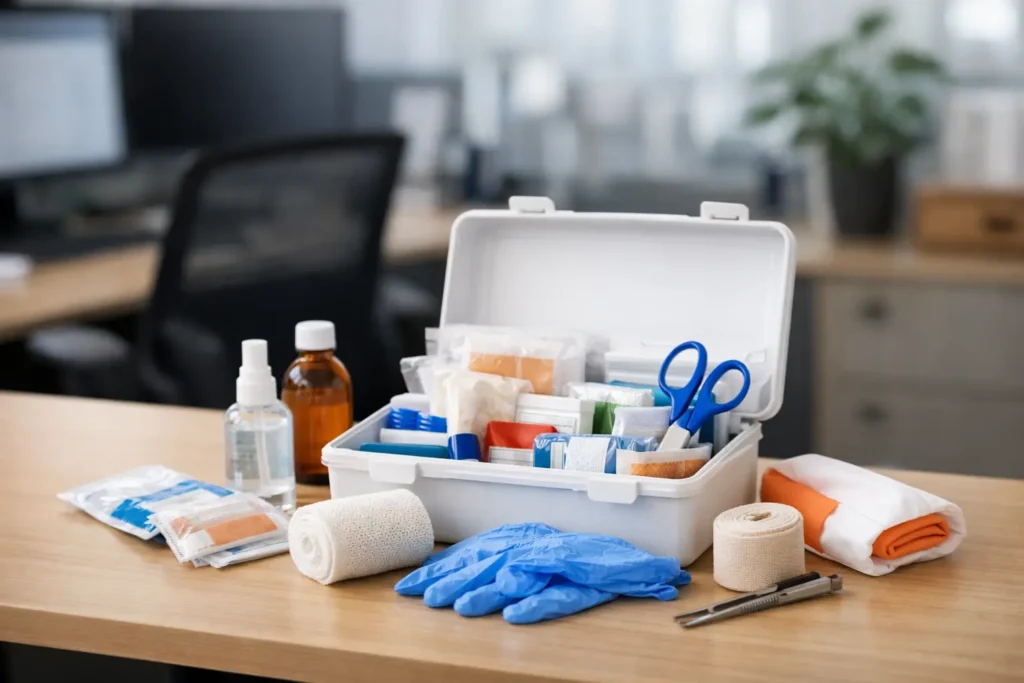
A well-stocked office kit should handle the incidents that happen most often. That usually means adhesive bandages in multiple sizes, gauze pads, rolled gauze, adhesive tape, antiseptic wipes, antibiotic ointment, burn gel, instant cold packs, scissors, tweezers, exam gloves, and a CPR face shield. Offices with kitchens, maintenance areas, or light warehouse activity may also need finger cots, elastic wraps, eye wash, and larger trauma dressings.
The goal is not to overbuild a kit with items no one knows how to use. It is to keep supplies relevant, organized, and accessible. A smaller, well-maintained kit in the right location is more useful than an oversized cabinet full of expired or unfamiliar products.
One first aid cabinet at reception may sound sufficient, but response time changes when teams are spread across floors or departments. Larger offices often need multiple kits placed near break rooms, production-adjacent spaces, fitness areas, or anywhere minor injuries are more likely. If your team has to walk several minutes to reach supplies, your setup is probably too centralized.
Placement should also reflect who is in the building. An office that regularly hosts clients, students, congregants, or members of the public may need supplies in visible, clearly marked locations rather than tucked inside a manager’s office.
If you are deciding what belongs in an office emergency response program, an AED should be part of the conversation. It is not a replacement for first aid supplies, but it addresses the event that leaves the least room for delay. Cardiac arrest can happen in any workplace, including low-risk office environments, and survival depends on rapid CPR and defibrillation.
For many organizations, the most important upgrade is not another box of bandages. It is adding an AED, placing it where staff can access it quickly, and making sure the program includes maintenance, pad and battery tracking, and team training. This is where offices often benefit from working with a preparedness partner instead of piecing together products from multiple vendors.
An AED program works when the device is visible, registered internally, checked routinely, and supported by trained staff. Pads and batteries expire. Cabinets and signage affect accessibility. New hires may not know where equipment is located. These details are easy to overlook until an emergency exposes the gap.
That is why offices should treat AEDs as part of an ongoing safety system, not a one-time equipment purchase. For organizations building a stronger workplace response plan, Square One Medical often helps connect those pieces through equipment support, training, and AED program management.
Not every office needs a large trauma bag, but many should think beyond minor first aid. If your facility has a workshop area, loading zone, campus setting, or public-facing footprint, trauma supplies can make sense. Items such as pressure bandages, hemostatic dressings, tourniquets, and trauma shears help address severe bleeding while EMS is en route.
This is an area where context matters. A small administrative suite may not need the same trauma inventory as a church campus, school office, municipal building, or mixed-use workplace. The question is less about checking a box and more about whether your building’s risk profile justifies a higher level of readiness.
Many offices have a first aid kit. Fewer have a refill process. Supplies get borrowed, used, misplaced, or quietly expire, and nobody notices until there is an urgent need. That is why the best first aid supplies for offices are not just the right items on day one. They are the supplies your team can keep in date, in stock, and easy to find.
A simple inspection schedule helps. Assign responsibility to one role, keep an inventory list inside each cabinet, and review expiration dates on items like ointments, burn products, eye wash, CPR barriers, and AED consumables. Offices with multiple locations or compliance requirements may want outside support to simplify tracking and replenishment.
There is a practical limit to what equipment can accomplish if no one feels prepared to use it. CPR masks, AEDs, severe bleeding supplies, and even epinephrine storage plans are far more effective when staff understand where items are located and what their role is during an emergency.
That does not mean every employee needs advanced medical training. It means your office should align supplies with realistic response expectations. If you stock trauma items, identify who has been trained. If you place AEDs, make sure your emergency action plan includes retrieval, EMS activation, and post-incident follow-up.
Start with three questions. How many people are regularly in the building? What kinds of injuries or emergencies are most plausible in your environment? How quickly can responders reach every part of the facility? Those answers will shape whether you need a basic cabinet, multiple station-based kits, trauma add-ons, or a more complete AED-supported program.
It also helps to think in layers. Everyday first aid covers minor cuts, burns, strains, and headaches. Emergency response planning addresses cardiac arrest, choking, severe bleeding, and evacuation support. Offices that build around both layers tend to be better prepared than those that treat first aid as a single box on a wall.
The strongest office safety programs are not necessarily the most complicated. They are the ones that make good decisions early, place the right equipment where it counts, and keep everything ready for the day it is needed. If your current setup has not been reviewed in a while, that is usually the best place to start.