
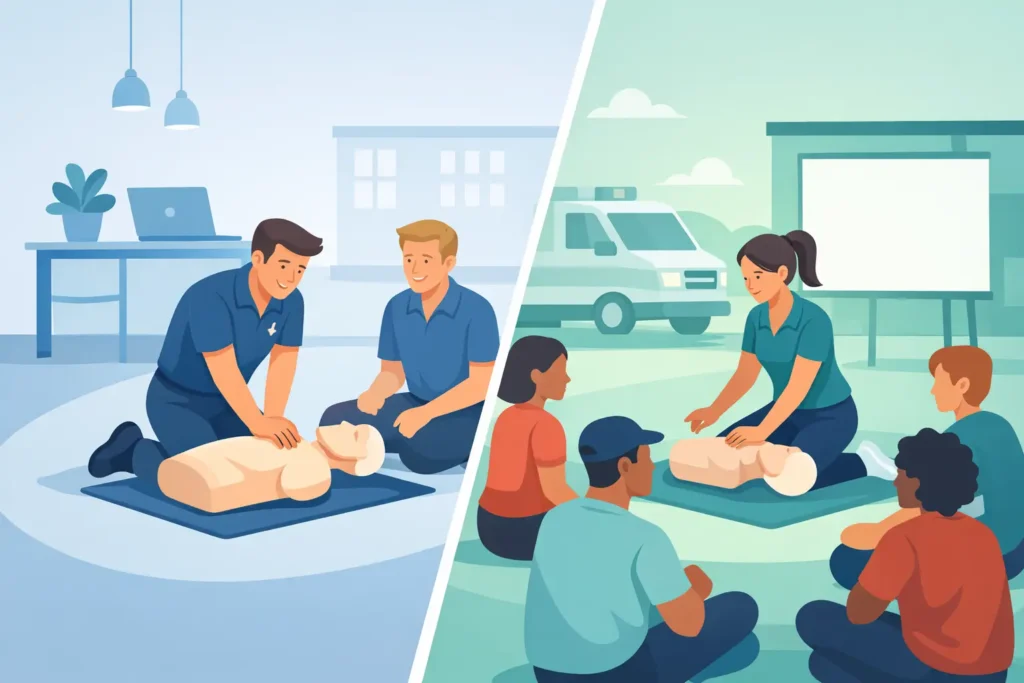
When one employee needs CPR certification, a public class can make sense. When you need ten teachers, twenty church volunteers, or an entire shift of manufacturing staff trained on the same day, the choice between onsite CPR classes vs public classes becomes less about preference and more about operations, risk, and readiness.
For most organizations, the right answer depends on how many people need training, how consistent you need the instruction to be, and whether you are building a broader emergency response program that includes AED placement, first aid supplies, and ongoing equipment management. CPR training is never just a box to check. It affects how quickly and confidently your team responds when seconds matter.
Public classes are open enrollment courses held at a training center or scheduled location. Individuals or small groups register for available seats, attend at the listed time, and complete the class with participants from other organizations.
Onsite CPR classes bring the instructor to your workplace, school, church, or facility. Your team trains together in your own environment, usually on a schedule built around your operations. That difference sounds simple, but it changes nearly everything – from staffing and productivity to emergency planning.
Public classes work well when your training needs are light and straightforward. If you have one new hire who needs certification, one coach renewing a card, or a small office with only a couple of employees requiring CPR and AED training, open enrollment is often the most efficient route.
They can also be a good option when your staff members have different availability. Instead of trying to coordinate one date that works for everyone, each person can register for a session that fits their schedule.
Cost is another factor. For a very small number of attendees, public classes may be less expensive than arranging a private onsite session. You are paying per seat rather than reserving instructor time for your organization alone.
That said, public classes have trade-offs. Your employees spend time traveling, parking, and waiting for a class outside your facility. They train with people from other organizations, which means the instruction is more general by design. It may cover CPR and AED fundamentals thoroughly, but it usually will not be tailored to your building layout, your emergency protocols, or the specific AED units and trauma supplies you keep on site.
Onsite training is usually the stronger choice for organizations with groups to certify, recurring compliance needs, or a serious focus on emergency readiness. If you are scheduling for a school district, a church staff, a public venue, a police department, or an employer with multiple departments, bringing the class to your site simplifies the entire process.
Your team trains together, on your schedule, in the setting where an emergency would actually happen. That alone improves practicality. Staff can ask better questions because they are thinking about real hallways, real gymnasiums, real office floors, and real response roles.
For employers, onsite classes also reduce disruption. You are not sending people in different directions or losing extra hours to travel. Training can be built around shifts, planning days, in-service schedules, or lower-traffic hours.
There is also a consistency benefit. When one group learns together, everyone hears the same guidance at the same time. That matters for schools, churches, manufacturers, and workplaces that want a coordinated response rather than a patchwork of individual training experiences.
This is where many organizations underestimate the difference between onsite CPR classes vs public classes. CPR training and AED readiness should support each other. If your people are trained but no one knows where the AED is, whether the pads are current, or how your response plan works in your facility, you still have a gap.
Onsite training gives you a better opportunity to connect instruction to your actual equipment. Teams can become familiar with the AEDs in their building, review where cabinets are placed, and discuss who retrieves the device, who starts compressions, and who calls 911. That kind of context makes training more usable.
For schools, churches, and workplaces, AED placement is not just about ownership. It is about accessibility, maintenance, visibility, and confidence. A strong preparedness program includes trained people, properly placed devices, current batteries and pads, and a process for staying ahead of expirations. Onsite training fits naturally into that larger system.
There is no universal price winner because it depends on headcount. Public classes are often more economical for one to three attendees. Once you are training a larger group, onsite instruction can become the better value, especially when you consider labor hours, mileage, scheduling complexity, and the cost of pulling employees off site.
Time matters just as much as tuition. Decision-makers often compare only the class fee and miss the administrative burden. Coordinating multiple staff members into public classes can create rescheduling issues, uneven completion dates, and extra tracking work for HR or safety managers.
With onsite classes, you often gain a cleaner process. One date, one roster, one instructor plan, and one training experience. For organizations that need recurring certifications, that simplicity adds up quickly.
Schools and childcare programs usually benefit from onsite training because staff response has to be coordinated and location-specific. The same is true for churches, where volunteers and staff may need to respond in sanctuaries, classrooms, fellowship halls, or youth areas.
Manufacturing and industrial employers often prefer onsite training because shift schedules and production demands make off-site classes harder to manage. Office environments may go either way, depending on team size. Public classes can work for a few designated responders, while onsite sessions are stronger for broader workplace preparedness.
Law enforcement agencies, athletic programs, and community organizations also tend to gain more from onsite instruction when emergency readiness is tied to venue layout, event coverage, or department procedures.
If you are certifying only a handful of people and just need an efficient, credible class, public enrollment is often enough. If you are training a team, managing compliance across departments, or trying to improve how your organization would respond to a real emergency, onsite training usually delivers more value.
The best decision is not just the least expensive option on paper. It is the one that makes your people more likely to act quickly, use the AED with confidence, and work from a response plan that fits your environment.
For many organizations, training works best when it is paired with a review of AED placement, cabinet visibility, replacement pads and batteries, and a simple management process to keep equipment ready year-round. That is where a full-service partner can save time and reduce risk, because preparedness is easier when training and equipment are aligned.
If you are choosing between onsite and public classes, start with a simple question: are you just certifying individuals, or are you building a response-ready organization? The answer usually points you in the right direction.