
Now for a limited time, trade in your old AED for a generous rebate toward a new unit!
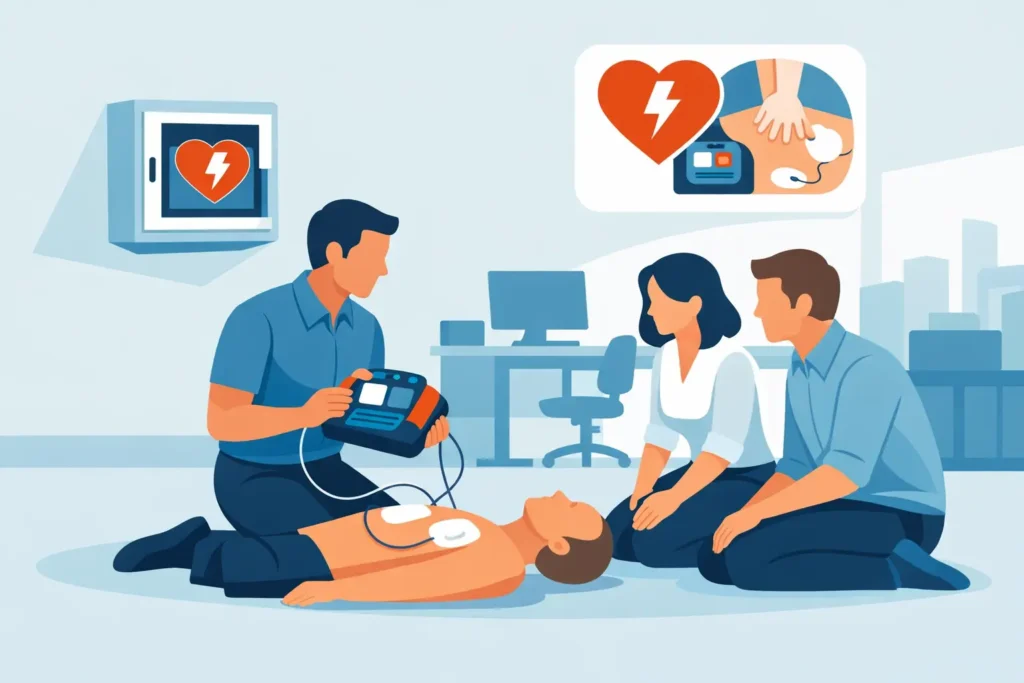
A cardiac emergency does not wait for the right person to be on site. It happens in offices, schools, churches, gyms, warehouses, and public spaces, often with little warning. That is why aed training matters so much. It gives ordinary staff members the confidence to recognize sudden cardiac arrest, start CPR, and use an AED quickly while EMS is on the way.
For the organizations responsible for people’s safety, training is only part of the picture. The stronger approach is to connect instruction with equipment placement, maintenance, and a clear response plan. When those pieces work together, your team is far more likely to respond well under pressure.
Many decision-makers assume AED use is highly technical. In practice, modern AEDs are designed to guide the rescuer with voice and visual prompts. Good training focuses less on memorizing complicated steps and more on helping people stay calm, act early, and follow the device correctly.
A quality course teaches participants how to identify the signs of sudden cardiac arrest, call 911, begin CPR, retrieve the AED, and apply the pads safely. It also addresses what happens around the event – crowd control, handoff to EMS, and post-incident reporting. That broader context matters in workplaces and public settings because emergencies rarely unfold in a perfectly controlled way.
Training also reduces hesitation. People often worry about using the AED incorrectly or harming the victim. That fear can cost valuable time. When staff have practiced the sequence with an instructor and a training device, they are much more likely to step in when seconds count.
It is easy to see the value of AEDs in athletic facilities, hospitals, or law enforcement environments. But sudden cardiac arrest also affects employees, visitors, students, vendors, and congregants in everyday settings. A front office, manufacturing floor, fellowship hall, or school gym can become an emergency scene without warning.
That is why AED placement and training are no longer just a box to check for obviously high-risk sites. They are part of a practical preparedness strategy for any organization with regular foot traffic or a responsibility for public safety.
The exact level of need depends on your environment. A large campus with multiple buildings may need several trained responders and strategically placed devices. A smaller office may need a leaner plan, but it still benefits from having trained staff and an accessible AED. The right answer depends on building layout, occupancy, response times, and the people you serve.
One common mistake is limiting training to a very small group. That can leave dangerous gaps when key people are absent, off shift, or in another part of the building. A better approach is to train enough employees or volunteers to create realistic coverage.
In a workplace, that often includes safety coordinators, supervisors, HR personnel, front desk teams, security staff, and floor leaders. In schools, administrators, coaches, teachers, nurses, and support staff are often strong candidates. In churches, ushers, children’s ministry leaders, facilities staff, and volunteer response teams can all play important roles.
Not everyone needs the same depth of responsibility, but more familiarity across the organization usually improves outcomes. Even staff who are not designated responders benefit from understanding where the AED is located and what to do while help is mobilized.
The best training is practical, credible, and matched to your setting. Hands-on instruction matters because people retain more when they physically practice pad placement, CPR cycles, and team response. For many organizations, onsite training is especially useful because it reduces scheduling friction and allows instruction to reflect the actual environment where an emergency could occur.
Course quality also depends on whether the trainer understands the operational side of preparedness. It is one thing to teach CPR and AED steps. It is another to help an organization think through AED placement, responder roles, signage, maintenance responsibilities, and replacement schedules for pads and batteries.
That is where a full-service partner can make a difference. If your provider can support training, equipment selection, and AED program management together, your internal team has fewer moving parts to manage. That is especially valuable for schools, churches, manufacturers, and multi-site employers that do not want to coordinate several vendors.
Training alone is not enough if the device is hard to find, the pads are expired, or nobody knows who checks the cabinet each month. A reliable AED program turns good intentions into readiness.
That usually includes selecting the right AED model for the setting, placing it where it can be reached quickly, assigning responsibility for routine checks, and tracking consumables before they expire. It may also include wall cabinets, signage, pediatric pad planning where needed, and documentation procedures after use.
This is where many organizations run into preventable problems. The AED is purchased, installed, and forgotten. Months or years later, batteries or pads are no longer current, or staff turnover leaves no one familiar with the response process. Ongoing management closes that gap.
For organizations that want preparedness to stay operationally simple, support services like expiration tracking, equipment updates, and supply replacement can make a meaningful difference. They reduce the chance that your emergency equipment looks ready but is not.
AED training is about saving lives first, but it also supports broader organizational goals. It strengthens workplace safety, demonstrates duty of care, and helps leadership show they have taken reasonable steps to prepare for a foreseeable emergency.
For HR and operations leaders, it can also improve confidence across the team. Employees want to know their workplace has a plan. Parents want to know a school is prepared. Congregations notice when a church invests in visible safety measures. Those signals matter because readiness affects trust.
There are trade-offs, of course. Training takes time. Equipment requires budget. Multi-site organizations may need phased implementation. But those are planning challenges, not reasons to delay action. In most cases, the more practical question is not whether to implement AED readiness, but how to do it in a way that fits your staffing, layout, and risk profile.
The strongest programs do not treat AED training as a one-time event. They build it into onboarding, recertification cycles, emergency planning, and equipment review. That keeps knowledge current and makes response faster when stress is high.
If your organization is reviewing emergency preparedness this year, start with a few direct questions. Do we have enough trained people to cover our schedule? Are our AEDs placed where they can be accessed quickly? Are pads and batteries current? Would a new staff member know what to do in the first two minutes of a cardiac emergency?
If the answers are uncertain, that is your starting point. With the right training, the right equipment, and a managed plan behind both, emergency readiness becomes much more practical than most teams expect.
Preparedness does not have to be complicated, but it does have to be real enough to work when someone’s life depends on it.