
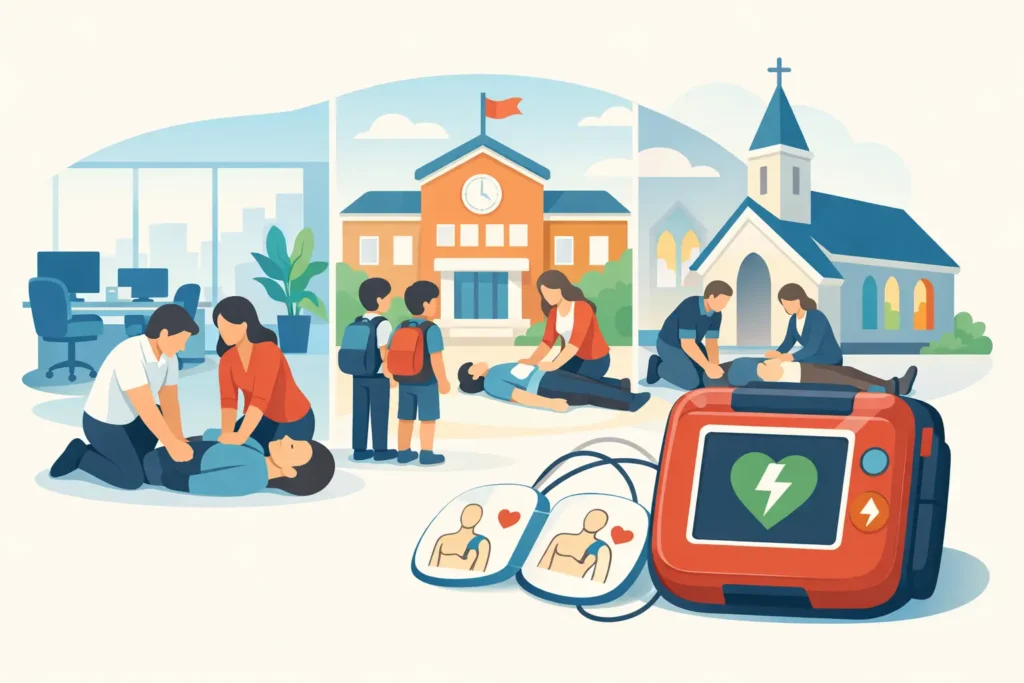
A medical emergency does not wait for the right person to be nearby. When sudden cardiac arrest happens, an AED can give staff, volunteers, and bystanders a real chance to act before EMS arrives. For organizations responsible for employees, students, guests, or congregations, that changes the conversation from general safety planning to a clear question: is your facility prepared to respond in the first few minutes?
An AED, or automated external defibrillator, is designed to analyze heart rhythm and deliver a shock only when needed. It gives voice prompts, walks users through the process, and is built for real-world emergencies, not just clinical settings. That matters because most cardiac arrests happen outside hospitals, often in places where the first people on scene are coworkers, teachers, ushers, coaches, or security personnel.
Some safety purchases are made to check a box. An AED is different because it addresses a time-critical event where every minute matters. Survival rates drop quickly when defibrillation is delayed, which is why CPR and early AED use are central parts of an effective response plan.
For employers and facility leaders, the value is not only medical. It is operational. An AED program helps reduce confusion during an emergency, gives staff a defined response path, and shows a serious commitment to duty of care. In schools, it supports students, staff, spectators, and visitors. In churches, it protects congregations that often include older adults and large gatherings. In manufacturing, distribution, and public-facing workplaces, it helps close the gap between an emergency and professional medical care.
One of the most common mistakes organizations make is assuming one device at the front desk is enough. Sometimes it is. Often it is not.
Good AED placement depends on building size, travel time, occupancy, and where physically demanding activity takes place. A small office with a compact floor plan may be well served by a centrally located unit. A school campus, church with multiple buildings, warehouse, or athletic facility usually needs more than one. The goal is simple: the AED should be reachable fast enough to support a response in the first few minutes.
In workplaces, common placement points include reception areas, break rooms, production floors, fitness areas, and security stations. In schools, front offices, gymnasiums, nurse stations, athletic fields, and high-traffic hallways are common choices. In churches, fellowship halls, main entrances, school wings, and areas used for large events tend to make the most sense. For law enforcement and public safety teams, vehicle-based access may be just as important as wall-mounted access inside a building.
Placement also needs to account for visibility. If the unit is hard to find, behind a locked door, or hidden in an office, the response slows down. Cabinets, signage, and simple orientation for staff can make a major difference.
This is where many organizations get caught off guard. They purchase an AED, install it, and assume they are covered for years. In reality, AED readiness depends on ongoing management.
Pads and batteries expire. Software and model guidance can change. After an incident, accessories may need to be replaced immediately. If no one is tracking those details, the device can be present but not fully ready.
AED program management solves that problem by turning a one-time purchase into a maintained safety system. That usually includes tracking expiration dates, checking device status, replacing consumables on schedule, documenting inspections, and making sure responders know where equipment is located. For organizations with multiple locations, this is even more important because readiness can drift when responsibility is spread across several people or departments.
HR leaders, operations managers, school administrators, and church staff often already have too much on their plate. Asking them to remember battery life, pad replacement windows, cabinet accessories, and compliance documentation is not realistic without a system in place.
A structured AED management approach reduces that burden. It makes readiness easier to maintain and easier to verify. It also gives leadership more confidence that the equipment they invested in will actually perform when needed.
AEDs are designed to be used by lay responders, but training still matters. Not because the device is too complicated, but because emergencies are stressful. People respond better when they have practiced the steps, handled the equipment, and understand how CPR and AED use work together.
That is why many organizations pair AED placement with CPR and first aid training. It creates a more capable response team and builds confidence across the facility. In schools, that may include coaches, teachers, office staff, and administrators. In workplaces, it often includes supervisors, safety teams, front desk staff, and shift leads. In churches, ushers, childcare teams, and ministry leaders are often strong candidates.
Training also helps leaders think through practical details that are easy to overlook, such as who calls 911, who retrieves the AED, who meets EMS at the entrance, and how to handle events after normal business hours.
Not every AED program looks the same, and that is a good thing. A small private office has different needs than a K-12 campus or a police department. Some organizations need straightforward public-access units. Others need features such as stronger durability, clearer feedback, pediatric capability, or accessories that support high-visibility placement.
The best choice usually comes down to a few practical questions. How many people are on site each day? How large is the facility? Will the unit stay inside or travel in a vehicle? Do you need pediatric pads? Who will oversee inspections and replacement supplies? Those answers shape the right equipment plan far better than price alone.
For buyers, this is also why working with a partner who understands both AED sales and training can save time. It is easier to build a usable program when the equipment, placement strategy, and staff education are considered together.
If your organization already has an AED, now is a good time to verify that it is visible, current, and supported by a real maintenance process. Check pad and battery dates, confirm staff know where the device is, and make sure your response plan still fits the way the building is used.
If you do not yet have an AED, start with your highest-traffic locations and highest-risk spaces. Think about travel time, not just square footage. Then match the equipment and training plan to the people you serve every day.
Preparedness does not have to be complicated, but it does need to be intentional. The right AED program gives your team more than equipment on a wall. It gives them a better chance to help when minutes matter most.