
Now for a limited time, trade in your old AED for a generous rebate toward a new unit!
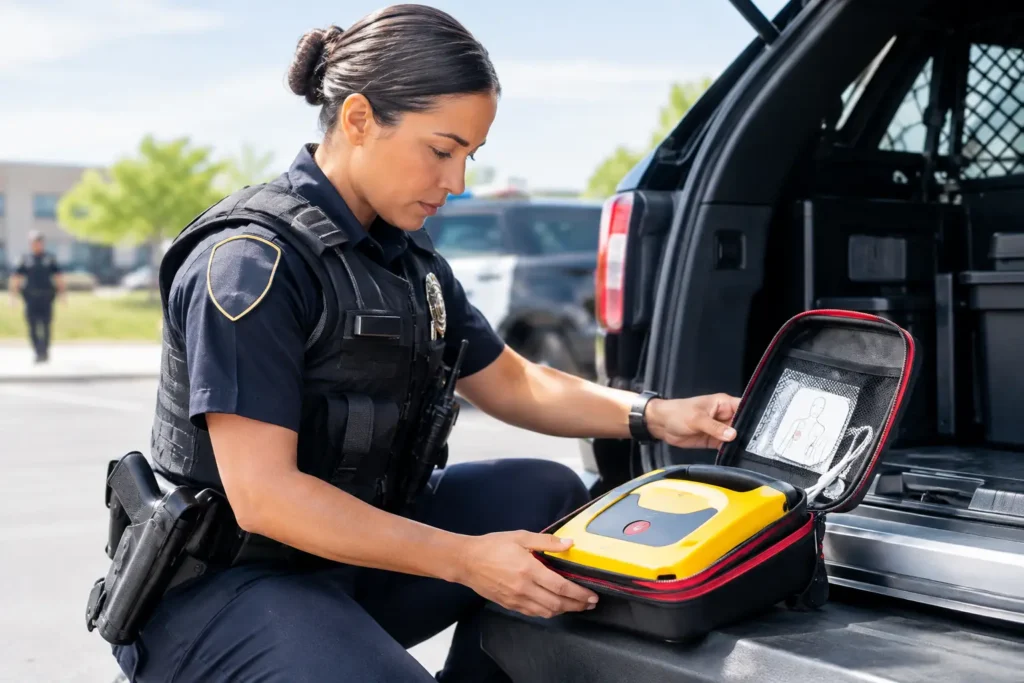
A patrol officer may arrive before EMS, find an unresponsive person, and have only a short window to change the outcome. A law enforcement AED guide should therefore be more than an equipment checklist. It should help an agency build a response capability that works in a cruiser, at a station, during a public event, and under the pressure of a real cardiac arrest.
For police leaders, safety coordinators, and training officers, the goal is simple: put a ready AED in reach, train personnel to use it without hesitation, and maintain the program so the device is ready when called upon.
Sudden cardiac arrest can occur anywhere officers work: in a residence, holding area, school event, municipal building, roadside scene, or police facility. Law enforcement is often among the first public safety resources on scene, especially in communities with longer EMS response times or incidents in remote areas.
An AED does not replace EMS or advanced medical care. It gives officers a practical, evidence-based tool to use alongside high-quality CPR while EMS is en route. The device analyzes the heart rhythm and provides clear prompts, allowing trained responders to deliver a shock when one is advised. For an agency, that capability can turn the minutes before EMS arrival into purposeful action.
The operational case is also broader than patrol response. An AED program protects employees, visitors, arrestees, witnesses, and members of the public who enter an agency building or attend an event supported by the department. It supports a culture of preparedness rather than relying on luck or proximity to a hospital.
The right AED program begins with an honest look at where and how your people respond. A department with a compact service area and 24-hour patrol coverage may prioritize vehicle deployment. A sheriff’s office covering rural territory may need AEDs assigned to patrol units, substations, and community event details. A larger agency may need a mix of vehicle units and clearly marked devices in stations, training facilities, and public-facing areas.
Placement should consider response time, shift coverage, and access. An AED locked in an office does little good after business hours. A device stored in a patrol vehicle may be close to a call but must be protected from temperature extremes, theft, and routine vehicle transfers. Station-based devices should be visible, accessible, and located where staff and visitors can reach them quickly.
There is no universal placement formula. Agencies should also account for specialized teams, school resource officers, detention operations, public event assignments, and buildings shared with other departments. A site assessment can identify coverage gaps before equipment is assigned.
Putting AEDs in patrol vehicles can improve response capability, but it adds operational responsibilities. Supervisors need to know which units carry devices, officers must confirm the AED is present at shift start, and the agency needs a process for moving equipment when vehicles are reassigned or taken out of service.
Temperature is another consideration. AEDs and their accessories have manufacturer-specific storage requirements. Extreme heat and cold can affect pads, batteries, and device readiness. A department should choose equipment and storage practices appropriate for its environment, then build those checks into daily or weekly vehicle inspections.
CPR and AED certification gives personnel essential skills, but agency training should also address the realities of police response. Officers may need to manage a scene, request additional resources, communicate with dispatch, begin CPR, retrieve an AED, and transition care to EMS. Repetition helps teams make those tasks feel organized rather than chaotic.
Scenario-based practice is especially useful. Training can include a cardiac arrest in a station lobby, a collapse during an arrest, or an unresponsive person at a community event. These drills reveal practical details: Who retrieves the AED? How is CPR maintained while pads are applied? What information is communicated to EMS? Where does crowd control fit into the response?
Training should reinforce that AED use is designed to be straightforward. Modern units provide voice and visual prompts, but confidence comes from hands-on practice. Agencies should establish a training schedule that includes new hires, patrol staff, supervisors, civilian employees who may be near station AEDs, and personnel assigned to public-facing facilities.
A device on a wall or in a cruiser is only useful if it is rescue-ready. Pads and batteries expire. Status indicators can signal a problem. After an incident, the AED may need new accessories, cleaning, documentation, and return-to-service verification.
Rather than relying on one person to remember every date, agencies should assign clear responsibilities and use an AED management process. This may be handled by a training division, quartermaster, risk manager, fleet coordinator, or designated safety officer. The key is that ownership is explicit.
A practical inspection process should cover these recurring tasks:
AED program management also reduces the risk of missed expirations across multiple locations. A department may begin with a few devices and later add units as its facilities, fleet, or event responsibilities expand. Centralized records make that growth manageable.
An AED program should fit within the agency’s broader emergency response plan. Work with local EMS partners when developing procedures for dispatch notification, patient handoff, incident reporting, and post-event equipment recovery. Those discussions can clarify expectations before a high-stress call occurs.
Departments should also review applicable state and local requirements, agency policy, and medical oversight practices. Requirements can vary by jurisdiction and may address training, maintenance, registration, reporting, and medical direction. A well-written policy should be clear about who may use the AED, where devices are assigned, how inspections are documented, and what happens after deployment.
Do not treat policy as a binder exercise. Officers and supervisors should know where to find the AED, what activates the response, and who takes responsibility for getting the device back in service. The policy should support fast action, not create uncertainty at the scene.
The strongest AED programs are not built around a one-time rollout. They account for recertification, new staff, turnover, consumable replacements, device updates, and facility changes. They also give leaders a reliable point of contact when equipment questions arise.
Square One Medical helps organizations bring training, AED placement, and ongoing equipment management into one coordinated preparedness plan. For law enforcement agencies, that kind of support can simplify the work of keeping multiple devices, teams, and locations response-ready.
A cardiac arrest call will never feel routine. But when officers know the AED is nearby, understand their role, and have practiced the response, they can spend less time searching for answers and more time delivering care when it matters most.