
Now for a limited time, trade in your old AED for a generous rebate toward a new unit!
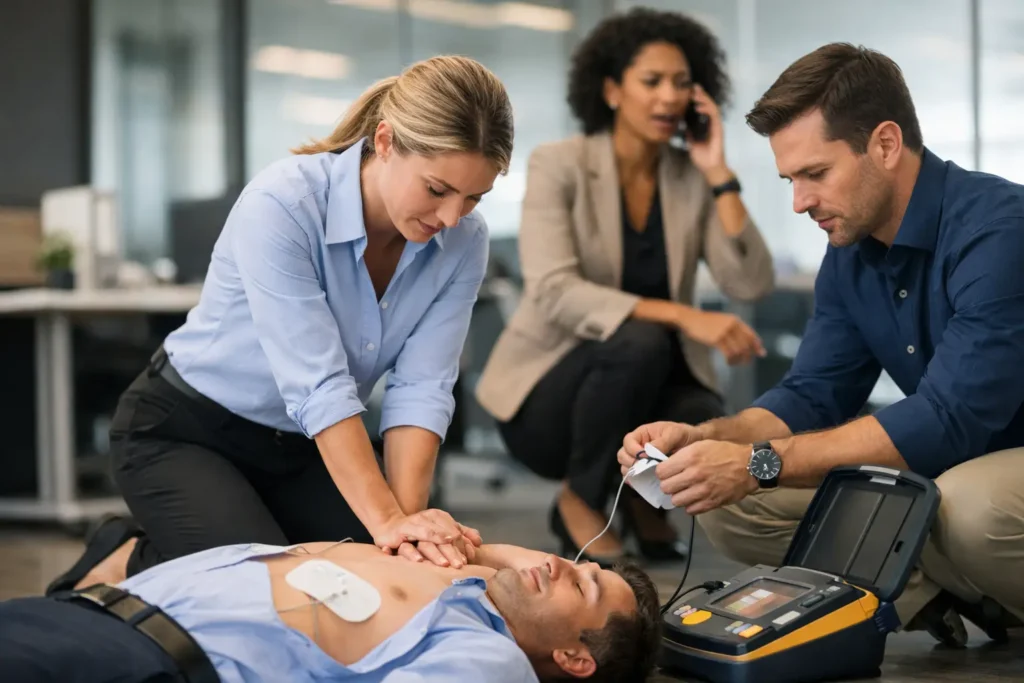
A wall-mounted AED is only part of an emergency response program. The real test is whether the people nearby know who calls 911, who retrieves the device, who starts CPR, and how the team communicates when every second feels compressed. Well-designed AED drill procedures turn a posted policy into a practiced response.
For employers, schools, churches, and public facilities, drills are not about creating a perfect performance. They are about finding the small operational gaps that can delay care: an AED cabinet no one can open, an outdated emergency contact list, unclear directions for visitors, or staff members who assume someone else is taking charge.
Sudden cardiac arrest can occur without warning, and the first few minutes are critical. CPR and early defibrillation can make a meaningful difference, but equipment must be accessible and responders must be willing to act. A drill gives your organization a controlled way to practice those early actions before an actual emergency creates stress, noise, and uncertainty.
It also tests more than individual skills. A certified employee may know how to use an AED, yet the facility may still have a response problem if the device is kept behind a locked door, the front desk does not know its location, or staff cannot direct EMS to the correct entrance. AED drills help leaders evaluate the full chain of response, from recognizing the emergency through EMS handoff.
The right frequency depends on the size of the facility, staff turnover, operating hours, and risk profile. A school with multiple buildings, a large manufacturer with several shifts, or a church with large weekend attendance may need more frequent practice than a small office. Annual training alone may not be enough to keep procedures familiar when personnel and facility layouts change.
A useful drill begins with a realistic but clearly announced scenario. For example, an employee or volunteer may be positioned in a common area as an unresponsive adult. Assign an observer to record timing and note what happens without coaching the team unless safety requires it.
The first objective is recognition. The initial responder should check responsiveness, confirm absent or abnormal breathing, direct someone to call 911, and send another person for the AED. In a real event, responders should follow their training and local emergency protocols. During the drill, the goal is to see whether those roles are stated clearly rather than assumed.
Next, observe AED retrieval. Is the closest device actually the fastest device to reach? Can staff identify it quickly from different parts of the building? If an AED is in a cabinet, confirm that the cabinet alarm, signage, access route, and visibility support a fast response. A device placed near an entrance may be excellent for visitors but less useful to staff in a distant wing. Placement should reflect where people gather and how they move through the facility.
Once the AED arrives, the team should practice bringing it to the patient, beginning CPR, turning on the trainer device, and following the prompts. Use a training AED and manikin whenever possible. A drill should reinforce that the AED provides voice and visual guidance, which can help a willing responder act even when they feel anxious.
Finally, practice the handoff. One person should be prepared to meet EMS, provide the exact location, explain what happened, and report any care already given. In larger facilities, this may include assigning someone to unlock gates, operate elevators, or guide responders through a secure entrance. These details are easy to overlook until they cost time.
The most valuable part of an AED drill happens after the scenario. Gather participants and observers for a short, practical debrief while events are fresh. Ask what slowed the response, what information was missing, and whether every participant understood their role.
Avoid treating the review as a pass-or-fail test of individual employees. A hesitant response may point to a system issue, such as too few trained staff on a shift, confusing instructions, limited signage, or no designated backup when a primary responder is away. The purpose is to improve the program, not embarrass people who stepped forward.
Track a few operational measures from each drill: time to recognize the emergency, time to activate 911, time to retrieve the AED, time to begin CPR, and time to simulated shock analysis. Timing is helpful, but context matters. A longer retrieval time may reveal that a second AED or different placement is warranted. A fast time with only one trained employee may reveal a staffing vulnerability instead.
A drill is an ideal time to verify that the equipment itself is ready. Confirm the AED status indicator shows readiness, the pads and battery are within their expiration dates, and the response kit contains the supplies your organization expects to have available. Check that the cabinet is visible, unobstructed, and accessible during normal operating hours.
Do not use a live AED on a manikin or attempt to test it in a way that conflicts with the manufacturer’s instructions. Your AED program manager or training partner can help establish a safe inspection process and document maintenance activity. Regular tracking matters because pads and batteries expire whether or not the device is ever used.
One generic scenario will not reveal every weakness. Schools may need to account for a nurse’s office, athletic facilities, after-school programs, and substitute staff. Churches may need to consider volunteers, children’s areas, large services, and multiple entrances. Offices and industrial sites may need to plan around secured areas, remote work zones, shift changes, noise, or large campuses.
Consider rotating scenarios over time. Practice a collapse near the front desk, in a gym, on a production floor, or in a meeting room. Include times when usual responders are unavailable. If your organization serves the public, test whether a visitor can quickly identify where to get help or alert a staff member.
Training should remain the foundation. Drills reinforce decision-making and facility procedures, but they do not replace hands-on CPR/AED instruction. Keeping a broad group of employees, volunteers, coaches, or staff members trained creates coverage when the person most familiar with the AED is absent.
After the drill, assign each improvement a clear owner and deadline. Replace missing supplies, update emergency maps, improve signage, revise the response plan, or schedule additional training as needed. Keep a simple record of drill dates, findings, corrective actions, and AED maintenance checks. Documentation helps safety leaders demonstrate that readiness is being actively managed rather than left to chance.
Square One Medical helps organizations connect practical CPR/AED training with AED placement, equipment support, and program management. That combination makes it easier to address what drills reveal, whether the need is refreshed training, better visibility, expiration tracking, or a more reliable response plan.
The best AED drill procedures leave people with something more useful than a completed checklist: the confidence to recognize an emergency, take the first role they can, and help the next person act faster.