
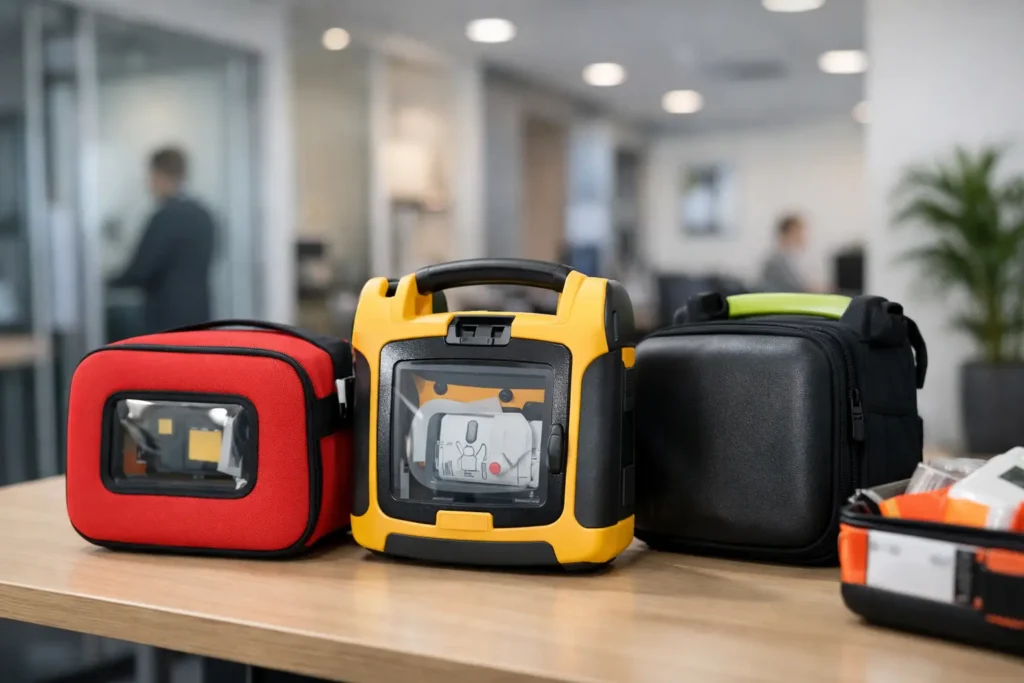
A cardiac emergency does not wait for someone to cross a parking lot, find the right key, or remember which hallway cabinet holds the AED. When organizations ask how many aeds does facility need, the real question is simpler: can your team get an AED to a person fast enough to make a difference?
That answer depends less on a fixed formula and more on response time, building layout, population, and daily activity. A small office on one floor may be well covered with one device. A school campus, manufacturing site, church with multiple buildings, or large recreation facility may need several. The goal is practical coverage, not checking a box.
For most organizations, the best starting point is access within about 3 minutes from collapse to AED arrival. That does not mean the AED should be 3 minutes away. It means someone has to recognize the emergency, call for help, retrieve the device, return, and begin care. In a large or busy building, that window disappears quickly.
A useful planning standard is to place AEDs so a responder can reach the person, retrieve the device, and get back without crossing long distances, elevators, locked doors, or crowded public areas. If one cabinet serves only a front office while the far side of the building requires a long round trip, one AED is probably not enough.
This is why square footage alone can be misleading. Two facilities may have the same size but very different needs. A single-story office with open visibility is not the same as a school with stairwells, a warehouse with restricted zones, or a church campus with a sanctuary, classrooms, and a fellowship hall.
The bigger and more segmented the space, the more likely multiple AEDs are needed. Separate wings, multiple floors, detached buildings, long hallways, outdoor athletic areas, and secured access points all slow response. In those settings, placing one AED in a central office often looks efficient on paper but performs poorly in a real emergency.
Think about where people actually gather. Break rooms, gyms, auditoriums, cafeterias, reception areas, production floors, and worship spaces often deserve closer coverage than storage areas or rarely used offices. A facility that hosts visitors, students, congregants, or event attendees may need broader placement than a similar-size private workspace.
Not every facility carries the same level of cardiac risk. Sites serving older adults, individuals with known health conditions, or physically active groups may need more aggressive AED placement. The same is true for workplaces with strenuous labor, high heat, elevated stress, or remote work areas where EMS access may be delayed.
A building may have trained staff, but they are not always in the same place at the same time. If your response plan depends on one nurse, one security officer, or one office manager being present, that plan has a weak point. AED placement should support the people who are actually on site during normal operations, evenings, weekends, and special events.
A small professional office with one floor and a modest staff may be appropriately covered with one AED placed in a visible, unlocked, central location. A two-story office, however, may need one per floor if stair travel adds delay.
Schools usually need more than one. A single front-office AED rarely covers classrooms, gymnasiums, athletic fields, cafeterias, and after-hours events. Many schools place AEDs by building zone or by activity area so both daytime and extracurricular use are covered.
Churches often underestimate their needs because weekly attendance patterns vary. If the sanctuary is in one area and classrooms, offices, or fellowship spaces are in another, additional devices may be warranted. Large campuses and children’s ministry areas deserve special attention.
Manufacturing and industrial sites often require multiple AEDs because distance, noise, restricted access, and physical hazards slow internal response. One device near the main entrance may leave production areas underprotected.
The first mistake is hiding the AED in a manager’s office, nurse’s room, or locked cabinet. During a cardiac arrest, visibility and access matter more than neat storage.
The second is using one AED to serve disconnected spaces. If your facility includes a main building, warehouse, detached classroom wing, or outdoor venue, each area should be evaluated on its own.
The third is treating AED placement as a one-time task. Renovations, staffing changes, new programs, and growth can all create coverage gaps. An AED plan should be reviewed as your facility changes.
The strongest approach is a simple site assessment. Walk the facility as if a collapse occurred in the farthest high-traffic area. Time how long it would take an average staff member to reach the AED and return. Repeat that exercise for upstairs locations, outdoor areas, and spaces used after hours.
If the answer is consistently too slow, add coverage. If special events change occupancy or access, account for those conditions too. For many organizations, this process makes the right number obvious.
It also helps to pair placement with program management. An AED only helps if it is ready to use, easy to find, and supported by trained staff. Pads and batteries expire. Cabinets should be visible. Staff need to know who responds, who calls 911, and who brings the device. That broader plan matters as much as the number of units on the wall.
If one AED cannot realistically reach every primary occupied area fast, your facility likely needs more than one. That is true in offices, schools, churches, municipal buildings, police facilities, and industrial workplaces alike. Good AED coverage is based on response performance, not guesswork.
For organizations building or updating a preparedness program, the best next step is not to look for a universal number. It is to map your space, test retrieval times, and place devices where real people can reach them without delay. When AED planning is done well, it gives staff confidence, shortens response time, and makes your emergency program far more usable when seconds count.
A well-placed AED is not just equipment on a wall. It is a decision made ahead of time that helps people act faster when the moment is critical.