
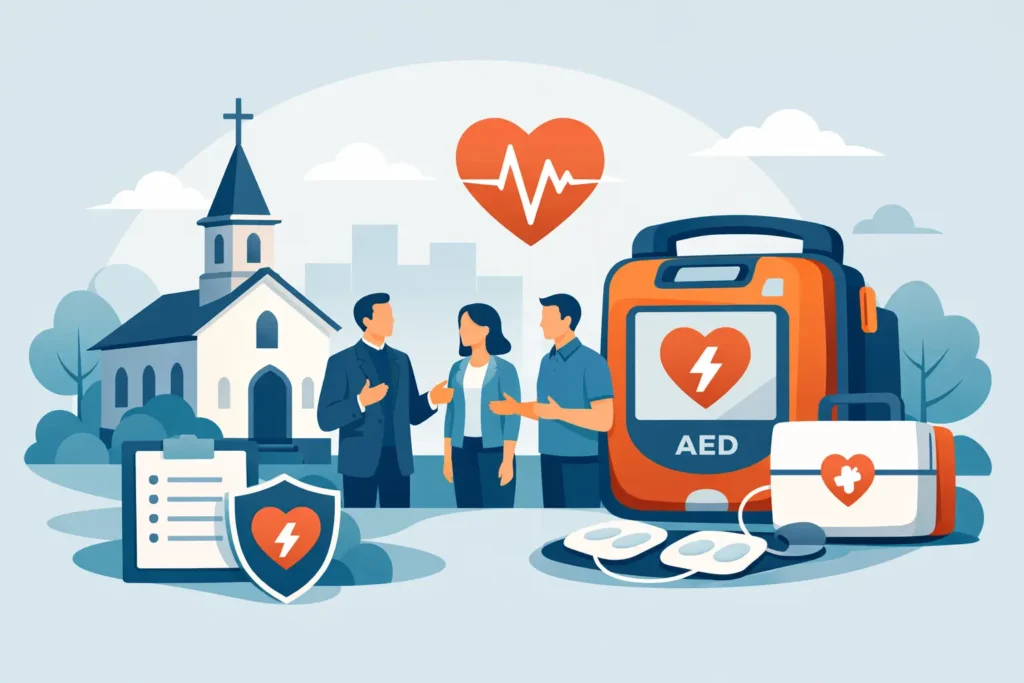
A medical emergency during worship service does not wait for the right volunteer to be in the room. It happens in the middle of a sermon, during children’s ministry check-in, at a fellowship meal, or outside in the parking lot after an event. A strong church AED program gives your team a realistic way to respond in those first critical minutes, when time matters most.
Churches are unique environments. They welcome large groups, span multiple age ranges, and often rely on a mix of staff and volunteers to keep things running. That makes emergency planning different from a typical office or retail setting. The goal is not just to buy an AED and hang it on a wall. The goal is to build a program people can use with confidence when stress is high and every second counts.
An AED is designed to be used by ordinary people, including those with limited medical experience. The device gives voice prompts, evaluates the heart rhythm, and only delivers a shock when appropriate. That simplicity is a major advantage in a church setting, where your response team may include ushers, children’s ministry leaders, front desk staff, facilities personnel, and longtime volunteers.
Still, a device alone is not a program. Churches run on schedules, shared spaces, and many moving parts. If no one knows where the AED is, who checks it, or how to respond when someone collapses, the benefit drops quickly. A church AED program brings together equipment, placement, training, maintenance, and a clear emergency response process.
That structure matters because sudden cardiac arrest is different from a heart attack and demands immediate action. CPR helps keep blood flowing. Early defibrillation can be lifesaving. In practical terms, your church needs people ready to call 911, start CPR, retrieve the AED, and guide EMS to the patient without confusion.
Many churches serve older adults, and that alone raises the value of AED access. But age is only part of the picture. Churches also host schools, preschools, youth sports, concerts, food pantries, holiday events, counseling sessions, and community meetings. A person at risk may be a member, a visitor, a parent dropping off a child, or a contractor working onsite.
Large campuses create another challenge. If your sanctuary is on one side of the property and your education wing or gym is on the other, a single AED may not be enough. Response time is the real issue. The best placement is not based on what looks tidy on a floor plan. It is based on where people gather, how quickly someone can reach the device, and whether the cabinet is accessible during the hours your building is in use.
That means smaller churches and larger churches may need different solutions. A compact building with one main gathering space may do well with a single centrally placed AED. A multi-building campus may need several units, plus a process for assigning responsibility at events and offsite activities.
The most effective approach starts with a simple question: if someone collapsed today, what would actually happen in the first three minutes?
That question usually reveals gaps fast. Maybe the AED is near the office, but the office is closed on weekends. Maybe a few staff members are trained, but most volunteers are not. Maybe nobody is tracking pad or battery expiration dates. A useful program begins with that honest assessment.
Walk the campus with response time in mind. Identify the highest-traffic and highest-risk areas, including the sanctuary, lobby, children’s wing, fellowship hall, gym, classrooms, and parking lot access points. Consider attendance patterns rather than just square footage. A room used by 200 people on Sunday morning may deserve different planning than a room used occasionally during the week.
If your church hosts childcare or school programs, include those spaces in the review. If you run sports leagues or community outreach events, include the field, court, or event area as well. This step often determines whether one AED is enough or if multiple units make more sense.
For most churches, ease of use should be the top priority. An AED should provide clear prompts, support lay responders, and be matched to the environment where it will be used. You may also need a wall cabinet, signage, pediatric capability, rescue kits, and a maintenance plan.
There is a trade-off here. Some organizations focus only on purchase price, but a lower upfront cost does not always mean lower long-term cost. Pads and batteries expire, software may need updates, and replacement parts should be easy to source. Program support matters because readiness is not a one-time purchase.
Not every church needs every volunteer certified, but every church should know who is expected to act. Start with staff, security team members, ushers, children’s ministry leaders, facilities personnel, and other volunteers who are consistently present. CPR and AED training helps reduce hesitation and gives people a role before EMS arrives.
Hands-on training is especially valuable in churches because volunteers often come from different backgrounds. Some have prior healthcare experience. Many do not. A practical class creates shared expectations and gives your team the chance to practice communication, AED retrieval, and scene coordination.
One of the most common program failures is simple: nobody owns it. Someone should be responsible for regular checks, documentation, supply replacement, and follow-up after use. In many churches, this role falls to a facilities director, operations leader, administrator, or safety team coordinator.
That person does not need to manage everything alone, but they do need a process. The AED should be checked regularly for readiness status. Pads and batteries should be tracked before they expire. After an incident, the device should be returned to service quickly with replacement supplies and event documentation handled properly.
A church AED program works best when the device is easy to find and easy to reach. That sounds obvious, but it is often where programs fall short. An AED locked inside an office, hidden behind a reception desk, or placed in a room that is not open during services creates delay.
Cabinets and signage help, but placement should also reflect how your congregation moves through the building. In some cases, the best location is the main lobby because it supports access to multiple areas. In others, placing an additional unit near the gym or children’s ministry wing is the better choice.
Think through your schedule as well. Sunday service is only one part of church life. If weekday counseling, preschool operations, recovery meetings, or evening Bible studies happen in different parts of the facility, your AED plan should reflect those patterns.
A church AED program should be simple enough to sustain. That usually means documenting a few key things clearly: where each AED is located, who responds, who calls 911, who retrieves the device, who performs monthly checks, and how replacement supplies are handled.
This does not need to become a thick binder that nobody reads. A concise written plan is often better. The point is consistency. When volunteers rotate and staff responsibilities change, a written process helps preserve readiness.
Maintenance is where many organizations need outside support. Batteries and pads do not last forever, and the people responsible for the AED often have many other duties. Program management support can reduce missed expirations and help churches stay response-ready without turning the process into another administrative burden.
That is one reason many organizations prefer a full-service partner that can help with device selection, training, replacement consumables, and ongoing oversight. For churches that want a straightforward path, Square One Medical supports both AED placement and AED program management in a way that keeps readiness practical.
The most common mistake is treating the AED as a purchase instead of a program. The second is underestimating how much building layout affects response time. The third is assuming trained staff will always be present exactly where needed.
Another issue is failing to plan for children and special events. If your church serves families, hosts VBS, or runs school-age programming, pediatric considerations may matter. If you host large holiday services or community events, temporary staffing and crowd flow should be part of the plan too.
It also helps to be realistic about volunteer turnover. Training a strong team once is good. Refreshing that team over time is better. Churches are living organizations, and your emergency response plan should keep up with that reality.
Church leaders are already responsible for more than sermons and schedules. They care for people in moments of joy, grief, crisis, and need. Emergency preparedness belongs in that same category of stewardship. It is a practical decision that supports the mission of welcoming and protecting the people who gather in your building every week.
The right program does not have to be complicated, but it should be deliberate. When equipment is placed well, volunteers are trained, and someone is managing readiness, your church is in a far better position to respond when the unexpected happens. That kind of preparation serves your congregation quietly until the day it matters most.