
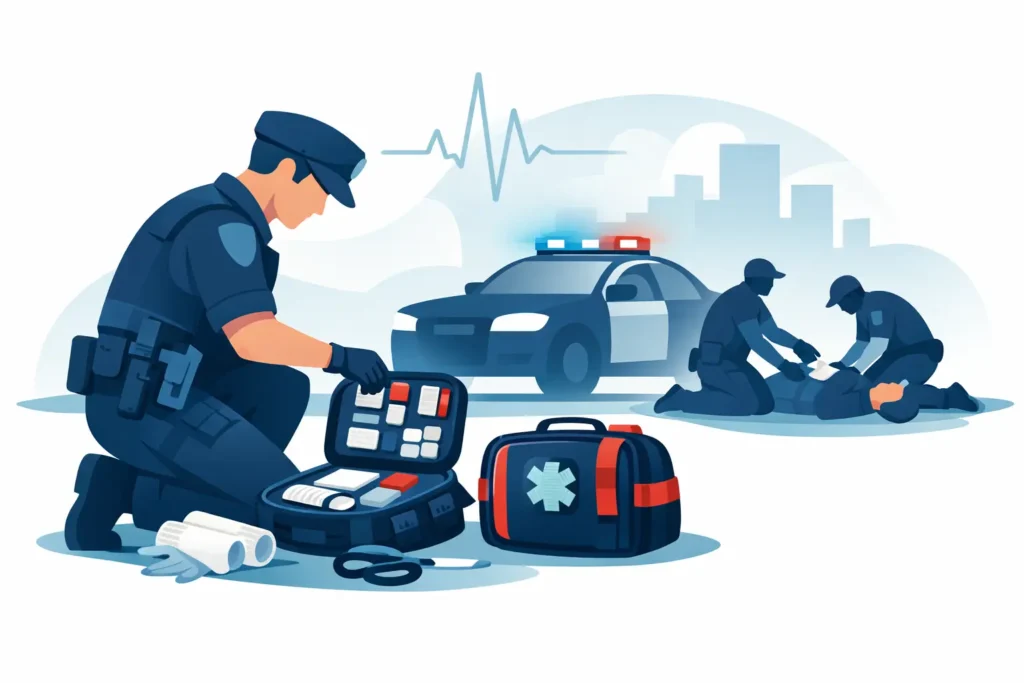
A trauma kit that looks complete on a shelf can still fail an officer on the street. The problem usually is not the label on the bag. It is whether the kit was built for real law enforcement use, staged for fast access, and supported by training that matches the gear inside. That is why law enforcement trauma kits need to be chosen with the same care agencies give radios, armor, and AED placement.
Police officers often arrive before EMS, and they may be the only trained responders close enough to stop severe bleeding in the first few minutes. That window matters. A kit that is missing essentials, packed poorly, or stocked with unfamiliar items adds delay when time is already short. For agencies, schools with school resource officers, houses of worship, and public venues that rely on law enforcement support, the right trauma kit is not a nice extra. It is part of operational readiness.
At the most practical level, these kits are meant to keep a patient alive long enough to reach higher care. In the field, that usually means controlling massive bleeding, supporting airway concerns within the scope of training, protecting the responder, and making treatment supplies immediately available under stress.
That sounds simple, but law enforcement scenes are rarely controlled. Officers may be working in low light, moving through crowds, dealing with an active threat, or treating one person while still thinking about scene safety. A trauma kit for that environment should favor speed, clear organization, and tools that officers have actually trained to use.
This is also where agencies can get tripped up by buying kits built for general first aid rather than tactical or patrol response. A general first aid bag may be useful for minor injuries, but it is not a substitute for a trauma kit designed around life-threatening bleeding and rapid intervention.
The exact loadout depends on agency policy, medical direction, and training level, but a dependable kit usually starts with hemorrhage control. Tourniquets, hemostatic gauze, pressure dressings, and compressed gauze are common core components because uncontrolled bleeding is one of the most immediate and preventable threats officers face.
Gloves, trauma shears, and chest seals are also often included. Some agencies add hypothermia support, markers for time tracking, and basic airway adjuncts if officers are trained and authorized to use them. The right answer is not always the biggest kit. It is the kit that matches the mission, fits the officer’s role, and can be deployed without searching through unnecessary items.
Quality matters here. A low-cost kit may appear to save money up front, but if the tourniquet is unreliable, the packaging tears easily, or components expire without a replacement plan, the value disappears quickly. For public safety organizations, durability and consistency usually matter more than buying the lowest-priced option.
A well-stocked bag can still be a poor field tool if it is hard to open, poorly organized, or too bulky for routine carry. Officers need gear they will actually keep with them, not supplies that stay in a trunk because they are cumbersome.
That is why form factor deserves real attention. An individual officer kit has a different job than a patrol vehicle trauma bag. A compact kit worn on body armor or duty gear needs immediate access to the most critical items. A vehicle-based kit can hold more supplies for multiple patients or prolonged response, but it still needs logical layout and clear labeling.
This is one of those it-depends decisions. A patrol division may benefit from both: an individual kit for immediate hemorrhage control and a larger vehicle kit for expanded response. Supervisors, school resource officers, and special event teams may also need different configurations based on where and how they operate.
The fastest way to weaken a trauma kit program is to treat gear and training as separate purchases. If officers are issued supplies they have not practiced with, hesitation is almost guaranteed. Under stress, people fall back on repetition, not good intentions.
Hands-on bleeding control and trauma response training should be built around the actual equipment officers carry. That means practicing tourniquet application, wound packing, pressure bandage use, and patient assessment with the same or equivalent products they will use on duty. It also means reviewing placement. A perfect kit does little good if no one can reach it quickly.
This is especially relevant for agencies and organizations already building broader emergency response plans. Trauma kits should not sit in their own silo. They should fit alongside CPR training, AED readiness, and site-specific response procedures. For many public settings, the response to a serious incident may involve both traumatic injury care and sudden cardiac arrest support, which is why equipment planning works better when viewed as a system rather than a series of unrelated purchases.
Start with use case, not catalog size. Ask where the kit will be carried, who will use it, what level of training they have, and what incidents are most realistic in your environment. A city patrol unit, courthouse security team, and campus police department may all need trauma kits, but the best configuration for each can be different.
Next, look at standardization. When agencies issue different kit layouts to different teams without a clear reason, training becomes harder and restocking gets messy. Standardizing core components across officers and vehicles usually improves familiarity and simplifies replacement.
After that, think through maintenance. Trauma kits are not one-time purchases. Consumables get used, sterile packaging can be damaged, and expiration dates keep moving whether the kit is opened or not. A reliable program includes inspection schedules, restocking procedures, and accountability for keeping equipment response-ready.
This is where many organizations benefit from working with a provider that can support both training and equipment. When the same partner helps evaluate trauma kits, AED needs, replenishment cycles, and readiness planning, the program is easier to manage and less likely to drift out of compliance or readiness.
One common mistake is choosing kits based on quantity instead of function. More items do not automatically create a better response tool. If half the contents are irrelevant to officer use, they add bulk without improving care.
Another is overlooking officer access. A trauma kit locked in a vehicle may be useful in some calls and unreachable in others. Immediate care tools should be positioned where they can be deployed in seconds.
The third is failing to plan for refresh and replacement. Trauma equipment ages. So do AED pads and batteries, which is why emergency preparedness works best when organizations have an ongoing management process instead of a one-time purchasing event.
There is also a training gap to watch for. Some agencies assume prior first aid exposure is enough. It usually is not. Trauma response under pressure benefits from repetition, scenario-based practice, and refreshers tied to actual field conditions.
Not every emergency faced by law enforcement is a trauma call. Officers also respond to collapse, overdose, cardiac arrest, and public medical emergencies in schools, churches, workplaces, and community spaces. That is why trauma kits should be part of a larger preparedness strategy, not the entire strategy.
AEDs remain one of the most important tools for public response because sudden cardiac arrest can happen anywhere, including during high-stress incidents or routine public interactions. Agencies and organizations that already maintain law enforcement trauma kits should also evaluate where AEDs are placed, who is trained to use them, and how those devices are tracked for readiness. A strong emergency response program covers both traumatic injury and cardiac events with equal seriousness.
For many decision-makers, the challenge is less about knowing these tools matter and more about implementing a practical system. Equipment selection, staff training, replacement schedules, and documentation all take time. The right support can make that manageable.
Square One Medical works with organizations that need this kind of practical readiness – not just products, but training, equipment support, and a clearer path to keeping lifesaving tools ready when they are needed most.
The best trauma kit is not the one with the most marketing behind it. It is the one your team can reach fast, use confidently, and trust when a scene turns critical.