
Now for a limited time, trade in your old AED for a generous rebate toward a new unit!
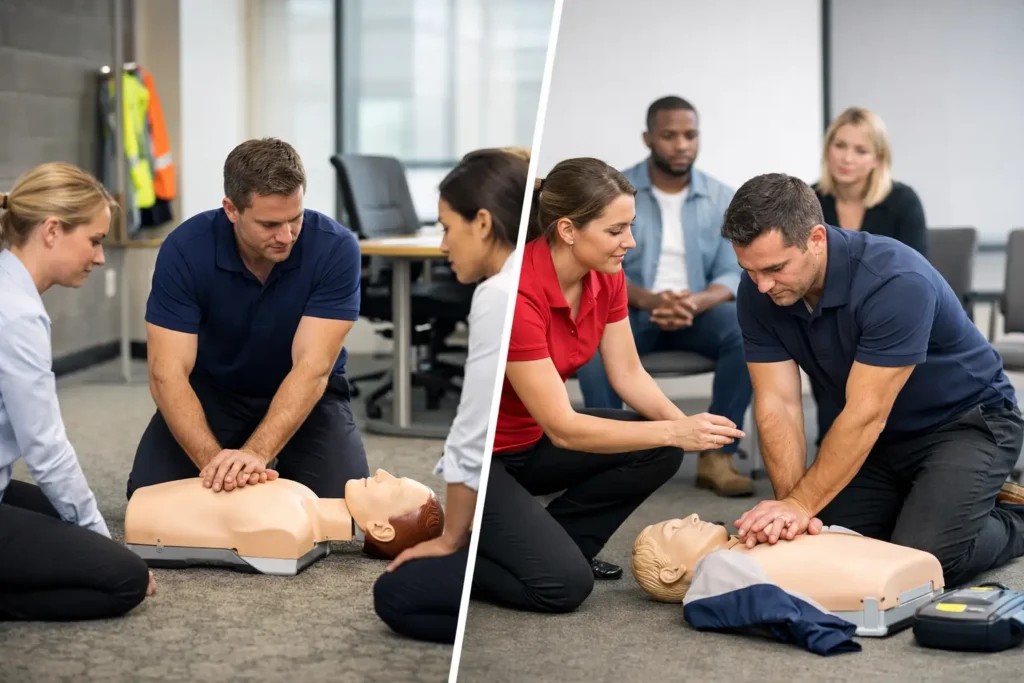
A staff member collapses in a school hallway, a church lobby, or a manufacturing break room. The first few minutes are not the time to figure out who is certified, where the AED is located, or whether the response plan works in the actual building. That is why the choice between onsite vs offsite cpr training is more than a scheduling decision. It affects participation, confidence, and how well training connects to the emergency equipment and procedures your organization relies on.
For many organizations, either format can produce capable CPR, AED, and first aid responders. The better choice depends on your team size, shift coverage, facility risks, available space, and the level of coordination you need around your AED program.
Onsite training brings an instructor, course materials, and hands-on practice equipment to your workplace, school, church, or community facility. Employees train together in a familiar setting, often during a scheduled workday, which can reduce travel time and make attendance easier to manage.
The strongest advantage is context. A trainer can help your team think through the route to the nearest AED, who calls 911, who meets emergency responders at the entrance, and how coverage works if an incident occurs during a busy period. For a school, that may mean discussing athletic facilities, cafeterias, and after-school programs. For a church, it may mean planning around services, children’s areas, and large gatherings. In a manufacturing setting, it may mean addressing shift changes, noise, large work areas, and access points.
Onsite instruction also gives organizations a practical opportunity to review AED placement. An AED is most useful when people can find it quickly, recognize it, and reach it without delays caused by locked doors, unclear signage, or an unfamiliar cabinet location. Training day can expose gaps that are easy to miss on paper.
This format is especially useful when several employees need certification at once or when an organization wants to build a coordinated response team. It can also be a good fit for organizations that need to minimize time away from operations, since training can be planned around shift schedules or lower-traffic periods.
Offsite training takes place at a dedicated training center or another host location. This can be an excellent choice for smaller groups, new hires, individual staff members who need renewal, or organizations without adequate room for skills practice.
A focused training environment has real benefits. Participants are away from workplace interruptions, phones, customer demands, and routine responsibilities. That can make it easier to concentrate on compressions, rescue breathing, AED use, choking response, and first aid scenarios. For an office manager with only two employees due for renewal, sending them to a scheduled class may be more efficient than organizing an onsite session.
Offsite courses can also offer scheduling flexibility when departments have different certification deadlines. Rather than waiting until an entire team is due, organizations can enroll staff in available sessions as needs arise. This helps maintain coverage when turnover, promotions, coaching assignments, or new safety responsibilities create unexpected training needs.
The trade-off is that offsite training does not automatically connect the course to your facility’s emergency plan. A team may learn how to use an AED correctly yet still be uncertain which device is closest to the gym, warehouse floor, sanctuary, or front office. Organizations using this approach should set aside time afterward to review their own equipment locations, emergency contacts, and response roles.
Start with the size and structure of your team. Onsite training often provides greater value when a full department, faculty, safety committee, or group of volunteers needs training together. It creates a shared baseline and supports consistent discussion about internal response procedures. Offsite training is often more practical for a small number of people or for staggered recertification needs.
Next, consider the operational cost of time away. Bringing training to your site can reduce commuting and simplify attendance, but it still requires a suitable space and a schedule that protects learners from interruptions. Offsite training may take staff away from the facility for longer, yet it may be easier to schedule when only a few people are attending.
Facility risk should also influence the decision. Organizations with public traffic, athletics, large campuses, industrial operations, or multiple AED locations generally benefit from onsite discussion of their actual response environment. The goal is not simply to check a certification box. It is to make sure trained people can act quickly in the places where emergencies may occur.
Finally, look at your broader preparedness program. CPR training is only one part of readiness. AED pads and batteries need to be within date, cabinets must remain accessible, signage should be visible, and responsible staff should know who performs routine checks. When training, equipment, and program management are handled as connected responsibilities, there is less risk of a problem being discovered during an emergency.
Whether your class is onsite or offsite, use the certification cycle to review the AED program. Confirm each device is registered in your internal equipment records, placed where people can reach it, and checked according to your organization’s process. Verify that adult and pediatric response needs have been considered where children are regularly present.
A practical review should include the AED cabinet location, alarm function if applicable, spare pad and battery dates, rescue kit contents, and clear access to the device. Teams should also know what happens after an AED is used: who contacts leadership, who replaces used supplies, and how the device returns to service promptly.
This is where a full-service safety partner can reduce administrative burden. Square One Medical helps organizations coordinate hands-on CPR and AED training with AED placement, ongoing equipment support, and expiration tracking so readiness is not split across multiple vendors or spreadsheets.
Choose onsite training when your priority is training a group efficiently, connecting skills to a real facility, or strengthening a coordinated emergency response plan. Choose offsite training when you have a small number of learners, need flexible enrollment, or lack an appropriate space for a class.
Some organizations benefit from both. They hold onsite sessions for annual team training and use offsite classes for new hires, renewals, or staff who miss the scheduled group session. That hybrid approach can protect certification coverage without forcing every training need into one format.
The best format is the one that leaves your people prepared to respond, your AEDs accessible and maintained, and your leadership confident that the plan works beyond the classroom. Before scheduling the next course, walk the building, locate every AED, and ask a simple question: if an emergency happened here this afternoon, would our team know exactly what to do?