
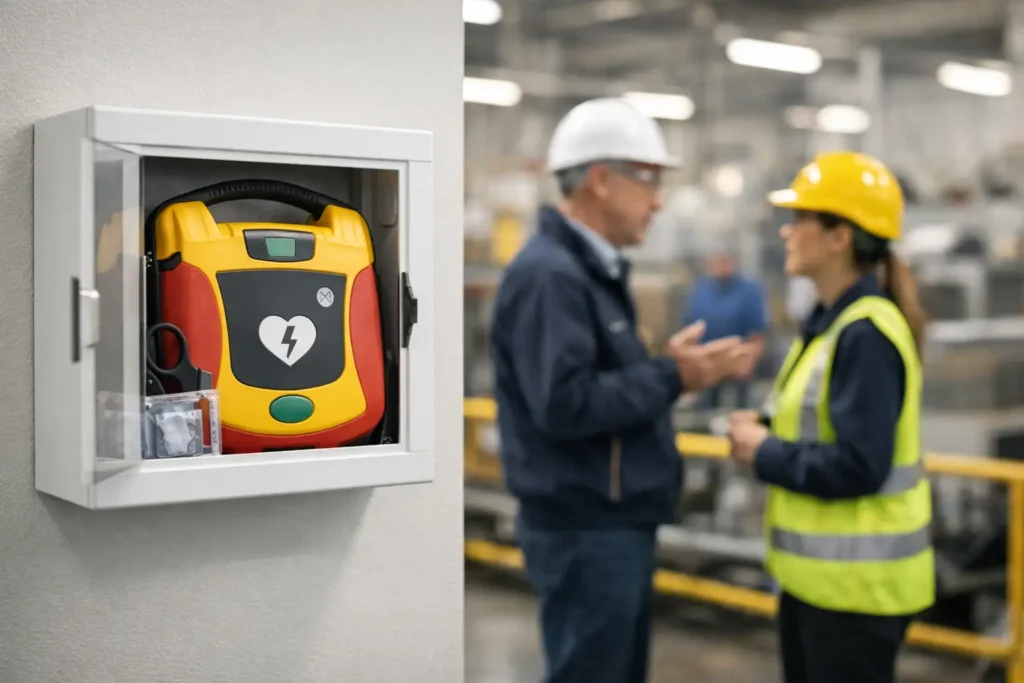
A cardiac emergency on a production floor rarely happens at a convenient time or in a convenient place. It may happen near a loading dock, in a maintenance shop, on a mezzanine, or at the far end of a warehouse during second shift. That is why AED placement for manufacturing facilities should never be treated as a box-checking exercise. Placement decisions affect response time, staff confidence, and whether an emergency plan works under real operating conditions.
Manufacturing environments are different from offices, schools, and retail spaces. The footprint is often larger, the noise level higher, and employee movement less predictable. Add multiple shifts, restricted access areas, temperature variations, and separate buildings, and a single front-office AED is usually not enough. The goal is simple – an AED should be easy to reach quickly from the places where people actually work.
The best placement strategy starts with travel time, not just square footage. In sudden cardiac arrest, every minute matters. If a team member has to leave the production area, navigate around equipment, and cross a large facility to retrieve an AED, the delay can be significant. A manufacturing site may technically have coverage, but still have poor practical access.
That is why facility layout matters so much. A plant with one compact floor and clear sightlines has different needs than a campus-style operation with multiple buildings. A site with heavy forklift traffic or badge-restricted zones may need additional units simply because movement is slower or more complicated in an emergency.
Headcount also matters, but not in isolation. A large number of employees concentrated in one assembly area may justify dedicated AED access there. A smaller team working in a remote maintenance building might need the same consideration because distance is the limiting factor, not population alone.
In many manufacturing settings, the right answer is a mix of central and area-specific placement. Break rooms, front offices, and main entrances are common starting points because they are familiar and easy to identify. But in many plants, those locations only serve administrative staff well.
Production floors, shipping and receiving zones, maintenance departments, warehouses, and employee gathering areas are often stronger candidates. If your site runs multiple shifts, placement should reflect where people are present overnight or on weekends, not just where supervisors work during the day. If outside contractors are regularly on site, that should factor in too.
There is also a visibility issue. An AED tucked inside a supervisor office may be technically available, but it is not functionally accessible if the door is closed or the office is unoccupied. Wall-mounted cabinets in clearly marked common-access areas are usually more dependable because responders can spot and reach them without hesitation.
Some manufacturing leaders assume AEDs should go only in the highest-risk production areas. That can make sense in part, especially where physical strain, heat exposure, or older workforce demographics may increase medical risk. But a risk-based model alone can miss the bigger point. Cardiac arrest can happen anywhere in the facility, including parking lots, locker rooms, training rooms, or administrative areas.
A better approach combines risk, geography, and operations. Start by mapping the facility and identifying how long it would take a trained employee to retrieve an AED and return to the victim from key locations. Then look for gaps. Large plants often find that response coverage breaks down at the edges of the building, in separate structures, or in areas divided by security doors and production barriers.
It also helps to think in terms of real response behavior. In an emergency, people move toward what is visible, familiar, and nearby. A well-placed AED supports that instinct. A poorly placed device adds uncertainty at exactly the wrong moment.
Manufacturing facilities have conditions that can affect both placement and readiness. Dust, vibration, moisture, extreme temperatures, and washdown procedures may influence where a cabinet can be installed and what protective accessories are appropriate. That does not mean the AED should be moved somewhere less useful. It means the environment should be planned for.
Access during all operating hours is another common issue. If a cabinet is mounted in a corridor that gets locked after the day shift, the location may fail your overnight team. If one building requires a badge after hours, responders from another department may lose valuable time. Placement needs to match actual access, not assumed access.
Training alignment matters just as much. If your emergency response team is assigned by department or zone, AED locations should support that structure. When trained responders know exactly which unit serves their area, they act faster and with more confidence. When locations are vague or poorly communicated, even a good device can become hard to use.
Placement is only one part of readiness. Once AEDs are installed, they need to be inspected, maintained, and tracked. Pads and batteries expire. Cabinets can be blocked by pallets or equipment. Staffing patterns change. Renovations alter traffic flow. A placement plan that worked two years ago may not reflect current operations.
That is why manufacturing facilities benefit from treating AEDs as a managed safety program rather than a one-time project. Review locations when layouts change, when headcount shifts, or when emergency teams are reorganized. Make sure signage is clear, devices are visible, and staff know what to do while someone retrieves the AED and calls 911.
For many organizations, this is where an experienced training and AED program partner adds value. Square One Medical helps employers think through placement, training, and ongoing oversight together so the program works in the real world, not just on paper.
The strongest AED placement plans are practical. They reflect how the plant actually runs, where people spend time, and how quickly a responder can act under pressure. They also account for trade-offs. More units may improve access, but they also increase oversight needs. Fewer units may be easier to manage, but only if response times remain realistic.
If you are evaluating AED placement for manufacturing facilities, start with your floor plan, your shifts, and your response team structure. Walk the site as if an emergency were happening right now. That exercise usually reveals the answer faster than any policy manual. The right placement is the one that helps your people respond without delay, wherever the emergency starts.
A well-placed AED does more than meet a safety expectation. It gives your team a real chance to act when seconds matter most.