
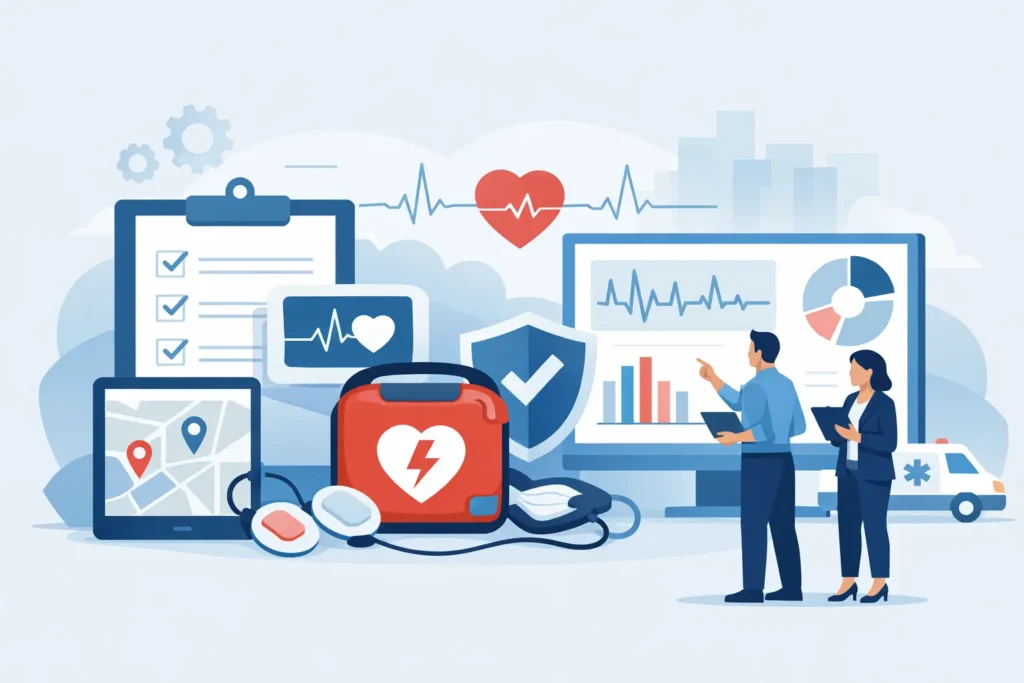
A wall-mounted AED can create a false sense of security if no one is checking pads, batteries, signage, placement, or training records. That is exactly why aed program management services matter. Buying the device is only the first step. Keeping it rescue-ready across months and years is what protects people and reduces risk for the organization.
For many employers, schools, churches, and public facilities, the challenge is not deciding whether an AED is valuable. The challenge is managing everything that comes after installation. Supplies expire. Staff turnover happens. Building layouts change. A unit that looked ready on day one can quietly fall out of date unless someone owns the process.
At a practical level, aed program management services are designed to help an organization maintain an effective, documented AED readiness plan. That usually includes oversight of the devices themselves, the consumables inside them, the people expected to respond, and the records that show the program is being maintained.
The equipment side is more involved than many buyers expect. AED pads and batteries have expiration dates. Cabinets may need alarms, updated signage, or better placement. Devices need routine visual checks and, in some settings, post-event support. If an AED is used in an emergency, the response does not end when EMS arrives. Pads often need replacement, the unit may need inspection, and event data may need to be handled properly.
The administrative side is just as important. Many organizations need a clear schedule for inspections, a process for tracking expirations, and records that show who was trained and when refreshers are due. In a larger facility or multi-site organization, that can become difficult to manage through spreadsheets and calendar reminders alone.
Most AED programs fail in ordinary ways, not dramatic ones. A battery reaches end of life and no one notices. Pads expire in a cabinet outside the gym. A trained staff member leaves, but the training roster is never updated. A renovation changes traffic flow, yet the AED stays in a spot that no longer makes sense.
These are operational problems, which is why AED management services are valuable. They bring structure to a responsibility that often gets assigned to already busy administrators, HR teams, school staff, or safety coordinators. The issue is rarely lack of commitment. It is lack of time, visibility, and a repeatable system.
There is also a compliance and liability angle. Requirements vary by state, industry, and setting, so there is no single checklist that fits everyone. A school may have different expectations than a manufacturing facility or a church. A good management approach helps organizations document what they have, where it is located, who is trained, and how the program is maintained over time.
The strongest benefit is readiness. In a cardiac emergency, no one wants to discover that the pads are expired or the nearest unit is not where staff thought it was. Management services reduce the chance of those preventable failures.
The second benefit is consistency. When multiple people share responsibility, tasks can fall between departments. A managed program gives the organization a defined process for inspection, replacement planning, and training oversight. That consistency matters in offices, schools, churches, police departments, and athletic spaces where responders may change but the expectation of readiness does not.
The third benefit is budget control. This may seem counterintuitive because management services add a service layer, but they often help organizations avoid rush orders, duplicate purchases, and unnecessary replacement mistakes. Planned replacement of pads and batteries is easier to budget than emergency scrambling after a device fails a check or is found out of date.
An AED program is not only about maintaining equipment. It is also about placing equipment where people can access it quickly. That sounds obvious, but placement decisions are often made once and then forgotten.
A growing organization may add staff entrances, expand a warehouse, open a second floor, or change how the public moves through its building. A school may need different placement support than a church campus or industrial facility. Program management should account for these changes, because a properly maintained AED in the wrong location is still a problem.
This is where working with a partner that understands both AED sales and AED program planning can make a difference. The right recommendation depends on building size, occupancy, response time, visibility, and who is on site. Some facilities need one AED. Others need several units, clear cabinet placement, and a plan for multiple response teams.
Not every provider offers the same level of support. Some focus mainly on reminders. Others provide a broader service model that includes equipment guidance, replacement scheduling, post-use support, and training coordination.
A strong provider should make the program easier to run, not harder to understand. That means clear documentation, practical communication, and support that fits your environment. A school administrator does not need the same workflow as a manufacturing safety manager. A church may need a simpler plan than a multi-building employer. The best service is the one that matches the complexity of the site.
It also helps to work with a company that understands the full lifecycle of AED ownership. That includes device selection, placement strategy, staff training, accessories, replacement parts, and ongoing maintenance. When those pieces are handled separately by different vendors, gaps are more likely.
For many organizations, the biggest advantage is having training, equipment, and program support aligned under one relationship. If your team needs CPR and AED training, a new device, replacement pads, and help tracking readiness, it is simpler when those services work together.
That is especially true after staffing changes or facility growth. Instead of rebuilding the program from scratch, you can update training schedules, review placement, and keep equipment current through one coordinated process. For decision-makers, that saves time and reduces uncertainty.
In Pennsylvania and Ohio, many organizations want support that feels practical rather than overly technical. They need a partner who can help them choose the right AED, place it wisely, train their people, and keep the program on track. That is where a service-driven approach stands out.
An AED is one of the most important emergency devices a facility can own, but ownership alone is not preparedness. The real measure is whether the device is maintained, accessible, supported by trained responders, and backed by a plan someone actually follows.
AED program management services help turn good intentions into an operational system. For busy workplaces, schools, churches, and community organizations, that can be the difference between having an AED on the wall and having an AED program that is truly ready to serve people when seconds count.
If your organization already has an AED, the right next question is not whether you bought the right unit. It is whether your program is being managed well enough to trust it on the day you need it.