
Now for a limited time, trade in your old AED for a generous rebate toward a new unit!
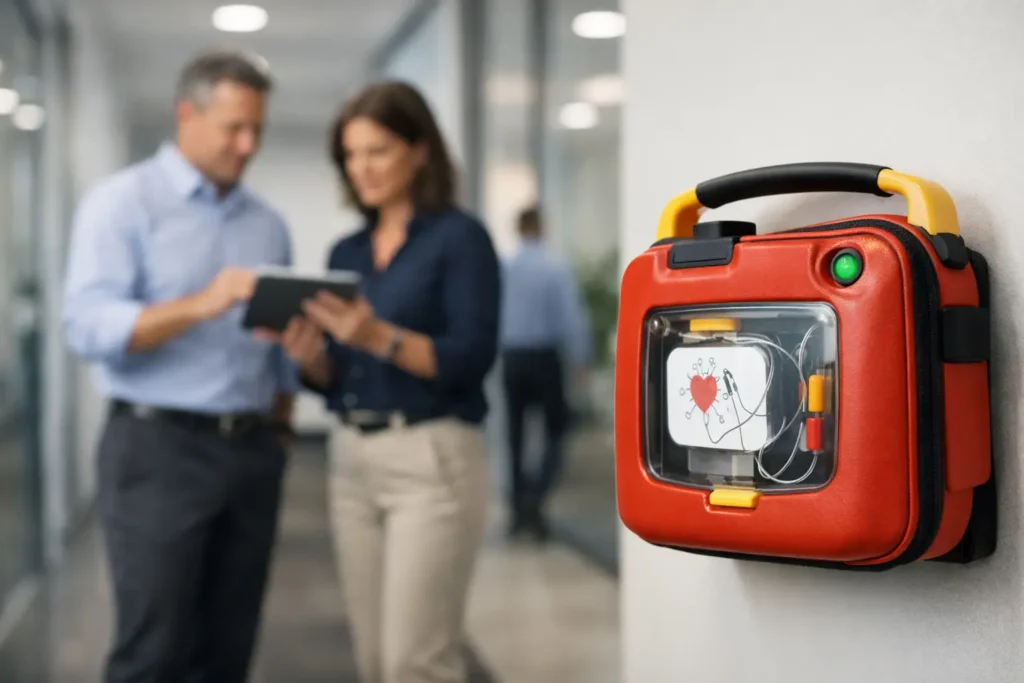
A cardiac emergency does not wait for a convenient time, a staffed front desk, or the person who remembers where the AED cabinet key is stored. Effective AED management makes sure your organization can respond quickly because the device, supplies, people, and records are ready before an emergency happens.
For workplaces, schools, churches, recreation programs, and public-facing facilities, an AED is not a one-time equipment decision. It is part of an ongoing emergency response program. That program should be simple enough to maintain consistently, even when staff changes, schedules get busy, and multiple locations are involved.
AED management is the process of keeping your automated external defibrillator accessible, operational, documented, and supported by trained responders. The device itself is only one part of the system. A complete program accounts for placement, routine inspections, pad and battery expiration dates, staff training, emergency protocols, and post-event follow-up.
The goal is practical readiness. If someone collapses, people should know who calls 911, who retrieves the AED, who begins CPR, and how emergency responders will be directed to the scene. The AED should be easy to locate and ready to provide prompts the moment it is opened.
A program can look different depending on the organization. A manufacturing facility may need devices near production areas, break rooms, and large loading zones. A school may need coverage near gyms, athletic fields, cafeterias, and after-hours entrances. Churches often need to consider children’s areas, worship spaces, fellowship halls, and events held at different times of the week. The right plan depends on the size of the property, typical occupancy, response time, and where people gather.
AED placement should be based on access during the first critical minutes of a cardiac emergency. A device locked in an office or stored in a distant supply room may technically be on site, but it may not be useful when seconds matter.
Walk through your building as if you were responding to an emergency. Consider how far a staff member would need to travel from high-traffic areas, whether doors are locked outside normal hours, and whether visitors could find the AED without assistance. Clear signage and visible cabinets help reduce hesitation. In larger facilities, maps, emergency action plans, and staff orientation should identify AED locations.
Placement also requires a realistic view of who is present. An office with 30 employees may have very different needs than the same office during a training event with 150 guests. Schools, houses of worship, and community facilities should account for evening programs, sports, volunteer events, and seasonal attendance. If the people using the facility change by the hour, your response plan must work for more than one shift or department.
The most reliable AED programs do not depend on one person remembering every detail. They assign responsibility, create a repeatable inspection schedule, and keep a record of what was checked.
A designated AED coordinator can oversee the program, but a backup person should be trained as well. This protects continuity when the primary coordinator is out, changes roles, or leaves the organization. For organizations with several sites, each location may need a local contact with one central person managing records and replacement schedules.
During routine inspections, confirm that the AED is in its assigned location, the status indicator shows the unit is ready, and the cabinet or alarm is functioning as intended. Check that the rescue kit is complete and that adult or pediatric pads are available according to your organization’s needs. Look for expiring pads, batteries, and other supplies well before their replacement dates.
Keep inspection records in a format your team can maintain. A paper log near the cabinet can work for a single small facility, while a centralized digital record may be better for multiple devices or locations. The best system is the one your team will consistently use. What matters is being able to verify that equipment was checked and that follow-up items were addressed.
An AED is designed to guide a responder through the process, but organizations are stronger when staff members are comfortable acting immediately. CPR and AED training helps reduce uncertainty during a stressful event and gives teams a chance to practice their specific response roles.
Training should not stop with the certification class. Include AED locations and emergency procedures in new-hire orientation, safety meetings, and facility walkthroughs. Staff should know that they do not need to wait for a designated responder before calling 911, starting CPR, or retrieving the AED. Clear expectations make a meaningful difference when a person is unresponsive and not breathing normally.
It also helps to discuss common barriers. Some employees worry about using an AED incorrectly or fear that they are not qualified. AEDs are designed to analyze the heart rhythm and provide instructions. Training reinforces that prompt action, following the device prompts, and coordinating with 911 are the priorities.
For schools and churches, consider the people who may be present when full-time staff are not. Coaches, volunteers, event leaders, ushers, and childcare teams may need training or a clear emergency briefing. A response plan that works only from 9 to 5 leaves avoidable gaps.
Documentation is not busywork. It gives your organization a clear picture of readiness and makes transitions easier when safety responsibilities change hands. Maintain records of AED locations, device model and serial information, inspection dates, pad and battery expiration dates, service history, and trained team members.
Many organizations also benefit from registering AEDs with local emergency response systems when applicable. Requirements vary by state and locality, so the right approach depends on where your organization operates. Registration can help emergency dispatchers understand that an AED is available on site and supports better coordination with local responders.
Your emergency action plan should identify the address of the facility, AED locations, internal notification procedures, and who meets emergency medical services. For large campuses or facilities with confusing entrances, include directions that help responders reach the right building, floor, or field quickly. Review the plan after remodeling, a move, a major staffing change, or a new program that changes building use.
A cardiac emergency is not the end of AED management. After the event, the device and response process need attention promptly. The AED may store event data that can be reviewed by medical professionals or authorized personnel. Used pads, batteries, gloves, and other response supplies need replacement. The device should be returned to ready status before another emergency occurs.
There is also a human side to post-event planning. Responders and coworkers may need support after a serious incident. A brief review can identify what worked well, what slowed the response, and whether placement, communication, or training needs adjustment. The purpose is not to assign blame. It is to strengthen readiness for the future.
The most common AED management problem is not a lack of good intentions. It is allowing responsibility to become scattered across facilities, departments, and changing staff. A managed program brings the moving pieces into one process, from selecting appropriate placement and training teams to monitoring consumable expirations and arranging replacements.
Square One Medical helps organizations build AED programs that connect equipment, training, and ongoing readiness support. That approach is especially valuable for teams that do not have a dedicated safety department or that manage several locations with different needs.
Your AED program should give people confidence, not create another complicated administrative task. Assign ownership, check equipment on a schedule, train the people most likely to respond, and revisit the plan as your organization changes. When an emergency occurs, preparation becomes the calm, clear action that helps someone get the care they need.