
Now for a limited time, trade in your old AED for a generous rebate toward a new unit!
A cardiac emergency rarely arrives when the right people happen to be gathered in the right room. It may happen during a shift change, after a school event, in a church hallway, or on a busy production floor. The top CPR training mistakes businesses make are usually not about a lack of concern. They happen when training, AED readiness, and response planning are treated as separate tasks instead of one workplace safety system.
A current CPR card is valuable, but it does not automatically mean a team is ready to act. Employees may complete a course, return to their roles, and never again discuss where the AED is located, who calls 911, or how to guide emergency responders to the scene.
Effective preparedness continues after class. Supervisors should reinforce the response process during safety meetings, orient new staff to the AED location, and make sure designated responders understand their roles. This does not require frequent full-scale drills, but it does require repetition. In an emergency, people fall back on what they have practiced and what is easy to find.
Training should also reflect the environment. A school may need a plan for athletic fields and large campus events. A manufacturer may need to account for noise, multiple shifts, and distance between work areas. A church may need volunteers and ushers to know how to respond during a crowded service. The certification course is the foundation. The site-specific plan is what makes it usable.
Online learning can help employees understand CPR and AED concepts, especially when scheduling is difficult. But organizations should be cautious about relying on a format that provides little or no opportunity to practice skills with an instructor.
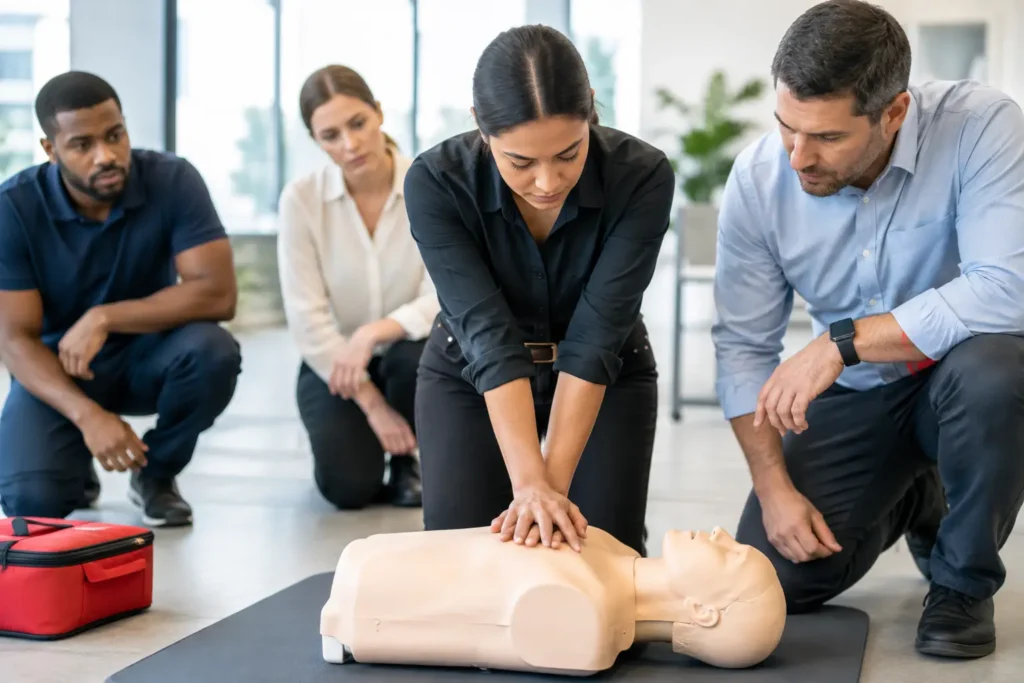
High-quality hands-on training lets participants work through the details that matter under pressure: delivering compressions at the right depth and pace, applying AED pads correctly, clearing the patient before analysis or shock delivery, and communicating with other responders. It also gives employees a chance to ask practical questions about their own workplace.
The right training format depends on job requirements, staff schedules, and the level of certification needed. Still, when a team is responsible for responding to a real medical emergency, practical skill time is not an extra. It is the part that builds confidence and exposes misunderstandings before they matter.
Another common mistake is certifying a small group of people without considering coverage. If all trained employees work similar hours, take lunch together, travel between sites, or leave after a standard shift, a business may have long periods with no prepared responder on site.
Look at staffing patterns rather than headcount alone. Consider early and late shifts, weekends, remote areas of a facility, seasonal staff, and times when visitors or students are present. A response plan is stronger when more than one trained person can act and when no single employee becomes the entire program.
CPR and AED use belong together. CPR keeps blood moving while an AED can analyze a shockable heart rhythm and, when appropriate, direct rescuers to deliver a shock. The AED is designed to guide users with clear prompts, but it must be accessible and ready before an emergency occurs.
Organizations sometimes install an AED, conduct initial training, and then assume the program will take care of itself. Over time, pads expire, batteries approach replacement dates, cabinets are blocked by furniture, or staff changes leave no one assigned to oversight. An AED that cannot be located or used immediately is not providing the protection the organization intended.
A practical AED management process includes routine visual checks, documented inspections, replacement of expiring pads and batteries, review of readiness indicators, and confirmation that signage remains visible. It should also include a clear point of contact and a backup person. The best program is not the one with the most paperwork. It is the one that makes equipment readiness simple enough to sustain.
An AED placed in a locked office or far from the people it is meant to protect may satisfy a planning conversation without supporting a fast response. Placement should be based on the size of the building, layout, population, activity level, and areas where people gather or exert themselves.
For many organizations, the goal is to make an AED reachable quickly from high-traffic areas. That may mean reviewing entrances, cafeterias, gymnasiums, assembly spaces, production lines, athletic facilities, or large meeting rooms. Multi-floor buildings and sprawling campuses may require more than one unit. The answer depends on the facility, but the decision should be based on response time rather than wall space alone.
Visibility matters too. Clear signs, accessible cabinets, and staff awareness reduce hesitation. If employees have to ask where the AED is during an emergency, the placement plan needs work.
AED pads and batteries have service lives. So do many first aid and trauma supplies. Waiting until an inspection, incident, or training renewal reveals an expiration date creates an avoidable gap in readiness.
This is where organizations benefit from assigning ownership and using a consistent tracking process. Record key expiration dates, inspect equipment on a schedule, and plan replacements before they become urgent. If an AED is moved, replaced, or added, update the records and notify staff.
AED program management can reduce this administrative burden by helping organizations keep track of consumables, equipment updates, and routine readiness tasks. For busy office managers, safety coordinators, and administrators, support with the operational details can be the difference between owning equipment and maintaining a reliable response capability.
Even skilled CPR responders need help quickly. A strong workplace response plan identifies who calls 911, who retrieves the AED, who meets arriving EMS, and how responders will be directed to the correct entrance, room, field, or floor.
This is especially relevant for larger facilities, secured buildings, schools, houses of worship, and sites with gated access. Consider whether an ambulance crew could find the scene without losing valuable minutes. Reception staff, security personnel, coaches, volunteers, and shift leads may all have a role, even if they are not the ones providing CPR.
Keep the plan simple enough to remember. During a crisis, clear assignments work better than a long policy that no one has reviewed.
Compliance requirements can motivate organizations to schedule CPR and AED training, and that is a useful starting point. But the strongest safety programs make preparedness part of the culture. Leaders visibly support training, employees know where equipment is located, and the organization reviews its plan as staffing and facilities change.
Square One Medical helps organizations bring these pieces together through hands-on training, AED placement guidance, and ongoing program support. The objective is not to make employees feel responsible for handling every emergency alone. It is to give them the knowledge, equipment, and clear next steps to begin helping while professional responders are on the way.
A well-prepared team does not need to be perfect. It needs to recognize the emergency, call for help, start CPR, retrieve the AED, and trust the plan enough to act.