
Now for a limited time, trade in your old AED for a generous rebate toward a new unit!
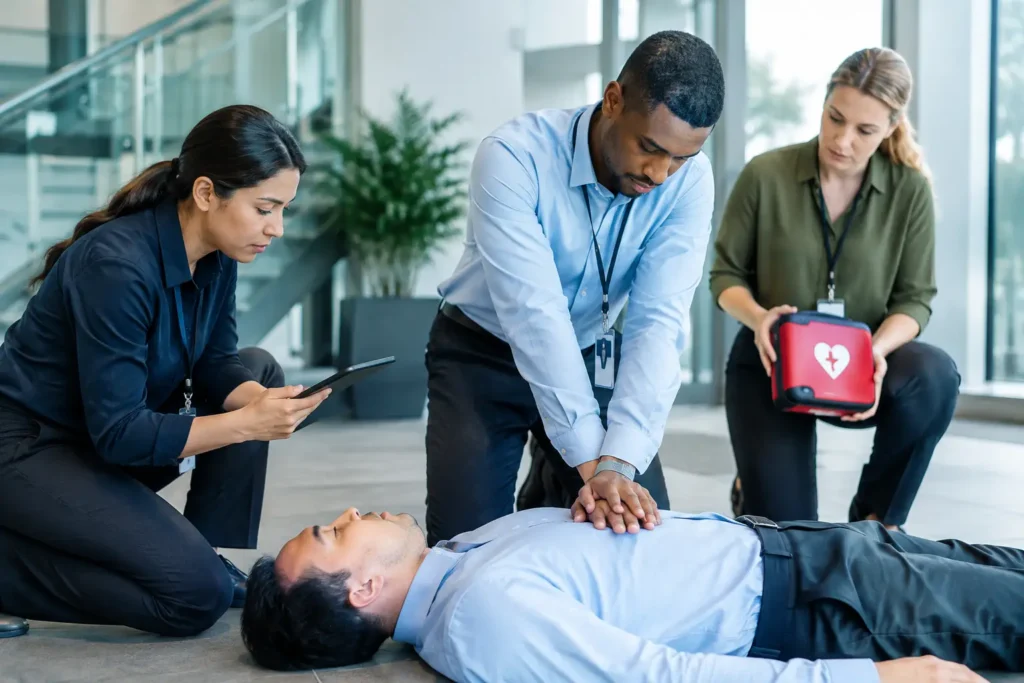
A cardiac emergency does not wait for the person who “usually handles safety” to arrive. In a workplace, school, church, or public facility, an effective emergency role assignment gives every nearby staff member a clear job before a crisis begins. The result is less confusion, faster CPR and AED use, and a more coordinated response when every second matters.
An AED program is more than placing a device on a wall. It is a readiness system that connects the right equipment, trained people, clear responsibilities, and routine maintenance.
During a sudden cardiac arrest, bystanders may have only moments to recognize the emergency, call 911, begin CPR, and retrieve an AED. Without defined roles, several people may call for help while no one starts compressions. Or a trained employee may hesitate because they are unsure who is responsible for getting the AED.
Role assignment reduces that hesitation. It does not mean only designated people can act. Anyone should call 911, begin CPR if able, and use an AED when one is available. Instead, assigned roles create an organized starting point for employees, volunteers, faculty, coaches, and other responsible adults.
The exact plan depends on the size and layout of your organization. A small office may need only two or three clearly identified responders. A large school campus, manufacturing floor, church complex, or police department may need multiple response teams and AED locations to account for distance, shift changes, public events, and access restrictions.
The strongest emergency plans use simple responsibilities that people can remember under stress. One employee may take more than one task in a small facility, but every task should have a backup.
This person calls 911 or directs a specific person to call. They should be prepared to give the exact address, building entrance, floor, room number, or field location. In larger facilities, the caller should also alert internal security, a front office, or a designated response team.
A common mistake is shouting, “Someone call 911.” Direct language works better: “Jordan, call 911 and come back to tell us when they are on the way.”
The responder checks the scene, assesses the person, begins CPR when appropriate, and applies the AED as soon as it arrives. AEDs provide clear voice and visual prompts, so trained responders do not need to diagnose a heart rhythm themselves. They need to act quickly, follow the device instructions, and minimize interruptions in chest compressions.
Organizations should train more than one person per area or shift. Vacation schedules, meetings, absences, and turnover can leave a plan exposed when it depends on a single trained individual.
The AED retriever knows the closest device location and the fastest route to it. This responsibility is especially valuable in large facilities or campuses where the AED may be in a cabinet near a lobby, gym, cafeteria, security desk, or common hallway.
AED placement should support rapid access, not simply convenient storage. If a device is behind a locked door, inside an office that closes early, or too far from high-traffic areas, the response plan may fail at the moment it is needed. A facility walkthrough can reveal where additional AED coverage or clearer signage is necessary.
This person clears space around the patient, meets EMS at the entrance, and guides responders to the emergency. In schools and churches, they may also move students, guests, or congregants away from the scene while preserving privacy and keeping hallways open.
For facilities with security personnel, this role may include opening gates, unlocking doors, operating elevators, or directing traffic. Those seemingly small actions can save valuable time for arriving EMS crews.
After the immediate response is underway, a designated leader communicates with family members, administrators, HR, or other necessary contacts according to organizational policy. This role should not distract the people providing care. It also helps prevent inaccurate information from spreading through staff text chains or social media during a stressful event.
A printed emergency chart is useful only if it reflects how your facility operates on a normal day. Start by identifying where people gather, where trained staff work, and where an emergency is most likely to be witnessed. For many organizations, this includes reception areas, gyms, break rooms, production floors, athletic fields, worship spaces, cafeterias, and parking lots.
Then consider coverage. Who is present during early mornings, evenings, weekends, school breaks, or overnight shifts? Who is trained when the primary safety coordinator is away? A plan for a single daytime team will not protect a facility that hosts events after hours.
It also helps to assign roles by position rather than by name alone. For example, a front desk lead may be responsible for EMS access, while the closest trained staff member starts CPR. Named backups should be documented, but position-based assignments make the plan more durable as employees change.
Written assignments are not a substitute for hands-on CPR and AED training. People need a chance to practice recognizing cardiac arrest, calling 911, delivering effective chest compressions, locating the AED, and following its prompts. They also need to understand that AEDs are designed to guide rescuers through the process.
Short drills are particularly helpful. A school can practice a response from the gymnasium. A church can test the route from the sanctuary to the AED cabinet. A manufacturer can run a scenario across a noisy production area or during a shift change. These exercises often uncover practical gaps, such as unclear cabinet signage, poor radio coverage, locked access points, or outdated staff lists.
Square One Medical helps organizations connect onsite CPR/AED training with AED placement and ongoing program support, making it easier to keep people and equipment ready together.
Emergency role assignment only works when the AED is ready to use. Assign one person or team to inspect devices, confirm that cabinets remain accessible, and monitor pads, batteries, rescue kits, and other time-sensitive supplies. Another person should maintain training records and make sure new staff members understand the response plan.
This does not need to become a complicated administrative burden. A clear inspection schedule, visible AED locations, updated emergency contacts, and expiration tracking can prevent avoidable failures. If your organization operates several sites, centralized AED management is often worth considering so every location follows the same readiness standard.
Review the plan after staffing changes, renovations, new equipment installation, or an actual incident. A response plan should evolve with the facility, not sit untouched in a binder.
When a person collapses, teams do not need perfect words or complicated procedures. They need an AED that is accessible, people who know their roles, and the confidence to begin helping right away.