
Now for a limited time, trade in your old AED for a generous rebate toward a new unit!
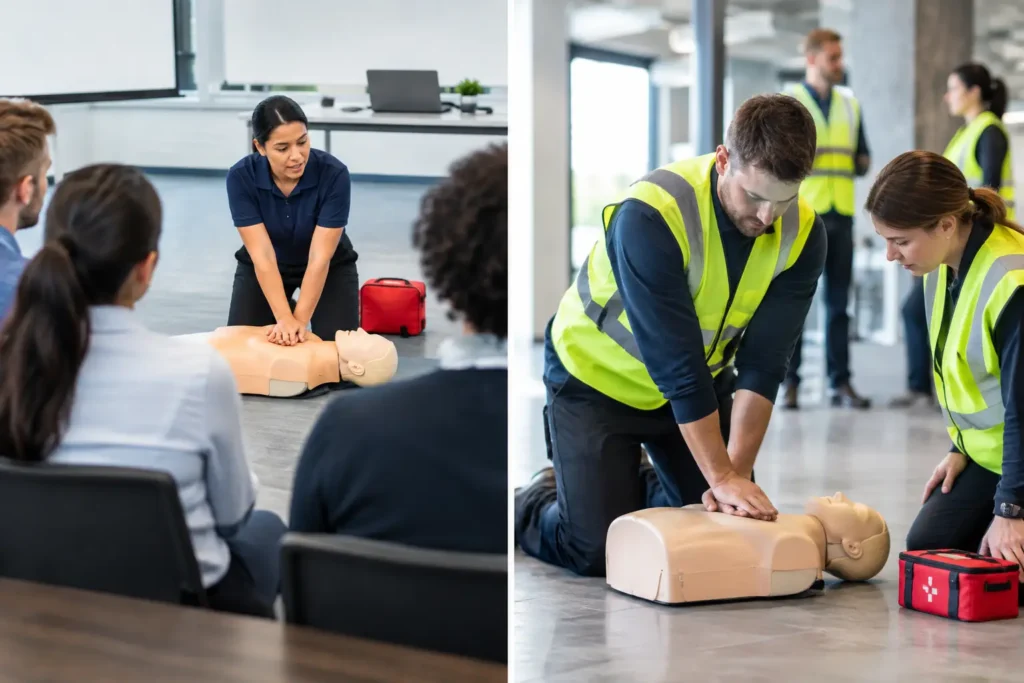
A CPR certification card is valuable, but it is not the whole emergency response plan. When a staff member collapses, a student goes into cardiac arrest, or a visitor needs help, the difference often comes down to whether people can act together, locate the AED, and follow a clear response process. That is why the choice between public versus onsite CPR training deserves more than a quick scheduling decision.
For many organizations, both formats have a place. The right choice depends on the number of people being trained, the complexity of the facility, the role of those employees, and how closely training needs to connect to an AED and emergency action plan.
Public CPR classes bring individual participants or small groups to a scheduled training location. They are often a practical option for a new hire, a coach, a volunteer, or a small organization with only one or two people needing certification. The course follows an established curriculum, provides hands-on practice, and generally offers predictable dates and pricing.
Onsite CPR training brings the instructor and course equipment to your workplace, school, church, or facility. Rather than sending employees away individually, the organization schedules a class around its team, operating hours, and facility needs. This approach is especially useful when several people need training at once or when the organization wants to connect CPR and AED skills to its actual response environment.
Neither option is automatically better. A public class can be efficient for a few participants. Onsite training usually provides more operational value for a larger team or a facility building a complete preparedness program.
Public training is often the simplest answer when the need is limited and immediate. If one employee’s certification is expiring next month, waiting to assemble a full onsite group may not be practical. A scheduled public course can help that person maintain required credentials without disrupting the rest of the team.
It can also work well for organizations with remote employees or dispersed volunteers. Instead of asking everyone to travel to one location, individuals may attend an available class closer to where they live or work.
That convenience has trade-offs. Participants learn the essential skills, but they may not practice finding the AED in their own building, assigning roles among coworkers, or managing access to a crowded school hallway, manufacturing floor, sanctuary, or office suite. Those details matter in the first few minutes of a real emergency.
Public classes also require administrative follow-through. Someone still needs to monitor certification dates, confirm attendance, document completion, and ensure that trained staff are available across shifts. For a small group, that work may be manageable. For a larger organization, it can become fragmented quickly.
Onsite training is designed around the organization rather than the other way around. Teams train together, which creates a more realistic foundation for emergency response. One person can begin CPR, another can retrieve the AED, someone else can call 911, and a supervisor can direct staff away from the scene. Those roles do not need to be complicated, but they should be understood before an emergency happens.
Training at your location also creates an opportunity to examine AED placement. An AED should be accessible, visible, and reachable quickly from the areas where employees, students, guests, or congregants spend time. A device placed in a locked office, behind a reception desk after hours, or far from a high-traffic area may not support a rapid response.
During an onsite session, organizations can ask practical questions that are difficult to address in a public classroom. Who retrieves the AED if an incident happens during a shift change? Can staff access the device when the facility is closed to the public? Are employees confident using the cabinet alarm? Does the emergency action plan identify who calls 911 and who meets responders at the entrance?
This is particularly valuable for schools, churches, manufacturing sites, police departments, and multi-floor workplaces. These environments have different traffic patterns, staffing structures, and response challenges. Onsite instruction gives the team a shared experience and gives leaders a clearer view of gaps that may otherwise remain hidden.
CPR and AED use are closely connected. High-quality chest compressions keep blood moving, while an AED can analyze the heart rhythm and advise a shock when appropriate. Staff should not view the AED as a piece of equipment reserved for a medical professional. Modern AEDs are designed to provide clear voice prompts that guide a lay responder through the process.
Still, an AED program involves more than mounting a cabinet. Pads and batteries have expiration dates. The device needs routine readiness checks. Staff need to know its location, and program documentation may need to be maintained according to organizational policy and local requirements.
An onsite course is a natural time to confirm that the AED is clearly marked, the response supplies are present, and the people most likely to be nearby know how to use them. It can also reveal whether one AED is enough for the size and layout of the facility.
The decision often comes down to logistics. Public classes may have a lower upfront cost per person for a very small group, and they require little coordination beyond registration. The hidden cost is employee travel time, separate scheduling, and the possibility that attendance gets delayed when business demands take priority.
Onsite training requires coordinating a date, training space, and participant roster. Yet it can reduce time away from work and allow an organization to train multiple employees during a planned window. For teams that need certification at the same time, this can be the more manageable option.
Consider the cost of inconsistency as well. When employees train months apart in unrelated settings, certifications may expire at different times and emergency procedures may be understood unevenly. A coordinated onsite schedule can simplify renewal planning and help maintain adequate coverage across departments and shifts.
Start with the actual risk and response needs of your facility, not simply the number of certification cards required. A small office with one designated first aid responder may be well served by a public class. A school with multiple buildings, a church hosting large weekly gatherings, or an industrial site with rotating shifts will usually benefit from training that includes the full team and its emergency equipment.
Ask whether staff need only individual certification or whether they need to function as a response group. Review where your AEDs are located, who can reach them, and whether trained people are present whenever the building is occupied. If you cannot confidently answer those questions, onsite training can be a useful starting point for a broader preparedness discussion.
Square One Medical helps organizations pair practical CPR and AED training with AED placement, readiness support, and ongoing program management. The goal is not simply to complete a course. It is to make it easier for ordinary people to respond effectively during an extraordinary moment.
The most helpful next step is to walk your facility as if an emergency were happening right now. Notice where help could be delayed, where an AED would be hard to find, and which team members would be expected to act. Those observations will point you toward the training format and preparedness support that fit your organization best.