
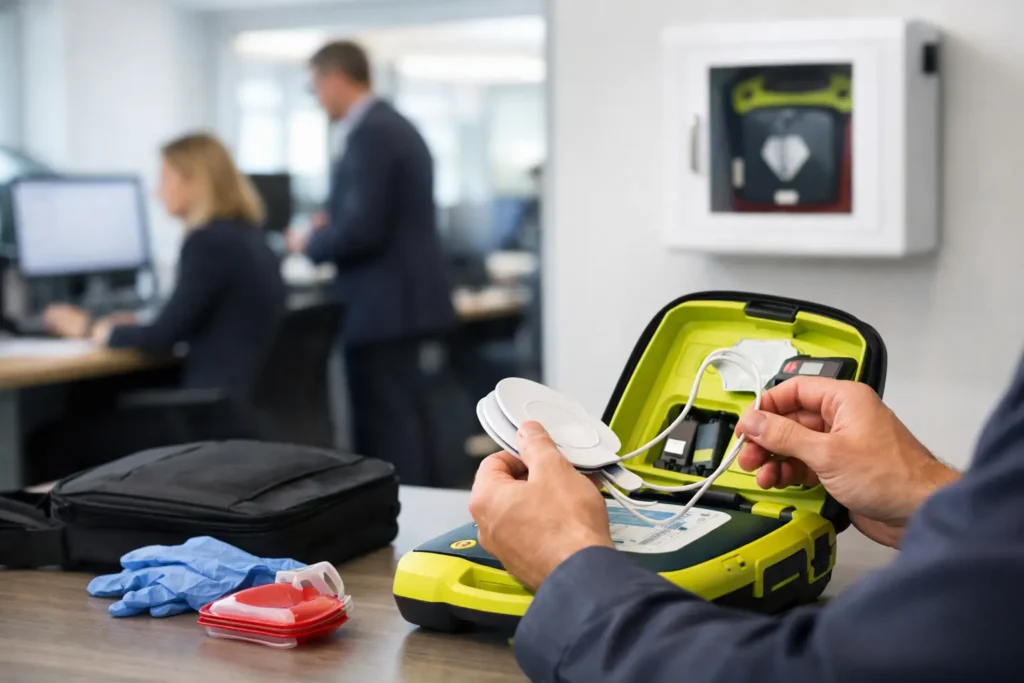
An AED mounted in an office hallway can create a false sense of security if no one knows whether it is ready to use. During a cardiac emergency, there is no time to search for a key, interpret a warning light, locate expired pads, or call someone who may have moved to another department. Knowing how to maintain office AEDs turns the device from a piece of safety equipment into a dependable part of your workplace response plan.
AED maintenance is not difficult, but it does require ownership. The strongest programs assign responsibility, document routine checks, keep trained responders current, and address problems before an emergency exposes them. For office managers, HR teams, operations leaders, and safety coordinators, a simple maintenance process can reduce uncertainty and help employees act quickly when seconds matter.
Every office AED needs a designated program owner and a backup. This might be a facilities manager, safety coordinator, HR professional, or office administrator. The role is not to provide medical care. It is to make sure the device, supplies, signage, records, and response procedures remain current.
Without a named owner, routine checks often become everyone’s responsibility, which usually means they become no one’s priority. The primary owner should know where every AED is located, have access to the cabinet, understand the device’s readiness indicator, and receive reminders for consumable expirations. A backup person protects the program when the primary contact is on vacation, changes roles, or leaves the organization.
This responsibility should also be reflected in your written emergency action plan. Employees need to know who calls 911, who retrieves the AED, who meets emergency medical services at the entrance, and who supports the person in distress until responders arrive.
Most modern AEDs run automatic self-tests, but that does not eliminate the need for human oversight. A monthly visual inspection is a practical baseline for many offices. Your manufacturer instructions and local requirements should guide the exact schedule, especially if your organization operates across multiple states or has industry-specific safety obligations.
During the inspection, confirm that the AED’s status indicator shows it is ready for use. A green check mark, flashing green light, or similar signal often indicates readiness, while a red symbol, alarm, or service message requires prompt attention. Do not assume a quiet device is functioning properly. Check the indicator directly.
Make sure the AED is visible, accessible, and not blocked by furniture, storage boxes, locked doors, or seasonal displays. An AED should be available whenever the office is occupied, including early shifts, evening meetings, and events. If it is installed in an alarmed or locked cabinet, staff should know how to open it without delay.
The inspection should also confirm that the cabinet signage is easy to see from a distance and that directional signs still make sense after office renovations or layout changes. In a large office, a device can be technically present but still too difficult to find under stress.
AED pads and batteries have expiration dates, even when they have never been used. Pads contain gel that can dry out over time, and batteries lose capacity as they age. Replacing these items before they expire is a core part of AED readiness.
Keep a record of the AED model, serial number, location, pad expiration date, battery expiration date, and last inspection date. A paper log stored near the device can work for a single small office, but a centralized digital record is often easier for organizations with multiple locations. The best system is the one your team will consistently use.
Your monthly check should also verify that the response kit is complete. Depending on the AED model and your organization’s setup, that may include adult pads, pediatric pads or a pediatric setting, gloves, a CPR mask, trauma shears, a razor, an absorbent towel, and a spare set of pads. These items support quick, safe use of the AED, especially when a person’s clothing or chest hair could delay pad placement.
If your office has employees, visitors, or programs serving children, review whether pediatric capability is appropriate. The right setup depends on who may be present and the AED model your organization uses. A qualified AED program partner can help evaluate that decision without creating unnecessary complexity.
An AED that issues a service alert should be taken seriously. Follow the manufacturer’s instructions, check the pads and battery, and contact your AED support provider when the message is unclear. Do not silence an alert and postpone the issue. A device that is not ready should be clearly marked and restored to service as soon as possible.
After any use, the AED needs attention immediately, even if it did not deliver a shock. The pads are generally single-use and must be replaced. The battery, rescue kit, and device status should be checked, and the AED’s event data may need to be downloaded according to your organization’s policies and the direction of medical professionals or your program coordinator.
An actual emergency can be stressful for the employees involved. Plan for a post-event process that includes restocking equipment, documenting what occurred, reviewing the response, and offering support to staff. The goal is not to assign blame. It is to restore readiness and learn from the experience.
A well-maintained AED is only part of the equation. Employees also need confidence to recognize a possible cardiac arrest, call 911, begin CPR, retrieve the AED, and follow the device’s voice prompts. AEDs are designed to guide rescuers, but hands-on CPR and AED training makes the process far less intimidating.
Train more than the minimum number of people whenever possible. Employees may be traveling, working remotely, in meetings, or absent when an emergency occurs. Consider your office schedule, floor plan, number of occupants, and visitor traffic when deciding how many people should be trained.
Training should also include the practical details of your workplace: where the AED is located, how to access it, and who has assigned roles in an emergency. A staff member who has practiced with a trainer AED is more likely to respond decisively than someone who only knows a device exists somewhere in the building.
An AED program should not remain static after installation. Reassess placement when your organization moves, expands, adds a floor, changes entrances, hosts more public events, or reorganizes departments. A device positioned near the center of daily activity may no longer be the best choice after a renovation.
Placement decisions depend on the size and layout of the facility. The guiding question is simple: can a responder retrieve the AED and return to the person quickly? Devices should be in public, clearly marked locations that remain accessible during normal operating hours. In larger workplaces, more than one AED may be appropriate to reduce retrieval time.
Square One Medical helps organizations build AED programs that combine appropriate placement, equipment oversight, CPR/AED training, and ongoing expiration tracking. That coordinated approach is especially useful when one person is managing safety across several offices, schools, churches, or community facilities.
Maintain inspection logs, replacement records, training rosters, device information, and emergency action plan updates in one accessible place. Good documentation supports consistency, helps new program owners take over smoothly, and shows that your organization is actively managing its safety equipment.
It also creates a useful rhythm: inspect, record, replace, train, and review. When AED maintenance becomes part of routine workplace safety operations rather than a once-a-year task, your team is far better prepared to respond with purpose when someone needs help.