
Now for a limited time, trade in your old AED for a generous rebate toward a new unit!
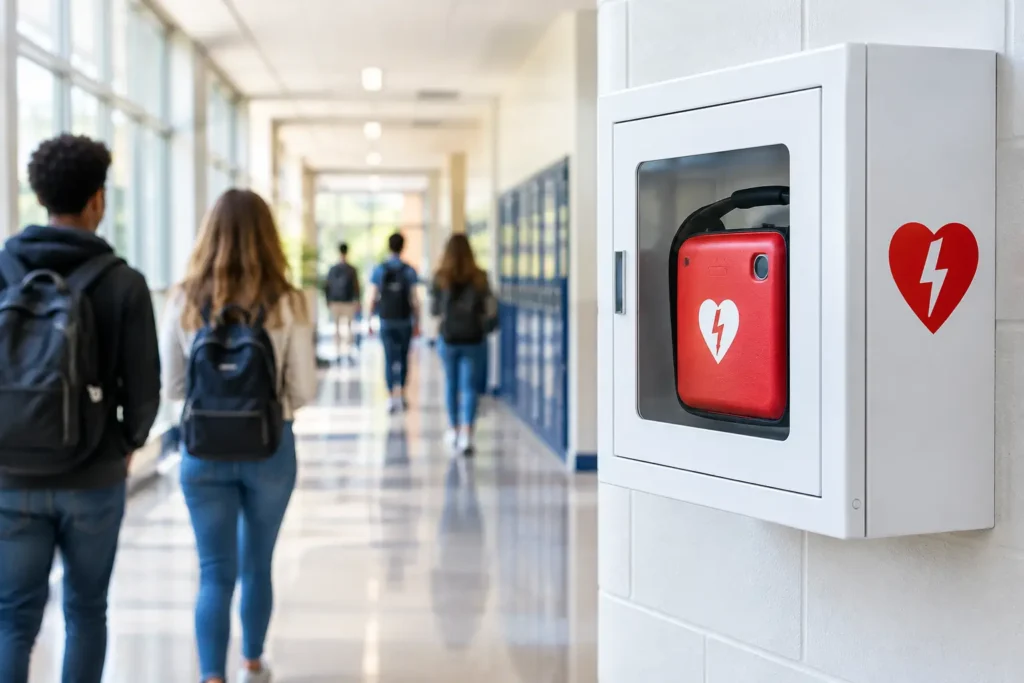
A cardiac emergency does not wait for the nurse’s office to open or for a coach to find a phone. It can happen in a gym during practice, a crowded auditorium, a hallway between classes, or a school event after hours. This Maryland school AED guide helps administrators turn an AED from a piece of equipment on the wall into a dependable part of their emergency response plan.
For schools, AED readiness is not only about having a device available. It is about placement, trained responders, clear communication, documented maintenance, and a process staff can follow under pressure. When those pieces work together, the school is better positioned to respond quickly for students, employees, families, and visitors.
An automated external defibrillator, or AED, analyzes a person’s heart rhythm and can deliver a shock when needed for certain life-threatening cardiac arrests. The device provides voice prompts, but the minutes before it arrives matter. A school’s AED program should therefore answer practical questions before an emergency occurs: Who retrieves the AED? Who calls 911? Who begins CPR? Who meets emergency medical services at the entrance?
Maryland schools should review applicable state requirements, district policies, and local emergency medical services guidance when establishing or updating a program. Requirements and implementation details can vary by school type and local jurisdiction, so administrators should avoid treating a general checklist as legal advice. The goal is a written, workable plan that aligns with the school’s procedures and is understood by the people expected to act.
A strong plan assigns an AED program coordinator and a backup. These individuals keep records current, oversee inspections, coordinate training, and make sure an AED remains response-ready throughout the year. Without clear ownership, simple but critical tasks, such as replacing expired pads, can be missed.
AED placement should follow the path of people, not just the floor plan. A device locked in a distant office may technically be on campus but still take too long to reach someone in cardiac arrest. Schools should aim to make an AED accessible quickly from high-traffic and higher-risk areas.
Start with a campus walk-through. Consider the main office, gymnasium, athletic fields, cafeterias, auditoriums, nurse’s office, playgrounds, entrances, and spaces used for community events. Large campuses, multiple buildings, upper floors, and outdoor athletic facilities may require more than one AED location. A single unit near the front office may be reasonable for a compact building, but it is often not sufficient for a sprawling campus or a stadium used after school hours.
Visibility matters as much as distance. AED cabinets should be clearly marked, accessible to responders, and not blocked by furniture, temporary displays, or locked doors. Staff, substitutes, coaches, custodial teams, and event personnel should know where each unit is located. A map in the emergency action plan can help, but it cannot replace an in-person orientation.
For athletic areas, consider the reality of games and practices. If an AED is inside a building that is locked during an evening event, the response plan has a gap. A weather-resistant cabinet or a nearby accessible unit may be appropriate, depending on the environment and the school’s security procedures.
AEDs are designed to guide users, but CPR and AED training gives school personnel the confidence to act fast and work as a team. School nurses, administrators, athletic staff, security teams, coaches, physical education teachers, front-office staff, and facilities personnel are logical priorities. It is also wise to have trained responders across shifts and buildings, rather than relying on one person who may be absent, in a meeting, or off campus.
Training should include hands-on CPR and AED practice, not just a policy review. Participants need to experience the sequence: check responsiveness, call 911, send someone for the AED, begin CPR, apply pads, follow prompts, and continue care until EMS takes over. They should also understand how to manage a chaotic scene, communicate with dispatchers, and protect the privacy of the person receiving care.
Teams should practice the school’s specific roles. For example, one staff member may retrieve the AED, another may start compressions, a third may call 911 and notify the office, and another may direct EMS to the exact location. Rehearsing these actions exposes delays that a written plan can hide.
An AED is only useful when its battery has power and its pads are within their expiration date. Maintenance is an operational responsibility, not a one-time setup task. Most modern AEDs perform self-tests, but schools still need routine visual inspections and a reliable way to document them.
The program coordinator should verify that the status indicator shows the device is ready, the cabinet is accessible, the pads and battery are current, and the response kit contains needed supplies. Schools should also confirm that the device remains in its assigned location after events, renovations, or seasonal changes. If a unit is removed for service, staff need to know where the temporary coverage is located.
A centralized tracking system is especially valuable for districts or private school networks with multiple buildings. It can track expiration dates, inspection records, device serial numbers, training dates, and replacement supplies. This reduces the risk that responsibility gets lost when staff roles change.
A school AED program works best when it is integrated into existing emergency planning. The plan should identify how the school will activate 911, alert trained responders, notify the nurse or administration, and open access points for EMS. It should also address emergencies during field days, athletics, performances, transportation staging, and community use of school facilities.
After any AED use, the school should follow its post-event procedure. That may include replacing pads and other used supplies, returning the unit to service promptly, preserving device data as appropriate, documenting the incident, and offering support to affected staff and students. A debrief can identify what worked and what needs adjustment without placing blame on responders.
Schools should also communicate the program appropriately. Staff need to know where AEDs are and how to respond. Families and visitors do not need every operational detail, but visible signage reinforces that the campus is prepared to act in an emergency.
For many administrators, the challenge is not recognizing the value of AEDs. It is coordinating equipment, training, inspections, records, and replacements while managing a school’s daily demands. Working with an experienced safety partner can simplify that work by combining CPR/AED training, AED placement planning, equipment support, and ongoing program management.
Square One Medical helps organizations build practical emergency readiness programs that fit their facilities and teams. The right approach depends on campus size, building access, event schedules, staffing, and the people each school serves.
The most useful next step is often a walk through the campus with an honest question in mind: if someone collapsed here right now, how quickly would a trained person reach them with an AED? The answer can guide the changes that make preparation real.