
Now for a limited time, trade in your old AED for a generous rebate toward a new unit!
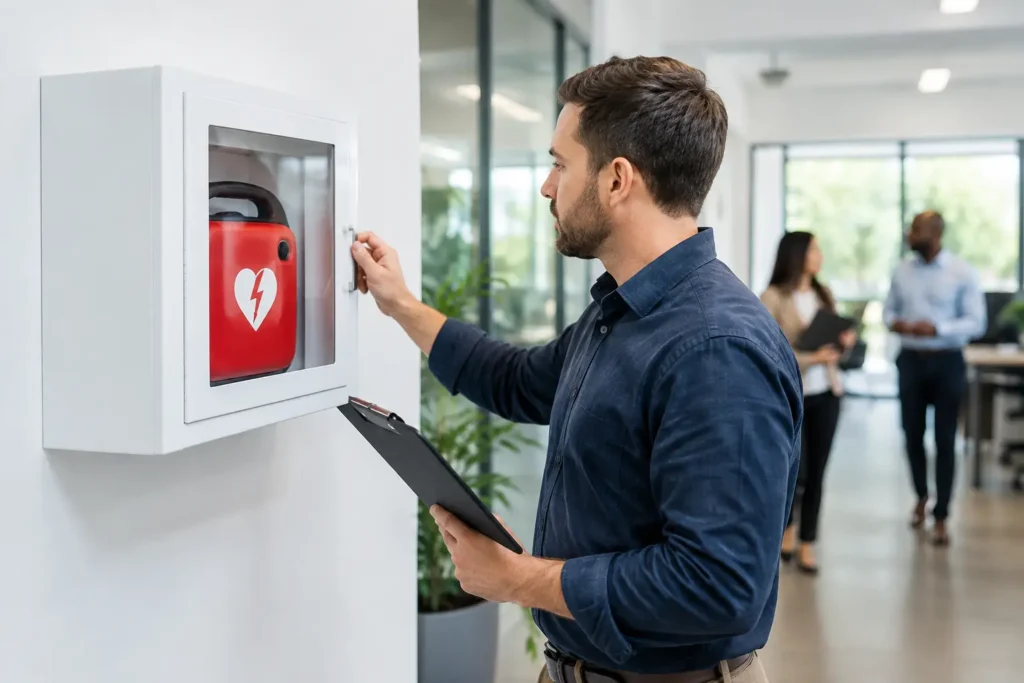
A cardiac emergency rarely happens beside the person who knows where the AED is stored, has access to the cabinet key, and remembers the response protocol. That gap is exactly why workplace AED readiness must be treated as an active safety program, not a piece of equipment mounted on a wall.
For employers, facility managers, HR teams, and safety coordinators, the goal is straightforward: make sure an AED can be found, used, and trusted in the first critical minutes of a sudden cardiac arrest. That requires thoughtful placement, trained staff, documented inspections, and a response plan that works across shifts, visitors, and changing facility layouts.
An automated external defibrillator is designed to guide a rescuer through a cardiac emergency with clear voice and visual prompts. Modern AEDs analyze the heart rhythm and advise a shock only when appropriate. That simplicity is valuable, but it does not remove the planning required before an emergency occurs.
A workplace AED program connects the device to the people, procedures, and maintenance habits that make it usable. A facility can have an AED in the building and still be unprepared if employees do not know its location, pads have expired, the battery is nearing replacement, or responders are unsure who calls 911.
Preparedness also looks different from one organization to another. A small office with a stable daytime staff may need a simple, clearly assigned inspection process. A manufacturing operation, school campus, church, warehouse, or multi-building employer may need several AEDs, coverage for evenings and events, and a more formal emergency action plan. The right program reflects the building, the population, and how people move through the space.
Placement should be based on response time, not where there happens to be open wall space. In general, an AED should be accessible within a short walk from the areas where employees, students, customers, or visitors spend time. Entrances, break areas, common corridors, fitness spaces, cafeterias, and high-traffic production areas often deserve careful consideration.
Look beyond the typical workday. If a facility hosts evening meetings, weekend services, athletic events, or public programs, the AED must remain accessible when those activities are underway. An AED locked behind an office door after 5 p.m. may not serve the people who need it most.
Visibility matters as much as distance. Use appropriate signage, make the cabinet easy to locate, and include AED locations on emergency maps and new-employee orientation materials. If the facility is large, identify the fastest route from major work areas. In a multi-floor building, an AED on every level may be appropriate. In a sprawling warehouse or campus, more than one device may be needed to reduce travel time.
The cabinet itself should support access, not create friction. Teams should know whether the cabinet is alarmed, whether it needs a key, and who is responsible for testing that it opens correctly. A cabinet alarm can alert others to the emergency, but it should never delay retrieval.
Placement decisions should account for everyone in the facility, not only full-time employees. Consider contractors, clients, students, congregants, event guests, delivery personnel, and members of the public. A church may need coverage that supports both weekly services and community gatherings. A school may need devices near athletic facilities, cafeterias, and areas used after school. A manufacturing facility may need coverage for remote production lines and shift changes.
This is also a reason to review AED placement when a building expands, departments move, or a new use is added to the facility. A once-effective location can become less practical as foot traffic changes.
During sudden cardiac arrest, effective action depends on a coordinated response. Someone calls 911, someone begins CPR, someone retrieves the AED, and someone helps guide emergency responders to the right location. These tasks can happen at once when employees have trained together and understand their roles.
CPR and AED training gives people the confidence to act. It also lets them practice details that are hard to absorb from a poster or policy alone: sending someone to call 911, clearing the patient while the AED analyzes, applying pads correctly, and continuing CPR between prompts. Hands-on practice is especially useful for teams that may be responsible for visitors or large groups.
Not every employee needs the same level of responsibility, but every employee should know how to activate the emergency response process and where the AED is located. Designated responders should receive current CPR/AED training and be distributed across departments and shifts. Avoid building a program around one trained employee who may be absent, on break, or working remotely when an emergency occurs.
A brief annual review can keep the plan familiar. Use a staff meeting, safety huddle, or emergency drill to revisit AED locations, emergency contacts, and the steps employees should take when someone collapses and is unresponsive.
AED readiness depends on small, repeatable maintenance tasks. Pads and batteries have expiration dates, and some devices require specific accessories or software updates. An AED may conduct automatic self-tests, but those features do not eliminate the need for human oversight.
Assign a specific person or team to check each device on a consistent schedule. The inspection should confirm that the AED status indicator shows it is ready, the cabinet is accessible, the pads and battery are within date, and necessary supplies are present. Many organizations also keep gloves, a CPR face shield, scissors, a razor, and a towel in or near the response kit because these items can help responders prepare the patient quickly.
Documenting inspections creates accountability and makes it easier to catch an approaching expiration before it becomes a problem. It is also helpful when the responsibility changes hands. A simple checklist is better than relying on memory, particularly in facilities with multiple AEDs.
After an AED is used, the program needs immediate follow-through. The device should be returned to service promptly with replacement pads and any other used supplies. The team should document what occurred according to organizational policy, support employees affected by the event, and review whether the response plan worked as intended. A real emergency can reveal issues such as unclear access, delayed communication, or missing equipment that should be corrected quickly.
The AED should be named directly in the organization’s emergency action plan. A vague instruction to “call for help” does not tell employees who retrieves the device, who meets EMS, or how to communicate a precise location in a large facility.
A useful plan identifies how to recognize a likely cardiac emergency, call 911, begin CPR, retrieve the AED, direct emergency responders, and notify internal leaders. It should also explain what happens if the incident occurs during a shift with limited staffing or during a public event.
Coordinate the plan with building security, reception, and front-desk teams. These employees may be the first to receive a call for help or the people responsible for opening gates, directing EMS, and moving visitors away from the response area. Their role should be clear before an emergency, not assigned in the moment.
Some organizations choose to register AED locations with local emergency dispatch programs where available. Requirements and processes vary by state and municipality, so it is wise to understand the rules that apply to the facility and maintain the documentation expected of the organization.
The strongest AED programs do not rely on a single annual reminder. They assign ownership, set inspection schedules, track replacement dates, train enough people to cover absences, and revisit placement when the facility changes. This work is manageable when it is built into normal safety operations rather than handled as a last-minute compliance task.
For organizations that need help connecting equipment, training, maintenance tracking, and emergency planning, Square One Medical can help simplify the process into a practical AED readiness program. The result is not just a device on the wall. It is a workplace where people know what to do, where to go, and how to help when seconds matter.
The best time to test whether your AED program works is on an ordinary day, when there is time to walk the route, open the cabinet, check the dates, and make the next emergency response easier for everyone involved.