
Now for a limited time, trade in your old AED for a generous rebate toward a new unit!
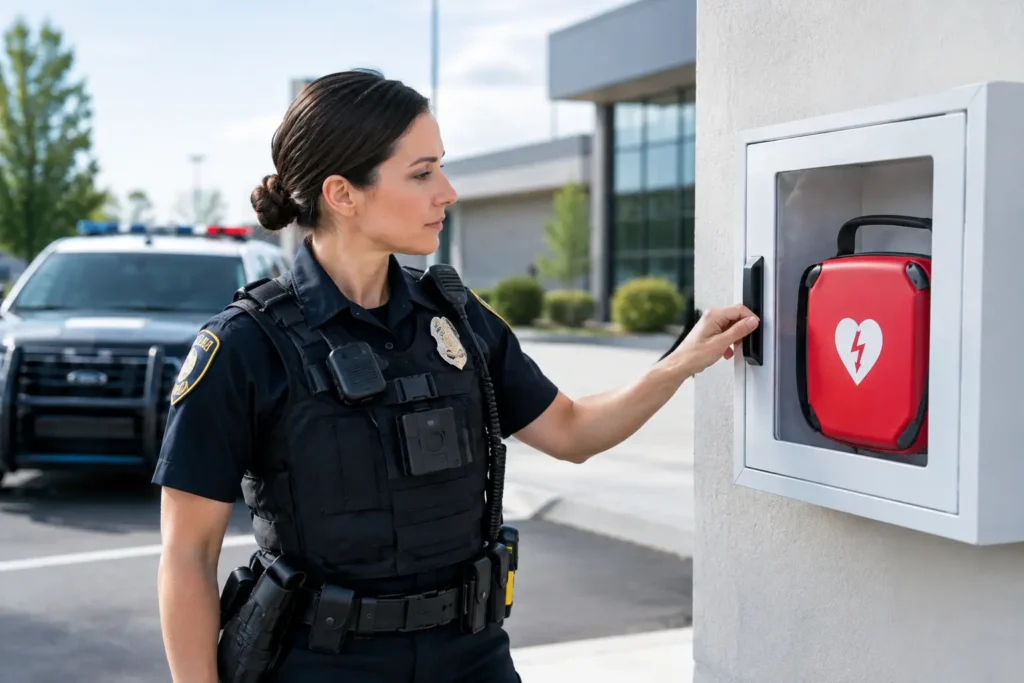
A cardiac arrest can become a law enforcement call before it becomes an EMS call. An officer may be first on scene at a vehicle crash, a school event, a community center, or a residence. A practical police AED placement guide helps an agency put defibrillators where officers can reach them quickly, safely, and consistently – without creating a program that is difficult to maintain.
The goal is not simply to place an AED in a building or vehicle. It is to build a response system that supports early defibrillation, clear communication, trained personnel, and equipment that is ready when someone needs it.
The best placement decision begins with a simple question: where are officers most likely to be when a sudden cardiac arrest occurs, and how quickly can they bring an AED to the patient?
For many agencies, the police station is only one part of the answer. An AED mounted near the public lobby or dispatch area may protect visitors, administrative staff, and officers working inside the facility. But it may not help an officer responding several miles away. Agencies that routinely arrive before EMS should evaluate whether patrol units, school resource officer vehicles, community policing units, and special-event details need AED access as well.
Response patterns matter. Review calls involving large gatherings, athletic facilities, schools, downtown business districts, parks, transit areas, and remote neighborhoods. Consider traffic conditions, shift coverage, and the typical time it takes for fire or EMS to arrive. A device that is technically available but locked in an office, stored in a distant garage, or carried only by an off-duty supervisor is not positioned for a fast response.
An AED should be easy to identify, retrieve, and carry to the patient. In a station, visible wall cabinets near public-facing areas, dispatch, booking, roll-call rooms, fitness areas, and high-traffic entrances can make sense. Placement should also account for who is present after normal business hours and whether the area is accessible during an emergency.
For patrol deployment, the AED needs a secure, known location in every designated vehicle. Officers should not have to search through a trunk, move tactical gear, or remember which bag contains the device. A consistent location and clear equipment checks at the start of shift help make retrieval automatic under pressure.
Vehicle placement requires additional planning. Heat, cold, moisture, vibration, and storage conditions can affect equipment and consumables. Follow the manufacturer’s instructions for use, confirm the unit is appropriate for the environment, and establish a process for responding to device alerts. A vehicle AED program may offer valuable coverage, but it also requires disciplined inspections and accountability.
Agencies should avoid placing an AED where access depends on a single person having a key, badge, or specialized knowledge. Security matters, particularly in public spaces, but access cannot be so restrictive that it delays care. Cabinets with alarms can deter misuse while still allowing immediate access.
AED placement works best when it is connected to dispatch procedures and officer training. Dispatchers should know which units carry AEDs and should be able to communicate that information during suspected cardiac arrest calls. If an AED is located in a station or public facility, employees and officers should know exactly where it is and who will retrieve it.
Training should reinforce the role of officers in the first minutes of a cardiac emergency: recognize unresponsiveness and abnormal breathing, activate the appropriate emergency response, begin high-quality CPR, apply the AED as soon as it arrives, and continue following the device prompts until EMS takes over. Officers do not need to wait for a medical background to act. AEDs are designed to guide trained responders through the process.
Scenario-based practice is especially useful for law enforcement teams. Run drills that reflect actual assignments, such as an officer responding alone to a collapse at a school gym, a station employee collapsing in a lobby, or a bystander suffering cardiac arrest at a public event. These exercises quickly reveal problems with radio communication, access, device location, and handoffs to EMS.
An AED program can lose effectiveness quietly. Pads expire, batteries approach replacement dates, rescue kits are used or misplaced, and a status indicator can change without anyone noticing. Placement is only the first step. Every device needs an assigned owner and a documented inspection schedule.
A monthly inspection process should verify the device’s readiness indicator, cabinet condition, battery and electrode pad expiration dates, rescue kit contents, signage, and accessibility. For vehicle AEDs, agencies may add a quick shift-level check because the equipment moves through a harsher environment and may be relocated between vehicles.
After an AED is used, the process should be equally clear. The device should be returned to service promptly, pads and other supplies should be replaced, and the incident should be reviewed according to agency policy. AED data may be valuable to the medical response process, so personnel should know how to preserve the device and coordinate with EMS after use.
An AED management program can reduce the burden on supervisors by tracking inspections, expirations, and replacement needs in one place. It also creates a dependable record that the agency has actively maintained its lifesaving equipment rather than treating it as a one-time purchase.
Police AED programs should align with local EMS protocols, medical direction requirements, and agency policy. Requirements can vary by jurisdiction, including expectations for training, registration, post-incident reporting, and medical oversight. Agencies should confirm their local obligations before finalizing deployment.
Coordination also improves the handoff on scene. When officers, dispatchers, fire personnel, and EMS understand the plan, they can move from CPR and AED use to advanced care with less confusion. The most useful policies are practical: they identify where AEDs are located, who checks them, what officers should do after use, and how replacement supplies are requested.
The strongest police AED programs are built around real response conditions, not a generic equipment checklist. A small department may begin with a station AED and selected patrol vehicles. A larger agency may need a broader strategy covering substations, specialty units, school resource officers, and public events. The right model depends on call volume, geography, staffing, EMS response times, and available maintenance capacity.
Square One Medical helps organizations connect AED placement, hands-on CPR/AED training, and ongoing equipment management so preparedness remains workable after installation. For a police agency, that partnership can turn a device on a wall or in a cruiser into a response capability officers are prepared to use.
The most valuable AED is the one an officer can locate immediately, bring to the patient without delay, and trust to be ready. That standard should guide every placement decision.