
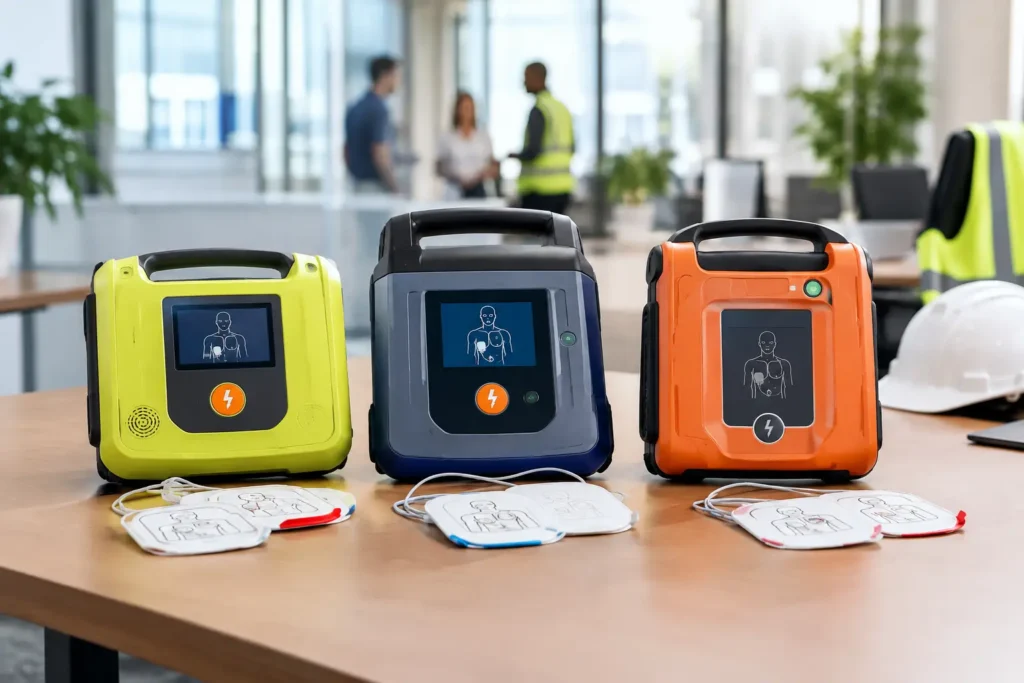
A meaningful ZOLL AED comparison is not about choosing the device with the longest feature list. For a workplace, school, church, or public safety organization, the better question is: Which AED will be recognized quickly, used confidently by trained responders, and kept ready over time? The answer depends on your environment, the people who may respond, and the way you plan to manage the entire AED program.
ZOLL AEDs are widely known for Real CPR Help, which provides guidance on chest compressions during a rescue. That focus matters because high-quality CPR and early defibrillation work together. Two common choices for organizations are the ZOLL AED Plus and the ZOLL AED 3. Both are dependable options, but they fit different readiness plans.
The ZOLL AED Plus is a proven AED designed to coach a lay rescuer through an emergency. Its clear voice prompts and visual guidance help users follow the rescue sequence, while Real CPR Help provides feedback on compression depth and rate when used with compatible CPR electrodes. For organizations concerned about a hesitant first-time responder, that practical coaching can make a real difference.
The AED Plus uses a straightforward design that many teams find familiar during CPR/AED training. It is well suited to offices, houses of worship, youth programs, small manufacturing facilities, and other locations where a trained employee or volunteer may be the first person on scene. Its long-life pads and batteries can also help simplify scheduled replacement planning, provided the unit is inspected and maintained according to the manufacturer’s instructions.
The ZOLL AED 3 builds on that approach with a modern interface, a full-color display, and integrated rescue guidance. It can provide both visual and audible direction, including a CPR dashboard that helps responders see whether compressions are meeting the device’s guidance. Available semi-automatic and fully automatic configurations give organizations another placement decision to consider.
A fully automatic AED can deliver a shock after warning rescuers to stand clear, while a semi-automatic model instructs the rescuer to press the shock button when advised. Neither approach is universally better. A facility may prefer a fully automatic unit where the likely responder population includes many occasional users. Another organization may choose semi-automatic operation because it aligns with its established protocols, training, or responder preferences.
The AED 3 often makes sense for organizations that want a highly visual device for prominent public-access placement. Schools, large offices, recreation centers, multi-building employers, and venues with changing visitors may value its clear display and streamlined guidance. Certain AED 3 configurations also support connectivity and program-management capabilities, which can reduce the burden of checking device status across multiple locations.
Connectivity is useful, but it does not replace accountability. Someone still needs to verify that each AED is accessible, cabinet alarms are functioning where used, signage is visible, and pads and batteries are within date. The value of a connected AED is strongest when it is part of a documented inspection process with assigned ownership.
The AED Plus remains a strong choice when an organization wants clear CPR coaching in a durable, established platform. It can be especially appropriate for a single-location facility or a program where simplicity, familiar training, and scheduled hands-on inspections are priorities. For many organizations, the practical goal is not more technology. It is an AED that employees can locate immediately and use without delay.
The right model can also vary within one organization. A school district, for example, may place AEDs near gyms, cafeterias, front offices, and athletic fields. A central indoor location might benefit from one device configuration, while an outdoor or high-traffic athletic setting may require different cabinet protection, visibility, and response planning. Device selection should follow a site assessment rather than a one-size-fits-all standard.
An AED is ready only when the surrounding program is ready. That includes placement, responder training, inspections, replacement supplies, emergency response procedures, and post-event follow-up. Looking only at the AED unit can leave important gaps.
Start with placement. An AED should be available quickly, clearly marked, and accessible during the hours when people are present. Consider where people gather, where physical activity occurs, how long it takes to reach emergency medical services, and whether doors, stairs, security checkpoints, or locked cabinets could delay access. Organizations with larger footprints may need several AEDs, not one centrally located unit.
Next, consider training. ZOLL AEDs are designed to guide rescuers, but training gives employees and volunteers the confidence to act. CPR/AED training should reflect the actual device type, the locations where AEDs are installed, and the organization’s emergency communication plan. Staff should know who calls 911, who retrieves the AED, who meets EMS, and how to direct others away from the scene.
Maintenance is equally important. Pads, batteries, pediatric accessories, cabinet alarms, and rescue kits all require routine attention. A monthly check may seem simple, but responsibility can get lost when personnel change or when equipment is spread across multiple sites. AED management systems, documented inspections, and expiration tracking turn a device placement into a maintained emergency resource.
A productive selection conversation begins with operations, not product specifications alone. Consider who is most likely to use the AED, whether your site has a trained response team, and whether the unit will serve employees, students, congregants, guests, or all of them. Think about the physical setting as well: indoor, outdoor, climate-controlled, public-facing, or secured.
It also helps to ask how your team will manage replacement dates and readiness checks. A single office with an assigned safety coordinator may need a different approach than a regional employer with multiple facilities. Schools and churches often need guidance that accounts for volunteers, after-hours events, athletic activities, and changing occupancy.
Finally, plan for pediatric response if children are regularly present. The appropriate pediatric accessories and responder training should be considered at the same time as the AED placement plan, not added later as an afterthought.
Square One Medical helps organizations connect device selection with CPR/AED training, placement planning, and ongoing AED management. That integrated approach is especially valuable when leaders need to build a consistent program across facilities without asking internal staff to coordinate multiple vendors.
The best AED is the one your people can reach, recognize, and use while the device and its supplies are maintained for the moment they are needed. A thoughtful ZOLL AED comparison should lead to that outcome: a response program that gives someone nearby the confidence to act before EMS arrives.