
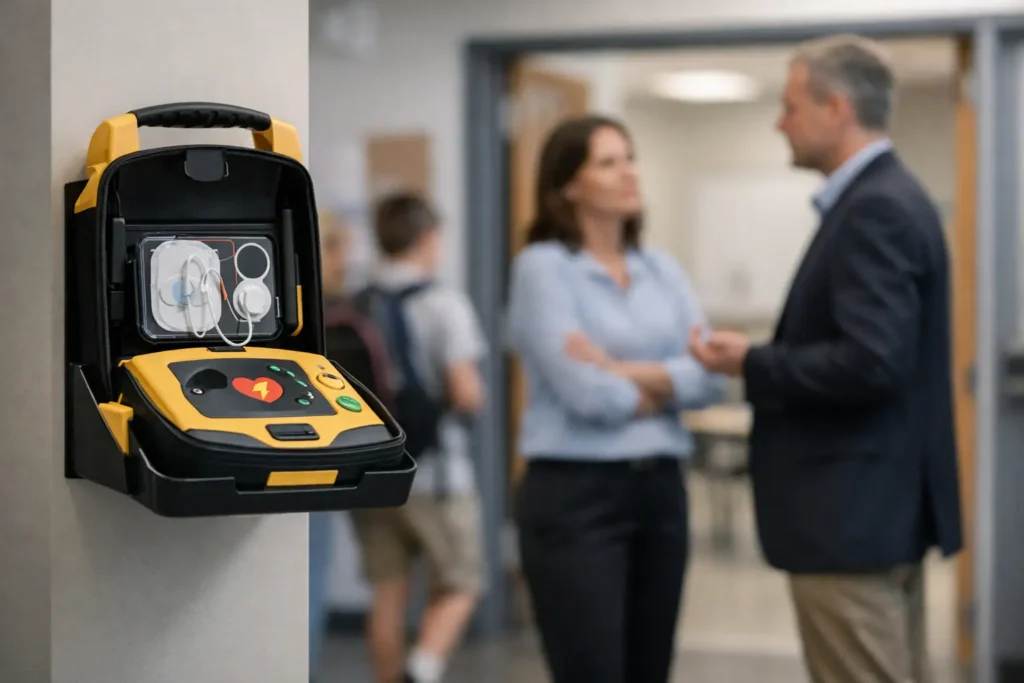
A student collapses in the gym. A staff member has chest pain during a meeting. A parent experiences sudden cardiac arrest during a school performance. In each situation, the first few minutes matter. That is why the question, are AEDs required in schools, deserves more than a quick yes or no.
The legal answer depends on the state and, in some cases, the school district. The practical answer is clearer: schools should treat an automated external defibrillator (AED) as a core part of their emergency response capability, not as a device to place on a wall and forget.
There is no single federal law requiring every U.S. school to maintain an AED. Requirements are generally set by state law, education regulations, athletic association rules, and local district policy. Some states require AEDs in public schools, while others require them only at schools with athletic programs, in certain buildings, or during school-sponsored athletic events. Private schools may be covered differently from public schools.
That variation is why administrators should avoid relying on assumptions or an outdated policy. A district may meet a state requirement on paper yet still have gaps in device placement, staff readiness, maintenance records, or emergency response planning.
For schools in Pennsylvania, Ohio, West Virginia, New Jersey, and Maryland, rules and guidance can differ by state and can change over time. School leaders should confirm the requirements that apply to their school type, activities, and facilities with their legal counsel, district leadership, or appropriate state education authority.
Compliance is the starting point, not the finish line. A school can have an AED and still be unprepared if no one can find it, the pads are expired, or staff do not know what to do while waiting for EMS.
Sudden cardiac arrest is different from a heart attack. It is an electrical problem that causes the heart to stop pumping blood effectively. Survival depends on early CPR, early defibrillation, and a fast call to 911. Every minute without defibrillation can reduce the likelihood of survival.
An AED is designed to guide a responder through the process with voice and visual prompts. It analyzes the person’s heart rhythm and delivers a shock only when appropriate. Staff do not need to diagnose the rhythm themselves, but they do need to act promptly, communicate clearly, and understand their role in the school’s response plan.
Schools serve more than enrolled students. On a typical day, a campus may include teachers, support staff, contractors, volunteers, grandparents, visitors, and coaches. Athletic events, concerts, graduations, and community gatherings can significantly increase the number of people on site. A thoughtful AED program protects the entire school community.
A single AED at the main office may not be enough for a large campus, a multi-floor building, or a school with separate athletic facilities. The goal is to make an AED quickly accessible, ideally so it can be retrieved and applied within a few minutes of a collapse.
Placement decisions should reflect how people actually move through the property. High-priority locations often include gymnasiums, athletic fields, cafeterias, auditoriums, nurse’s offices, main entrances, and areas used for large events. An exterior cabinet or event-specific plan may also be appropriate where facilities are open after regular school hours.
The right number of AEDs depends on building size, layout, population, security procedures, and response times. There is a trade-off: placing devices in locked or hard-to-reach offices may protect equipment, but it can delay access during the emergency when seconds count. Cabinets should be visible, clearly marked, and incorporated into the school’s emergency maps and drills.
Not every employee needs to carry the same level of responsibility, but schools should have enough trained responders across shifts, buildings, and activities. CPR and AED training is particularly valuable for administrators, nurses, coaches, physical education staff, security personnel, front-office staff, facilities teams, and event personnel.
Training should match the reality of a school emergency. Who calls 911? Who retrieves the AED? Who meets EMS at the entrance? Who continues CPR? Who directs students away from the scene? When these responsibilities are discussed before an emergency, staff can respond with greater confidence and less confusion.
A strong plan also accounts for staff absences, substitute coverage, after-school events, and summer programs. The person who is usually trained or assigned to retrieve the AED may not be in the building when an incident occurs.
An AED program requires ongoing attention. Pads and batteries expire. Pediatric pads may be needed depending on the age groups served. Cabinets, signage, response kits, and alarm systems should be checked. Device status indicators must be reviewed, and maintenance records should be organized.
After an AED is installed, schools should establish a documented inspection routine and assign clear ownership. This work can be handled internally, but it should never be informal. If the responsibility belongs vaguely to “the office” or “maintenance,” critical checks can be missed during staffing changes.
Program management should also include medical direction or oversight as required by applicable law, registration where required, and a post-event process for replacing used supplies and reviewing the response. These details help a school move from simply owning equipment to maintaining an operational lifesaving program.
Square One Medical helps organizations coordinate AED placement, hands-on CPR/AED training, and ongoing readiness support so the equipment and the people responsible for using it are prepared together.
A useful readiness review begins with practical questions. Can an AED reach every major area of the campus quickly? Are devices accessible during games, performances, and evening activities? Are pads and batteries within date? Does the school have trained responders available when students and visitors are present? Does every relevant staff member know how to activate 911 and direct EMS to the patient?
It is also wise to review whether the school’s emergency plan identifies AED locations, includes communication procedures, and has been practiced recently. A written plan sitting in a binder is not the same as a team that has rehearsed its response.
Whether an AED is legally required at a particular school should be verified carefully. But the larger responsibility is straightforward: when cardiac arrest occurs, a prepared school gives students, staff, families, and visitors their best chance at a rapid response when it matters most.