
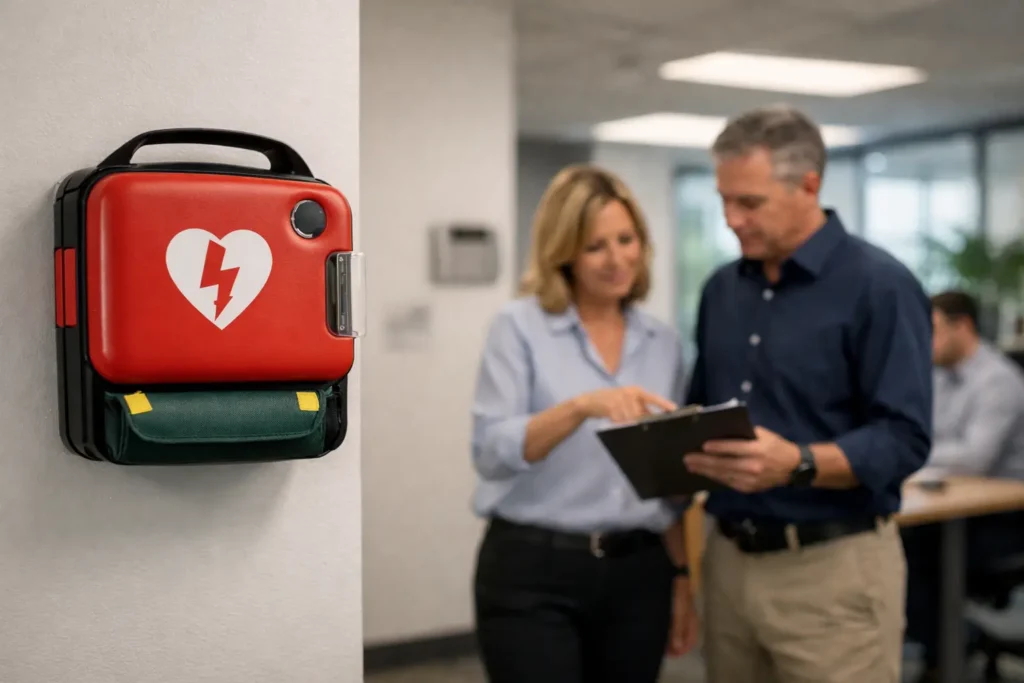
A wall-mounted AED is only useful when people can find it, trust that it will work, and know what to do next. That is the practical standard behind New Jersey AED compliance. For schools, workplaces, churches, recreation programs, and public-facing facilities, the goal is not simply to have a device on site. It is to maintain an emergency response capability that is ready during the minutes when sudden cardiac arrest is most survivable.
New Jersey requirements are not identical for every organization. Specific obligations can depend on the type of facility, who is served, the activities taking place, and applicable state or local rules. Schools, health clubs, youth athletic programs, public venues, and certain licensed or regulated operations may face requirements that differ from a typical office or house of worship.
That distinction matters. A facility manager should avoid assuming that one AED on the premises satisfies every obligation. Start by confirming which laws, regulations, licensing standards, insurance requirements, and organizational policies apply to your location. Legal counsel, the relevant licensing authority, or local emergency officials can help clarify questions unique to your operation.
Even where an AED is not specifically mandated, a documented AED program is a sensible risk-management measure for locations where employees, students, members, visitors, or patients gather. Sudden cardiac arrest can affect people of many ages and fitness levels. Preparedness gives bystanders a practical path to act before EMS arrives.
An AED should be placed based on access and travel time, not simply where wall space is available. A device locked in an administrative office, stored in a closet, or placed behind a front desk that is closed after 5 p.m. may not be reachable when it is needed.
Walk the property as if an emergency has just been reported. Consider entrances, gyms, cafeterias, worship spaces, athletic fields, production areas, public meeting rooms, and remote wings. Think about the hours each area is occupied and whether staff can access the AED without waiting for a keyholder.
Clear signage is part of effective placement. Visitors and newly hired employees should be able to identify the AED location quickly. In larger buildings or campuses, multiple devices may be appropriate. The right number depends on layout, occupancy, physical barriers, security practices, and the time it takes to retrieve a device and return to the victim.
Placement should also reflect the realities of the organization. A school may need coverage for athletic facilities and after-hours events. A church may need a plan that works on Sundays and during community programs. A manufacturing site may need devices positioned around shift schedules and restricted-access areas. There is no one-size-fits-all floor plan.
New Jersey AED compliance is supported by a program, not a single equipment purchase. Every organization should designate an AED coordinator or a small response team with clear responsibility for the program. This person does not need to be a medical professional, but they do need the authority and time to keep the program current.
A dependable program includes written procedures for activating 911, retrieving the AED, providing CPR, guiding responders to the scene, and documenting an incident afterward. It also identifies who performs routine checks, who orders replacement supplies, and who receives notices about manufacturer updates or recalls.
A written plan is especially valuable when staff changes occur. Without one, critical knowledge can leave with a departing office manager, coach, facilities lead, or safety coordinator. A simple program binder or digital record should include AED locations, serial numbers, inspection logs, training records, pad and battery expiration dates, and emergency contact information.
After an AED is used, the organization should have a process for taking it out of service if necessary, replacing pads or other used supplies, reviewing the response, and returning the unit to readiness promptly. Waiting until the next annual review is too late.
Most modern AEDs run automatic self-tests, but that does not eliminate the need for human oversight. Someone still needs to confirm that the status indicator shows the device is ready, the cabinet is accessible, the unit has not been damaged or removed, and the needed supplies are present.
Pads and batteries have expiration dates. Pediatric pads, rescue kits, gloves, razors, and barrier masks can also be missing or expired. A neglected cabinet can create a false sense of security: the device is visible, but the supplies needed for a response are not usable.
Set an inspection schedule that fits the organization and document it consistently. Monthly checks are common for many programs, though your facility’s policy or regulatory obligations may call for a different approach. The key is assigning responsibility, recording the result, correcting issues promptly, and tracking upcoming expirations before they become urgent.
AED management support can reduce the administrative burden for organizations with several sites or limited safety staff. Expiration tracking, replacement planning, equipment updates, and inspection documentation are routine tasks, but they are the tasks that keep an AED program from drifting out of readiness.
AEDs are designed to guide rescuers with voice and visual prompts, and bystanders should call 911 and act quickly in a suspected cardiac arrest. Still, hands-on CPR and AED training gives employees and volunteers the confidence to recognize an emergency, begin compressions, use the device, and coordinate with others under stress.
Training should match the people who are likely to respond. In a small office, that may be a cross-section of staff from different departments and schedules. In a school, it may include administrators, nurses, coaches, security personnel, teachers, and after-school staff. In a church, include ushers, ministry leaders, childcare teams, and facility volunteers.
Avoid relying on one trained person. That individual may be on vacation, working remotely, leading an event elsewhere, or simply too far from the emergency. Broader coverage creates a more reliable response, particularly across shifts and large campuses.
Practice the communication chain as well. Who calls 911? Who meets EMS at the entrance? Who brings the AED? Who continues CPR? A brief drill can reveal obstacles that a written policy misses, such as a locked door, unclear building address, poor signage, or an AED cabinet no one can open.
The strongest AED programs are reviewed whenever the facility changes. Renovations, a new athletic field, expanded worship space, changes in staffing, or revised operating hours can all affect response time and placement. Review the program at least annually and after any actual emergency or drill.
For organizations managing training, equipment, inspections, and consumable replacements across multiple locations, working with one preparedness partner can make follow-through easier. Square One Medical helps organizations coordinate AED placement, program management, hands-on CPR/AED training, and ongoing readiness support so safety responsibilities do not fall through the cracks.
The most useful question is not, “Do we have an AED?” It is, “Could someone use it successfully here, right now?” When the answer is supported by accessible equipment, trained responders, current supplies, documented checks, and a practiced emergency plan, your facility is better prepared to give a neighbor, colleague, student, member, or visitor a real chance at survival.