
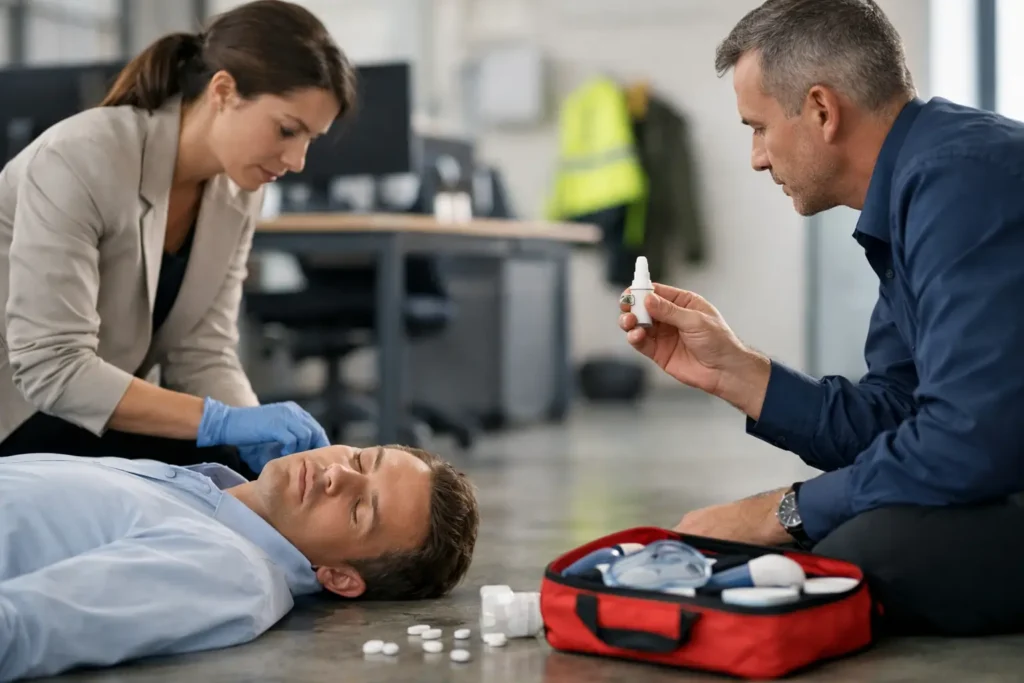
An overdose can happen in a break room, a restroom, a parking area, or during a community event. For employers and facility leaders, the first few minutes are not the time to decide who is responsible, where supplies are stored, or whether staff are allowed to act. A workplace overdose response guide gives employees a clear, practiced path from recognition to emergency care.
Opioid overdoses can affect any organization. A thoughtful plan is not an assumption about employees, visitors, students, or congregants. It is a practical safety measure, much like having an AED, trauma kit, first aid supplies, and trained responders available when an unexpected medical emergency occurs.
An overdose response plan reduces hesitation. Staff do not need to diagnose the cause of a medical emergency before calling 911 and providing appropriate aid. They need to recognize that a person is unresponsive or breathing abnormally, activate emergency services, locate naloxone, and follow their training.
The plan should fit into the emergency action procedures your organization already uses. Identify who calls 911, who meets emergency medical services at the entrance, who retrieves emergency equipment, and who communicates with a supervisor or designated incident lead. In a small office, one person may handle several of these responsibilities. In a school, manufacturing facility, church, or large campus, the roles may be shared across a response team.
Privacy matters, but it should never delay care. Employees should understand that they are responding to a medical emergency, not conducting an investigation. Documentation and follow-up can occur after EMS has taken over.
An opioid overdose may look like someone sleeping, fainting, or having a seizure. Common warning signs include an inability to wake the person, slow or stopped breathing, gurgling or snoring-like sounds, limpness, pale or clammy skin, and blue, gray, or purple lips or fingertips. Pupils may appear very small.
Not every medical emergency with these signs is an overdose. That uncertainty is exactly why staff should treat the situation seriously and call 911. Naloxone is designed to reverse opioid overdose and generally will not harm someone if opioids are not involved. Your organization should still follow its medical direction, training protocols, and local policies.
When a person is unresponsive or not breathing normally, first make sure the scene is safe. Try to get a response by speaking loudly and tapping the person. Have someone call 911 immediately and bring the naloxone kit and AED.
Give naloxone according to the product instructions and your training. Many workplace kits use a nasal spray that is administered in one nostril. If the person is not breathing normally, provide rescue breaths or CPR as trained and as directed by the 911 dispatcher. Place the person in the recovery position if they begin breathing on their own but remain unconscious.
An AED does not reverse an opioid overdose. However, prolonged lack of oxygen can lead to cardiac arrest, and an AED should be brought to any unresponsive person who is not breathing normally. Apply it as soon as possible if indicated, follow its voice prompts, and continue care until EMS arrives. This is one reason overdose preparedness works best when it is connected to a broader AED and emergency response program rather than treated as a stand-alone supply purchase.
Naloxone may wear off before the opioid does. If the person does not respond after the first dose, or symptoms return, additional doses may be needed while waiting for EMS. Continue monitoring breathing and follow dispatcher instructions. Anyone revived with naloxone still needs medical evaluation.
A locked cabinet, a kit in an administrator’s desk, or supplies kept only in a medical office can add costly minutes. Place naloxone in visible, accessible locations that align with the way people move through your facility. Common locations include near first aid supplies, security stations, main offices, break areas, athletic facilities, reception areas, and AED cabinets or nearby emergency response stations.
Placement depends on building size, public access, shift schedules, and known response times. A distribution center with multiple entrances may require several response points. A small office may need one centrally located kit. Schools and churches should consider after-hours events, gymnasiums, auditoriums, and outdoor programs where the normal office may be closed.
Clear signage helps trained employees and bystanders locate equipment quickly. Your plan should also identify who checks expiration dates, replaces used supplies, and confirms that cabinets remain stocked and accessible. This is the same operational discipline required for AED pads, batteries, trauma kits, and first aid replenishment.
A written procedure is useful, but emergency readiness depends on people knowing what to do under pressure. Include overdose response awareness in new-hire orientation, safety meetings, and periodic drills. Staff should know where naloxone and AEDs are located, how to call for help within the facility, and which responders are trained in CPR, AED use, and naloxone administration.
Training should address the realities of your workplace. For example, an operations manager may need a process for overnight shifts when fewer supervisors are present. A school administrator may need protocols that coordinate nurses, coaches, security personnel, and front-office staff. A church may need volunteers to understand procedures during services and community events.
There is a balance to strike. Not every employee needs the same level of hands-on responsibility, but every employee should know how to recognize an emergency, call 911, and get help. Designated responders should receive practical, current training and have opportunities to rehearse their roles.
Assign ownership of the overdose response plan to a specific role or team. That person should maintain the equipment inventory, schedule refresher training, review incidents, and update procedures after building changes or staffing transitions. They should also verify that the plan aligns with applicable state requirements, organizational policies, and guidance from legal counsel or medical advisors.
After any emergency, hold a brief, respectful review. Ask whether equipment was easy to find, whether 911 was called promptly, whether staff understood their roles, and whether access barriers affected the response. The goal is not to assign blame. It is to improve the system before the next emergency.
Square One Medical helps organizations connect CPR, AED, first aid, and overdose response training with the equipment and ongoing program support needed to keep readiness practical. A plan is strongest when supplies, placement, training, and maintenance all work together.
The most useful emergency program is the one employees can carry out without searching, guessing, or waiting. Put the right tools in reach, give people a simple response sequence, and make preparedness part of how your organization cares for its people every day.