
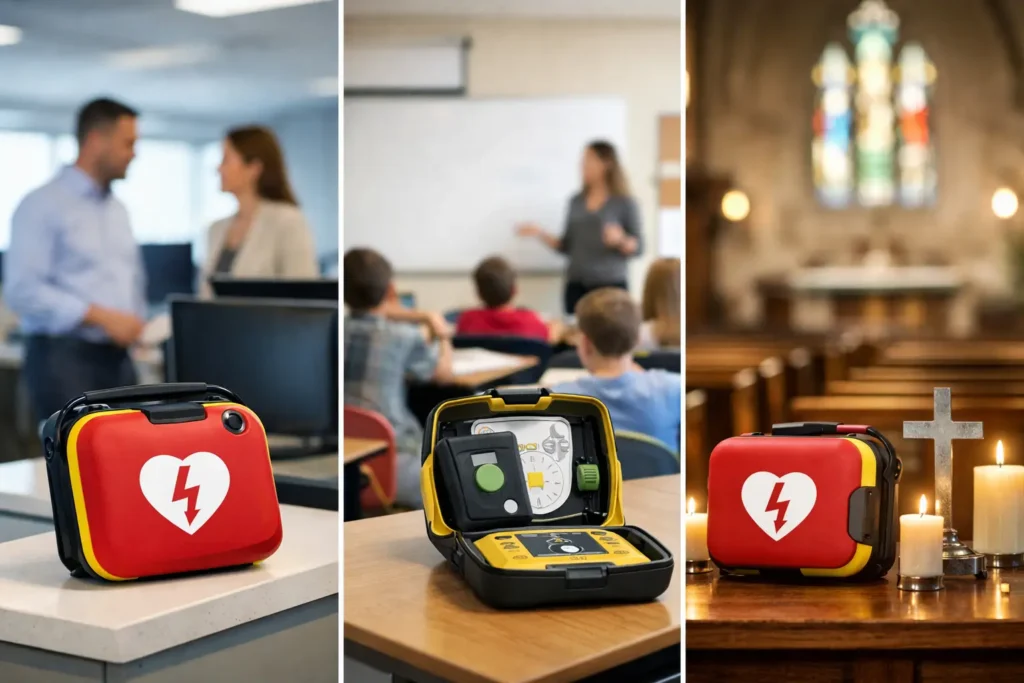
A cardiac emergency does not wait for a safety committee meeting, a school board vote, or a Sunday service to end. When someone collapses, the difference between a prepared organization and an unprepared one often comes down to whether an AED is accessible, maintained, and supported by people who know what to do.
AED laws set the baseline for how organizations place, register, maintain, and use automated external defibrillators. But legal compliance alone is not the same as emergency readiness. Requirements vary by state and facility type, so a practical AED program should account for the law, the layout of the property, the people on site, and the procedures staff will follow in a real emergency.
There is no single nationwide AED law that applies to every workplace, school, church, recreation center, or public venue in exactly the same way. States establish many of the rules governing AED programs, and local emergency medical services agencies may add registration or notification requirements.
Some states require AEDs in certain settings, such as schools, fitness facilities, dental offices, public buildings, or locations hosting organized athletic activities. Other states focus less on requiring a device and more on defining the protections and responsibilities that apply when an organization chooses to place one. A facility with locations in multiple states should not assume that one policy automatically satisfies every jurisdiction.
The details matter. State AED laws may address whether the device must be registered with local EMS, whether a medical director or physician oversight is needed, how often the unit must be inspected, where it should be located, and what training expectations apply. Good Samaritan protections may also apply differently depending on the circumstances and whether the organization has followed applicable requirements.
For this reason, organizations should treat legal guidance as the starting point for their AED program, not the finish line. Confirm current requirements with qualified legal counsel, state agencies, and local EMS authorities when developing or updating a policy.
An AED on a wall is only useful if it is ready when needed. Most laws and program standards focus on readiness because an AED can be unavailable at the worst possible moment if pads have expired, a battery is depleted, or the cabinet is blocked by furniture, boxes, or a locked door.
A dependable AED management process includes routine visual checks, documented inspections, replacement of pads and batteries before expiration, and confirmation that the unit’s status indicator shows it is ready. It should also include a clear plan for what happens after an AED is used. The device may need to be returned to service, its data reviewed as appropriate, and its supplies replaced quickly.
This is one reason periodic expiration tracking matters. AED consumables do not last forever, even when the device is never used. Assigning responsibility to a single employee without a backup can create a gap when that person changes roles, takes leave, or leaves the organization. A shared schedule and documented inspection process create more reliable accountability.
Many organizations begin by asking how many AEDs they need. A better first question is: how long would it take someone to retrieve an AED, return to the person in cardiac arrest, and apply it?
The answer depends on the facility. A compact office may need a different placement strategy than a large manufacturing floor, school campus, multi-building church property, police department, warehouse, or sports complex. Stairs, secured entrances, elevators, long hallways, outdoor fields, and access restrictions can all add critical time.
AED placement should account for areas with high occupancy, higher-risk activities, limited access, and long travel distances. In a school, that may include gymnasiums, athletic fields, cafeterias, and main activity areas. In a church, it may mean considering worship spaces, fellowship halls, classrooms, and recreation facilities. In a workplace, it may mean serving both office staff and employees working on large production or distribution floors.
Visibility matters as much as location. AEDs should be clearly marked, easy to reach during operating hours, and protected from damage or unauthorized removal without creating unnecessary barriers to access. A cabinet alarm can help alert nearby staff when the AED is removed, but the cabinet should not slow down a responder who needs the device immediately.
Many modern AEDs provide voice and visual prompts designed to guide a lay responder. That does not mean training is optional from a preparedness standpoint. CPR and AED training gives staff the confidence to recognize cardiac arrest, call 911, begin high-quality CPR, retrieve the AED, and work together until EMS arrives.
Training also clarifies responsibilities that are easy to overlook. Who calls 911? Who meets responding EMS personnel at the entrance? Who retrieves the AED? Who stays with students, coworkers, or visitors nearby? In a high-stress event, these roles should not be figured out for the first time.
The right training schedule depends on your organization, staff turnover, occupancy, and state-specific requirements. Schools, youth programs, athletic organizations, and sites with large public gatherings may need a broader response team than a small office. Organizations with shift work should make sure trained personnel are available across operating hours rather than only during a single daytime shift.
A written cardiac emergency response plan turns equipment and training into an organized response. It does not need to be overly complicated, but it should be specific to the facility and understood by the people most likely to respond.
A useful plan identifies AED locations, names the staff or teams responsible for inspections, explains how to call 911, and outlines how responders will direct EMS to the scene. It should include a process for documenting AED checks and replacing supplies after use or expiration. Organizations should also decide how they will communicate an emergency internally, especially in larger buildings or campuses.
Practice is valuable. A brief tabletop discussion or on-site drill can expose issues that are invisible on paper: an AED cabinet that is hard to see, a locked exterior door, unclear radio procedures, or staff who do not know the building address they need to give dispatchers. The goal is not to create anxiety. It is to make the first minutes of a real emergency more coordinated.
Organizations often have good intentions but incomplete systems. Four gaps appear repeatedly:
These gaps are manageable when they are identified early. AED program management creates a repeatable way to track equipment, prepare responders, document readiness, and make changes as the organization evolves.
AED laws are intended to support a fast, effective response to sudden cardiac arrest. Meeting applicable requirements is essential, but the most prepared organizations go further by making readiness visible and operational. They know where their AEDs are, who maintains them, which staff members are trained, and how EMS will reach the person who needs help.
Square One Medical helps organizations bring training, AED placement, equipment support, and ongoing management into one practical preparedness program. The most meaningful next step is simple: walk your facility as if an emergency were happening now, and identify what would help your team respond faster and with greater confidence.