
A staff member collapses in a school hallway, church lobby, or production area. Someone calls 911, another begins CPR, and a third person retrieves the AED. In that moment, the value of BLS training is not a certificate on file. It is whether your team can recognize cardiac arrest, work together, and use the AED without losing critical time.
So, does BLS include AED training? In most recognized Basic Life Support courses, yes. BLS training typically includes hands-on instruction in using an automated external defibrillator, or AED, along with high-quality CPR and choking response. However, organizations should understand exactly what their selected course covers and how training fits into a broader AED readiness program.
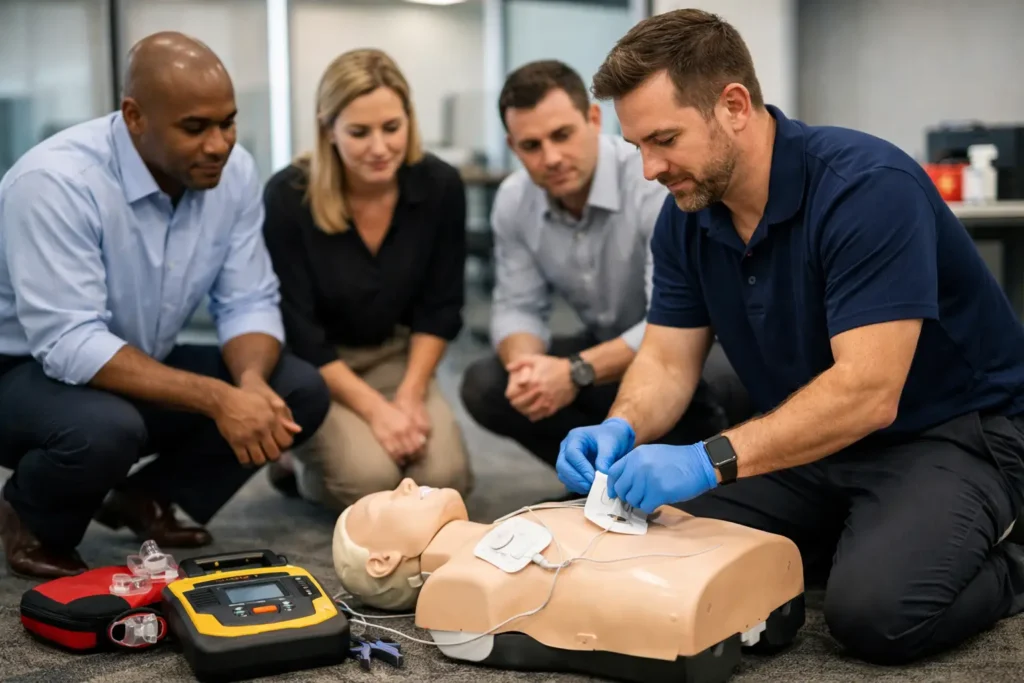
BLS is designed for healthcare professionals and trained responders who may need to act as part of a coordinated emergency response. Standard BLS courses commonly teach adult, child, and infant CPR, use of an AED, relief of choking, rescue breathing, and team dynamics. Participants generally practice applying AED pads, following the device’s voice prompts, clearing the patient for rhythm analysis, and safely delivering a shock when advised.
The exact curriculum can vary by training provider, course format, and credentialing organization. A healthcare-focused BLS course may place greater emphasis on multi-rescuer scenarios, bag-mask ventilation, and team roles. A CPR/AED course intended for workplace staff or community responders may cover similar AED fundamentals while using scenarios more relevant to offices, schools, churches, or public facilities.
For that reason, do not assume every class labeled “CPR” includes the same level of AED instruction. Before scheduling training, confirm that the course includes hands-on AED practice, not simply a brief discussion of what an AED does.
AEDs are built to guide rescuers through the response, but familiarity matters. During a quality BLS course, learners should have an opportunity to handle a training AED and perform the steps in sequence. This helps reduce hesitation when a real emergency occurs.
Participants learn to first confirm the scene is safe, assess the person, activate emergency response, and start CPR. They then turn on the AED as soon as it arrives, expose and prepare the chest, apply the pads in the correct positions, and follow the prompts. The device analyzes the heart rhythm and tells rescuers whether a shock is advised. Rescuers must make sure no one is touching the person during analysis and shock delivery, then immediately resume CPR.
That process sounds straightforward, and the technology is intentionally user-friendly. Still, a real event can be stressful and chaotic. Hands-on repetition teaches people how to divide tasks, communicate clearly, and avoid delays such as searching for scissors, struggling with pad placement, or waiting too long to resume compressions.
Training devices allow students to practice without delivering a shock. The AED mounted in your facility is a live medical device intended for an actual sudden cardiac arrest. Staff should understand where it is located, who is expected to retrieve it, and how to access it quickly.
A BLS class builds response skills, but it cannot by itself confirm that your organization’s AED is visible, accessible, properly maintained, and ready for use. Those responsibilities belong to the facility’s AED program.
An AED program turns a device on the wall into an operational emergency resource. For schools, workplaces, churches, police departments, and other public-serving organizations, that means planning for the entire response – not just the first training day.
Start with AED placement. A device should be reachable quickly from areas where employees, visitors, students, or congregants gather. Large campuses, multi-floor buildings, athletic spaces, remote work areas, and high-traffic public locations may need more than one unit. Placement decisions should account for walking time, building access, security procedures, and who may be present after regular hours.
Maintenance is equally essential. AED pads and batteries expire, and some devices require regular readiness checks or software updates. A cabinet may need alarms, signage, or climate considerations depending on the environment. When an emergency occurs, there is no room for uncertainty about whether the device is functional.
Organizations also benefit from establishing a response plan. Identify who calls 911, who retrieves the AED, who begins CPR, and how staff will direct emergency medical services to the patient. The best plans allow anyone nearby to act while giving trained team members a clear structure to follow.
BLS is often the appropriate choice for clinical staff, healthcare personnel, professional responders, and teams with employer or regulatory requirements for BLS certification. For other employees, a CPR/AED and first aid course may better match their duties and likely emergency roles.
The right option depends on your workplace, participant responsibilities, and any requirements set by your industry, licensing body, school district, or insurer. A manufacturing facility may need a broad group of trained responders across shifts. A church may focus on greeters, children’s ministry volunteers, and security teams. A school may train nurses, coaches, administrators, and staff who supervise athletics or large student groups.
In every setting, practical instruction matters. Look for a course that gives participants adequate time to practice CPR and AED use, ask questions, and work through realistic scenarios. Online education can be helpful for knowledge review, but organizations should carefully evaluate whether a blended or fully in-person option is needed to meet their certification and hands-on training goals.
Certification periods can create a false sense that preparedness is handled for years at a time. Skills fade, staff changes, and facilities evolve. A short internal review can keep the response plan usable.
Consider conducting periodic drills that focus on locating the AED, assigning roles, and calling for help. These drills do not need to be complicated. A five-minute walk-through can reveal that a cabinet is blocked by furniture, a new employee does not know the AED location, or a key holder is unavailable during evening events.
It is also helpful to designate an AED program coordinator. This person can track pad and battery expirations, maintain training records, coordinate replacements, and make sure AED locations remain clearly marked. For organizations with multiple sites or many devices, ongoing AED management support can reduce the administrative burden and help prevent missed maintenance deadlines.
BLS usually includes AED training, and it gives responders the skills to use the device during a cardiac emergency. But an AED program is what ensures the right equipment is present, maintained, easy to find, and supported by a team that knows its role.
Square One Medical helps organizations connect those pieces through hands-on training, AED placement guidance, and ongoing equipment support. The most useful next step is simple: walk your facility as if an emergency had just been reported, then ask whether your people can reach a ready AED and begin care without delay.