
Now for a limited time, trade in your old AED for a generous rebate toward a new unit!
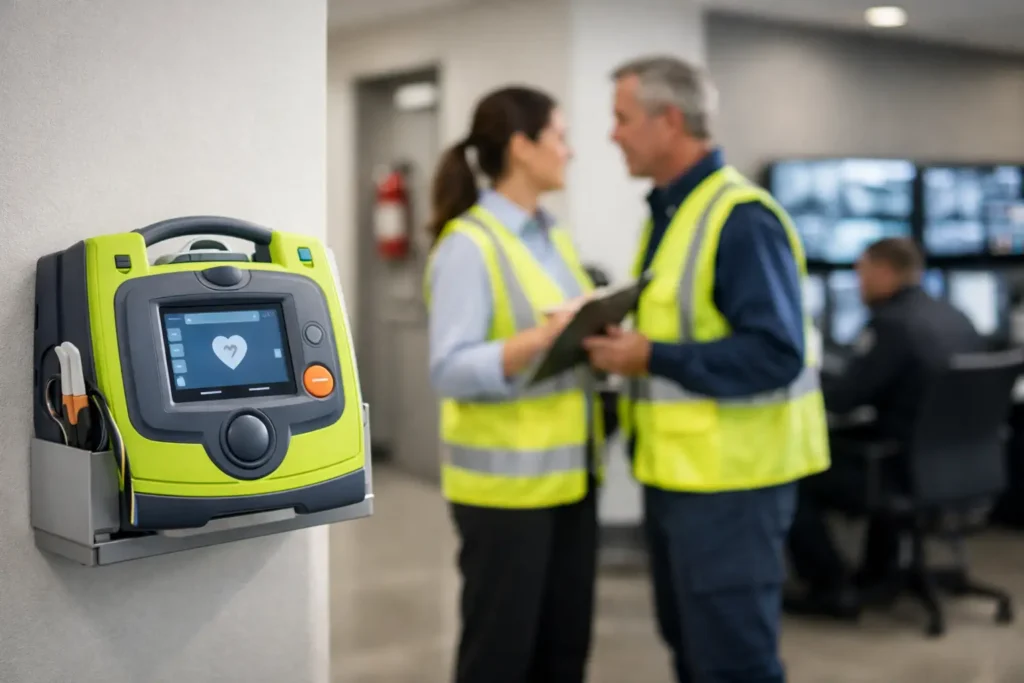
A ZOLL AED program review should look beyond the device mounted on the wall. For an organization, an AED is only ready when people can find it quickly, responders know what to do, pads and batteries are current, and someone is accountable for checking the program. ZOLL’s AED ecosystem is designed to support that larger responsibility, making it a strong fit for workplaces, schools, churches, and public-facing facilities that need a practical, manageable response plan.
A complete AED program combines equipment, placement, training, maintenance, documentation, and response planning. The AED is central, but it is not the entire solution. A facility can have a high-quality device and still be unprepared if the unit is difficult to access, staff do not know its location, or replacement supplies expire unnoticed.
ZOLL AEDs are widely recognized for features intended to guide rescuers during a stressful event. Models such as the ZOLL AED Plus and ZOLL AED 3 use clear visual and audio prompts to lead a responder through the process. Certain ZOLL devices provide real-time CPR feedback, helping rescuers adjust the depth and rate of compressions. That guidance can be especially valuable in an office, school, church, or recreation setting where the first person to respond may not be a medical professional.
For program administrators, the more significant consideration is how the device fits into day-to-day readiness. A dependable AED program establishes who inspects each unit, where records are kept, how expiring components are replaced, and how new employees or volunteers are trained.
The strongest feature of a ZOLL-centered program is its emphasis on responder support. During sudden cardiac arrest, people often hesitate because they are afraid of doing something wrong. An AED that speaks clearly, illustrates the steps, and provides CPR coaching can help reduce that hesitation. The device analyzes the heart rhythm and will only advise a shock when appropriate, so users should follow the prompts and begin CPR without waiting for a medical expert to arrive.
Another advantage is consistency across an organization. A school district, manufacturing company, or multi-site church can standardize device placement, inspection practices, signage, staff training, and replacement schedules. This creates a more repeatable process than leaving each site to manage emergency equipment independently.
ZOLL equipment can also support facilities that want a visible, approachable AED solution. The AED Plus, for example, is known for its prominent rescue graphics and CPR-D-padz, which include a visual hand-placement guide. That design may make sense for environments with many lay responders. The AED 3 offers a different feature set and may be appropriate for organizations that prioritize connectivity and streamlined device status monitoring. The best choice depends on the facility, the anticipated responder group, and the organization’s management process.
An AED requires ongoing attention. Pads have expiration dates, batteries need replacement on a defined schedule, and the device must remain accessible and protected. After an emergency, the unit needs to be reviewed, restocked, and returned to service promptly. These are manageable tasks, but they can fall through the cracks when they are assigned informally.
A formal AED management process gives each task an owner. It should include a documented inspection schedule, a central record of serial numbers and expiration dates, and a clear method for reporting an issue. Facilities should also inspect the cabinet, wall signage, and pathway to the AED. A device that is blocked by furniture, behind a locked door, or hidden from visitors is not properly placed.
For larger organizations or locations with several devices, connected management tools can reduce manual follow-up. However, technology is not a substitute for a local readiness plan. Staff still need to know where AEDs are located, who calls 911, who begins CPR, and who meets emergency responders at the entrance.
AED placement is not simply a matter of putting one unit in the main office. The goal is to get an AED to a person in cardiac arrest as quickly as possible. Organizations should consider building size, floor layout, population density, stairs, access after hours, and high-risk areas such as fitness centers, athletic fields, cafeterias, workshops, and security stations.
Schools may need coverage near gyms, auditoriums, nurse offices, and outdoor activity areas. Manufacturers may need units near production floors, break rooms, and shift entrances. Churches should consider worship spaces, fellowship halls, classrooms, and event areas. Police departments and public safety agencies may require placement that supports both station personnel and public access.
A site assessment can reveal coverage gaps that are easy to miss on a floor plan. It also helps an organization decide whether cabinets, alarms, signage, trauma supplies, or overdose response equipment should be incorporated into the broader emergency preparedness plan.
An AED is designed to be used by a lay responder, but training builds confidence and improves coordination. CPR and AED training gives staff practice recognizing sudden cardiac arrest, activating emergency response, starting high-quality compressions, applying pads, and following the device prompts. It also creates an opportunity to rehearse location-specific questions: Which entrance should EMS use? Who retrieves the AED? Who communicates with family members or visitors?
Training should not be treated as a one-time event. Employee turnover, changing facility layouts, and new AED placements all affect readiness. Organizations benefit from maintaining a reasonable number of trained responders across shifts, departments, and locations while ensuring all staff know the basic emergency procedure.
Square One Medical helps organizations pair ZOLL AED placement with hands-on CPR/AED training and ongoing program support. Keeping equipment, education, and expiration tracking coordinated through one preparedness partner can reduce administrative burden for safety coordinators and facility leaders.
No AED program is effective solely because of a brand name. ZOLL may be an excellent choice for organizations that value strong lay-responder guidance and structured program support, but leaders should still evaluate their specific environment. A small office with one accessible floor has different needs than a campus with multiple buildings, public events, and weekend activity.
Budget matters as well, but the initial device cost is only one part of the decision. A realistic plan accounts for cabinets, signage, replacement pads and batteries, staff training, inspections, and post-use replenishment. Selecting equipment without planning for those recurring responsibilities can create avoidable readiness gaps later.
It is also wise to confirm organizational policies, local requirements, and medical direction expectations that may apply to your facility. Schools, healthcare-adjacent environments, athletic programs, and public agencies may have additional procedures to follow.
The best measure of an AED program is simple: if someone collapses tomorrow, can your team respond without losing time? The answer should include a visible and accessible AED, trained people nearby, current supplies, a practiced call-for-help process, and documented oversight.
A ZOLL AED program can provide a capable foundation for that standard, particularly when device selection, placement, training, and maintenance are planned together. Emergency readiness is not about expecting the worst. It is about giving your people a clear, confident path to act when every minute matters.