
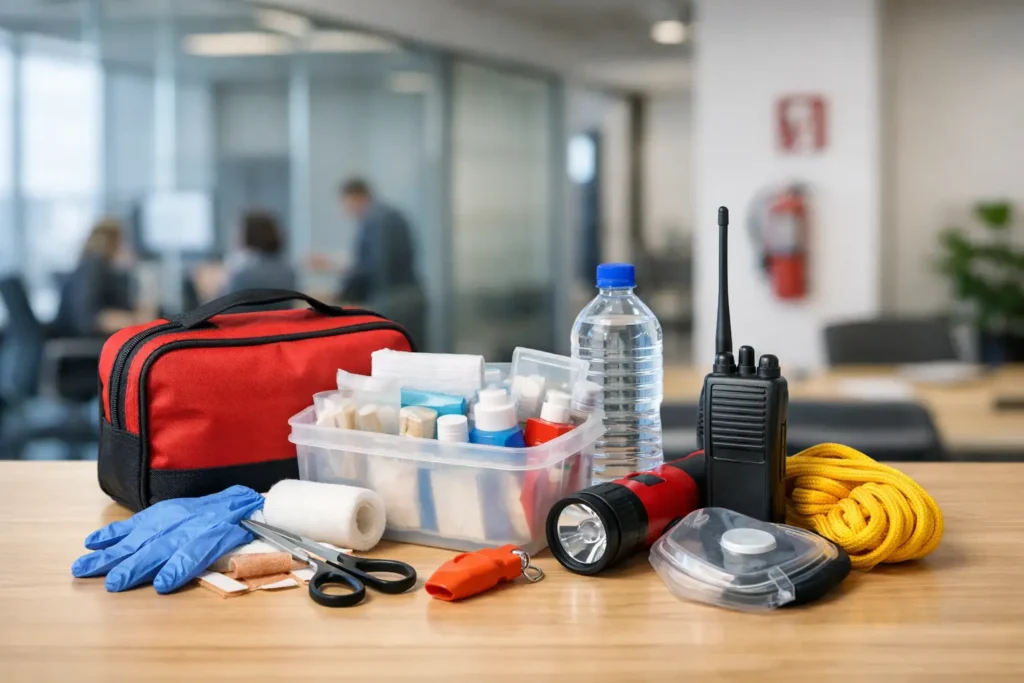
A medical emergency at work rarely looks dramatic at first. It might be a collapsed employee in a break room, a visitor with chest pain in the lobby, or a serious bleeding injury near a loading area. In those first minutes, office emergency response supplies are not just items on a checklist. They are the difference between waiting helplessly and responding with purpose.
For most organizations, the challenge is not whether to prepare. It is deciding what belongs on site, where it should go, and how to keep it ready without creating a complicated system no one maintains.
The right setup depends on your workplace, but some categories matter in almost every office. An AED should be near the top of the list. Sudden cardiac arrest can happen in any workplace, not only in industrial settings or fitness facilities, and early defibrillation is one of the most time-sensitive interventions a team can provide.
Alongside an AED, a well-planned office response program often includes a first aid kit, bleeding control supplies, personal protective equipment, and clearly marked storage or cabinets so responders are not wasting time searching. In a larger building, one kit at reception may not be enough. If staff are spread across floors or departments, placement becomes just as important as product selection.
That is where many offices get stuck. They buy a few supplies, store them in a closet, and assume they are prepared. In practice, hidden equipment is almost the same as unavailable equipment.
An AED is often the most important device in an office emergency response supplies plan because cardiac emergencies do not wait for EMS to arrive. If your building has employees, clients, contractors, or visitors coming through regularly, AED placement deserves serious attention.
The key is to think beyond having one unit somewhere in the building. You need a realistic response time. If the AED is locked in an administrative office, tucked inside a nurse station that is not always staffed, or placed so far from common areas that retrieval takes several minutes, that placement may not support an effective response.
Training matters just as much. A workplace is better positioned when staff know how to recognize sudden cardiac arrest, start CPR, retrieve the AED, and work together under pressure. Equipment without training creates hesitation. Training without equipment limits what your team can do.
For organizations building a stronger preparedness program, AED management also deserves attention. Pads and batteries expire. Readiness indicators need to be checked. After-use support and replacement planning should be simple and documented. This is why many workplaces benefit from working with one partner that can support training, placement guidance, and ongoing program management rather than treating the AED as a one-time purchase.
Not every office has the same risk profile. A corporate suite with mostly desk-based employees has different needs than a school administrative building, a church office, or a manufacturing front office connected to an active floor. That is why a generic cabinet approach can miss important gaps.
If your team hosts the public, consider front-of-house response. If you have employees who drive, lift, handle tools, or move between office and warehouse spaces, trauma supplies may need greater emphasis. If your building serves older adults, large groups, or community programs, AED visibility and response planning become even more important.
There is also a practical balance to strike. More supplies are not always better if staff are not trained to use them or if the cabinet becomes cluttered with items no one can identify quickly. The best workplace setups are organized, clearly labeled, and tied to a response plan your staff can actually follow.
One of the most common mistakes with office emergency response supplies is storing everything in a single location because it feels easier to manage. That may work in a small office with a compact layout. It often fails in larger facilities.
Supplies should be placed where emergencies are most likely to happen and where responders can reach them quickly. Reception areas, break rooms, fitness spaces, warehouse transitions, and multi-floor access points are all worth evaluating. Visibility matters too. In an emergency, people do not perform a scavenger hunt well.
A wall cabinet for an AED, paired with nearby response supplies and clear signage, often creates a much stronger setup than a general first aid bin stored under a sink. The goal is not only compliance. It is speed and confidence.
Preparedness programs often weaken after the initial setup. Someone orders the equipment, stores it, and then months or years pass. By the time it is needed, pads are expired, gloves are missing, or the team is unsure who is responsible for checks.
A reliable program assigns ownership. That might be an HR lead, safety coordinator, facilities manager, school administrator, or church operations leader. What matters is that someone is tracking inspection dates, replacing consumables, documenting AED readiness, and scheduling training refreshers.
This is also where a managed approach can save time. Instead of relying on memory or scattered spreadsheets, organizations benefit from a system that supports expiration tracking, replacement reminders, and updates as guidelines or equipment needs change. For busy offices, that operational support is often what turns emergency planning from a one-time task into a dependable program.
Emergency supplies are only as strong as the people expected to use them. That does not mean every employee needs advanced medical training. It does mean key staff should know where equipment is located, what situations it is intended for, and how to activate emergency response quickly.
Confidence grows when training is practical and connected to the actual workplace. Staff should understand who calls 911, who retrieves the AED, who meets responders, and what to do if the emergency happens in a conference room, parking lot, or stairwell instead of an obvious public area.
Organizations often find that preparedness improves when training and equipment planning happen together. Square One Medical supports that kind of integrated approach, helping workplaces not only place AEDs and response supplies appropriately, but also build the training and management structure that keeps them ready.
The best office emergency response supplies plan is not the biggest cabinet or the longest product list. It is a system that fits your building, your people, and your risks. It includes an AED where it can make a difference, supporting supplies that reflect real workplace needs, and a maintenance process that keeps everything ready.
If your current setup depends on good luck, vague responsibility, or equipment no one has checked in months, that is your starting point. A stronger response program does not need to be complicated. It needs to be clear, accessible, and ready when someone’s worst day happens at work.