
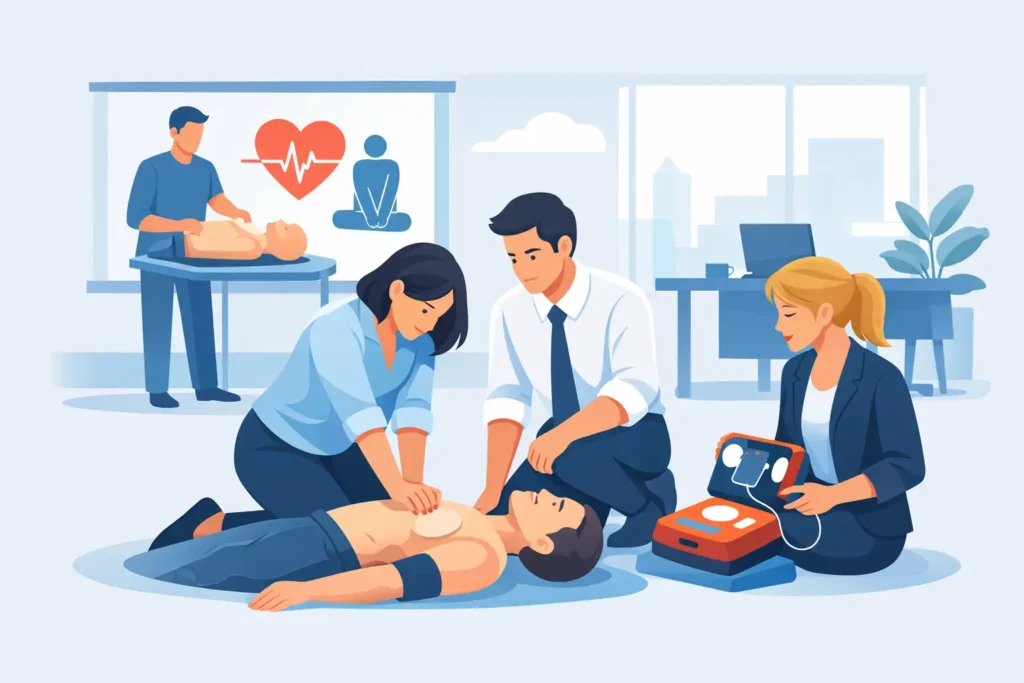
A medical emergency in an office rarely looks dramatic at first. Someone collapses in a break room. A coworker says they feel dizzy and then stops responding. In those first few minutes, CPR training for office staff can make the difference between waiting for help and actually helping.
For office managers, HR leaders, and safety coordinators, the question is not whether an emergency could happen at work. It is whether your team would know what to do before EMS arrives. Offices may seem lower risk than warehouses or construction sites, but cardiac arrest, choking, falls, and sudden medical events happen in every type of workplace. A prepared office is not one with a binder on a shelf. It is one with trained people, accessible equipment, and a simple response plan.
Cardiac arrest can happen without warning, even in workplaces that do not involve physical labor. Age, underlying health conditions, stress, and routine daily activity can all be factors. The challenge in an office setting is that people often assume someone else will step in. That delay is costly.
CPR keeps blood flowing to the brain and vital organs until advanced care arrives. When an AED is available and used quickly, the chances of survival can improve significantly. That is why CPR and AED training should be treated as part of workplace readiness, not as a box to check for compliance.
There is also a practical business case. Training reduces confusion, supports duty of care, and helps staff feel more confident in an emergency. For employers, that can mean a stronger safety culture and a clearer response process when seconds matter.
Not every course is the right fit for every workplace. Some offices need formal certification for designated responders. Others need broader awareness training across departments. The right program depends on your headcount, layout, public access, and whether you already have emergency equipment onsite.
At minimum, office staff should know how to recognize cardiac arrest, call 911, start high-quality CPR, and use an AED. They should also understand how to respond to choking and how to coordinate until professional responders take over. If your office serves visitors, clients, or the public, broader first aid training may be worth adding.
Hands-on practice matters. Staff need to physically rehearse chest compressions, pad placement, and the sequence of actions during a real event. Video-only instruction may help with awareness, but it usually does not build the same confidence under pressure.
It is common for companies to schedule CPR training but overlook AED placement. That creates a gap in the response plan. CPR helps keep oxygenated blood moving, but an AED is often the tool that can restore a survivable heart rhythm during sudden cardiac arrest.
For most offices, the better approach is to treat training and equipment as one program. If you already have an AED, staff should train with that reality in mind. They need to know where it is, who can access it, and what the device will prompt them to do. If you do not have one yet, training often makes the case obvious. Teams quickly see that recognizing an emergency is only part of the equation. Fast access to the right equipment matters just as much.
AED placement in workplaces should be based on response time, building size, and where people gather. A small office with one central common area may only need one device. A larger floorplan, multi-story building, or campus-style office may need more than one. The goal is simple: an AED should be reachable and usable without delay.
Training works best when it fits into a larger emergency preparedness process. That does not mean creating a complex manual no one reads. It means deciding a few critical details in advance.
Start with roles. Who calls 911? Who retrieves the AED? Who meets first responders at the entrance? In a smaller office, one person may handle more than one task. In a larger workplace, it makes sense to assign backup responders for each shift or department.
Next, make the equipment visible. AEDs should be easy to locate, clearly marked, and not locked away in a manager’s office. The same goes for first aid supplies and trauma kits if your workplace keeps them onsite.
Then look at maintenance. An AED program is not finished after the cabinet goes on the wall. Pads and batteries expire. Status checks need to happen. After any use, supplies must be replaced promptly. This is where AED program management becomes valuable. Many organizations do not struggle with buying an AED. They struggle with keeping it ready year after year.
One of the biggest mistakes is assuming CPR certification for a few employees is enough. It helps, but coverage can be thin if those employees are out sick, traveling, or in another part of the building when an emergency happens. A wider base of trained staff usually creates a stronger response.
Another mistake is treating AED ownership as a one-time purchase. An AED without current pads, battery support, or a documented management process can create false confidence. The device needs to be ready every day, not just present.
Offices also tend to underestimate retraining. Skills fade. Even confident employees benefit from refreshers and scenario-based practice. If your team trained several years ago and has not reviewed the process since, that is a sign the program needs attention.
For office environments, convenience affects follow-through. If training is hard to schedule, it gets postponed. Onsite CPR and AED training is often the most practical option because it reduces travel time and lets employees train in the setting where they would actually respond. That can also make AED placement discussions more concrete.
Some organizations prefer certification courses for safety teams and awareness sessions for the rest of the staff. That can be a smart balance. It keeps a designated group fully trained while still giving the larger office a basic understanding of what to do.
If your company has multiple locations, it helps to standardize as much as possible. Use similar emergency signage, similar AED models where practical, and a consistent maintenance process across sites. That reduces confusion and makes refresher training easier to manage.
Many workplaces end up splitting training, AED purchasing, replacement supplies, and compliance support across different vendors. That usually creates delays and missed details. A single partner that can train your staff, help with AED selection and placement, and support ongoing AED management makes the program easier to sustain.
That is especially useful for office leaders who are already balancing HR, operations, and facility responsibilities. Instead of chasing expiration dates or wondering whether your equipment setup still makes sense, you have a clearer path to keeping everything current.
Square One Medical works with organizations that need that kind of practical support, from CPR and AED training to equipment placement and ongoing program management.
CPR training for office staff is not about turning employees into medical professionals. It is about giving ordinary people the skills and confidence to act in the few minutes that matter most. When training, AED access, and a simple response plan work together, your office becomes much better prepared to protect employees, visitors, and your wider community.