
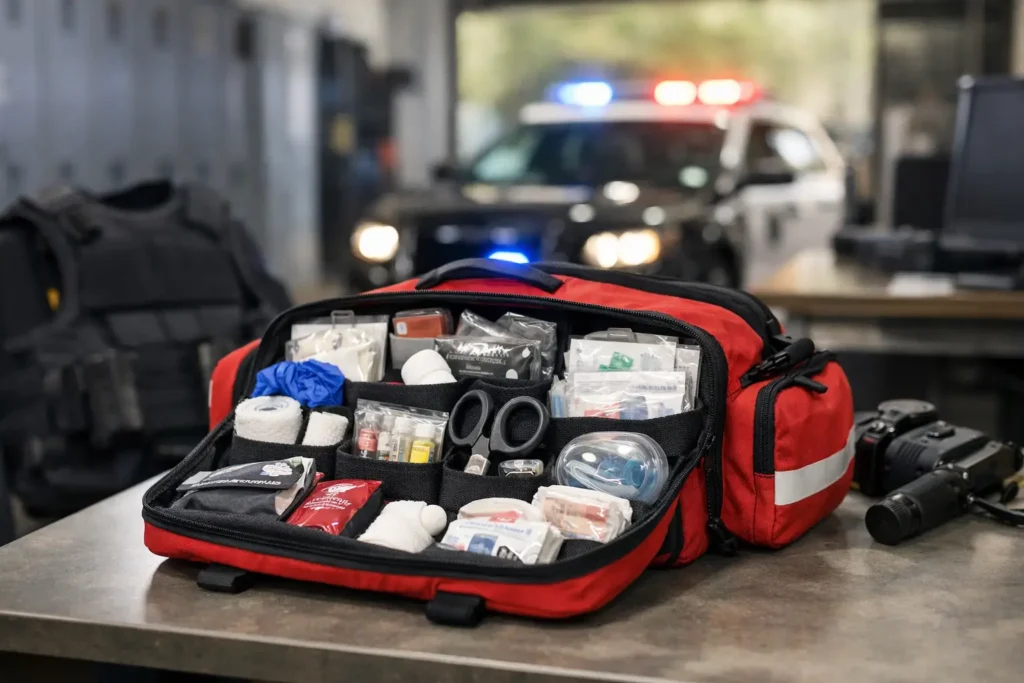
A trauma bag that looks full can still fail an officer in the first 60 seconds of care. That usually happens when supplies were packed for general first aid instead of high-risk field response. If you are deciding how to stock police trauma bags, the goal is not quantity. It is speed, access, and equipment that matches the injuries officers are most likely to face before EMS takes over.
A police trauma bag is not the same as a school first aid kit or a workplace cabinet. Law enforcement officers may need to control catastrophic bleeding, protect an airway, manage chest trauma, and maintain personal safety in unstable scenes. The bag has to support treatment in tight spaces, low light, bad weather, and moving environments.
That reality changes what belongs inside. A well-stocked bag should focus first on lifesaving interventions for the preventable causes of trauma death, especially severe hemorrhage and airway compromise. It also needs to support handoff to EMS without wasting time searching for basic items.
Start with the injuries officers are most likely to encounter. Penetrating trauma, major extremity bleeding, head injuries, chest wounds, and medical emergencies during custody or public response should shape the bag. From there, build around categories rather than random products.
The core of any police trauma bag is hemorrhage control. Tourniquets should be immediately accessible, not buried in packaging at the bottom of the bag. Most agencies are better served by carrying more than one, since one patient may need multiple tourniquets or an officer may be first on scene at a multi-patient incident.
Hemostatic gauze and compressed gauze matter for wound packing, especially for junctional injuries where a tourniquet will not work. Pressure bandages help secure packed wounds and maintain control during transport. Trauma shears should be durable enough to cut through uniforms, outerwear, and gear quickly.
This is one area where overpacking can help, within reason. Bleeding supplies get used fast, and they are often the first items to run low after training if replenishment is not tightly managed.
Airway tools are only valuable if officers are trained to use them under stress. Many departments include nasopharyngeal airways, lubricant, and a pocket mask or bag-valve mask depending on protocol and level of training. Chest seals are a high-priority item for penetrating trauma, and carrying vented options can simplify treatment for open chest wounds.
Gloves and barrier devices should be easy to reach without unpacking half the bag. If your team includes personnel trained beyond basic first aid, the bag may also need additional airway adjuncts. If not, keep the focus on simple, effective tools that officers can use confidently.
Police scenes can involve bloodborne pathogens, broken glass, drug exposure concerns, and environmental hazards. Nitrile gloves should be stocked in enough quantity to support multiple responders and multiple patient contacts. Eye protection, masks, and disposable gowns may be appropriate depending on your agency’s risk profile.
This category is often understocked because it does not feel as urgent as hemorrhage control. In practice, it is essential. If officers are not protected, care slows down and scene risk increases.
Although the name says trauma bag, officers are often first to patients with cardiac arrest, overdose, seizure activity, or respiratory distress. That does not mean turning the bag into a full ambulance jump kit. It does mean recognizing that field response is broader than gunshot wounds and severe bleeding.
A compact resuscitation mask, basic monitoring tools if permitted by protocol, and clear space for overdose response supplies may be appropriate. In many organizations, police response planning should also account for AED access. The AED does not usually live inside the trauma bag, but the two should be treated as part of the same readiness system. If officers are expected to respond to public medical emergencies, trauma supplies and AED program management should work together, including training, pad and battery replacement, and expiration tracking.
Knowing how to stock police trauma bags is also about how items are organized. The best setup reduces decision-making under pressure. High-priority bleeding control items should be placed where they can be reached immediately. Airway and chest trauma supplies should be grouped together. PPE should be accessible before patient contact, not after.
Clear labeling helps, especially for shared bags used across shifts. Color-coded pouches or internal sections can speed access and make restocking easier. If a bag has too many compartments, officers may waste time searching. If it has too few, supplies become a pile. The right layout depends on your deployment model, but simplicity usually wins.
One common mistake is allowing every cruiser, supervisor unit, or specialty team to build its own version of a trauma bag. That creates confusion during mutual aid and shift changes. Standardization improves training, restocking, and field performance because officers know where critical supplies are no matter which bag they grab.
That does not mean every unit must be identical in every detail. Tactical teams may need a different loadout than patrol. A school resource officer may face a different response profile than a K-9 unit. Still, the essential lifesaving contents should stay consistent across the agency whenever possible.
A trauma bag is only as reliable as the inspection process behind it. Supplies expire, packaging tears, tourniquets disappear during training, and batteries in supporting devices get missed. A smart stocking plan includes a documented check schedule, assigned responsibility, and a replenishment method that does not depend on someone remembering after a long shift.
This is where many agencies benefit from working with a single preparedness partner that can support both training and equipment management. The right process makes it easier to keep trauma supplies ready, align equipment with officer training, and coordinate related programs such as AED readiness across vehicles, facilities, and public-facing spaces.
There is no perfect universal list because policy, scope of practice, call volume, geography, and transport times all matter. A rural department with longer EMS arrival times may need a deeper inventory than an urban agency with rapid advanced care response. A department that trains heavily in tactical emergency casualty care may carry more advanced tools than one focused on basic officer first aid.
The practical test is simple. Can an officer use the bag to address massive bleeding, support airway and breathing, protect themselves with PPE, and manage the first critical minutes until EMS arrives? If the answer is yes, the bag is doing its job.
Well-stocked police trauma bags support confidence because they remove guesswork at the moment it matters most. Build them around real response needs, keep the layout simple, and treat ongoing restocking as part of operational readiness, not an afterthought.