
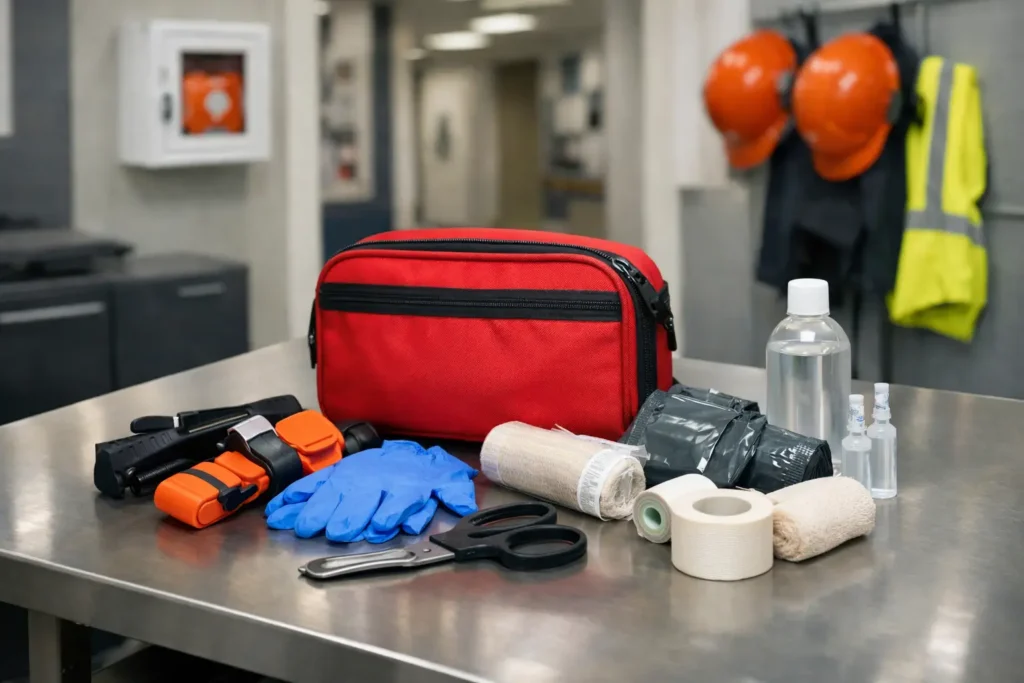
A severe bleeding emergency does not leave much room for hesitation. Whether it happens in a school hallway, a manufacturing floor, a church parking lot, or a sports facility, the first few minutes matter. That is why choosing the right essential items for bleeding control stations is not just about checking a box. It is about making sure the people on site can act fast with equipment that is visible, practical, and ready to use.
For organizations responsible for staff, students, visitors, or congregants, bleeding control stations work best when they are treated as part of a larger emergency response plan. The station itself matters, but so do placement, training, inspection, and how well it fits the risks in your building.
A bleeding control station is designed to help bystanders respond to life-threatening blood loss before EMS arrives. In many settings, that means giving non-clinical staff access to simple trauma supplies they can use with brief training. The goal is not to replace professional care. The goal is to buy critical time.
This is also why bleeding control stations should not be packed with random first aid supplies. When too many unrelated items are included, response can slow down. In an emergency, people need a clear, purpose-built setup with equipment that matches the task.
The core contents of a station should support the basic actions used to control severe bleeding: applying direct pressure, packing a wound when appropriate, and using a tourniquet for extremity bleeding. A well-equipped station typically includes bleeding control dressings, compressed gauze, at least one quality tourniquet, protective gloves, trauma shears, and clear instructions.
Tourniquets are one of the most important items to get right. Not every tourniquet on the market performs the same way, and lower-cost options may create problems during a real emergency. For workplaces and public facilities, it makes sense to standardize around proven, training-compatible tourniquets so staff are more likely to use them correctly under stress.
Compressed gauze and trauma dressings are also central. Gauze can be used to pack certain wounds and help control bleeding where a tourniquet is not appropriate. Trauma dressings help maintain pressure and secure the wound area. These supplies should be vacuum sealed or otherwise protected so they remain clean and compact until needed.
Protective gloves are easy to overlook, but they matter. In an emergency, staff may hesitate if they are not able to protect themselves from blood exposure. Nitrile gloves are a common choice because they are durable and suitable for many users with latex sensitivity concerns.
Trauma shears round out the station by making it easier to cut away clothing quickly and reach the injury site. Without shears, valuable seconds can be lost trying to work around jackets, uniforms, or heavy fabric.
Depending on your environment, the essential items for bleeding control stations may need to go a step further. In a large campus, athletic facility, warehouse, or law enforcement setting, adding more than one tourniquet can make sense. Some injuries require multiple interventions, and some incidents involve more than one person.
A marker is another useful addition. It allows responders to note the time a tourniquet was applied, which can be important for EMS and hospital staff. Instruction cards with simple visual steps are also worth including, especially in locations where not every likely responder has formal first aid training.
Some organizations also choose to include a rescue blanket or basic PPE enhancement such as eye protection. That can be appropriate, but only if it does not clutter the station or confuse its primary purpose. The more focused the setup, the easier it is to use.
The best supplies are less helpful if no one can find them. Bleeding control stations should be clearly marked, easy to access, and placed where people already expect to find emergency equipment. Many facilities place them near AED cabinets, first aid cabinets, security desks, gym entrances, or other high-traffic areas.
That pairing often works well. Staff already learn where the AED is located, and placing bleeding control supplies nearby creates a more complete emergency response point. For schools, churches, and workplaces building a broader preparedness program, this can simplify training and improve recall during a crisis.
Cabinet style matters too. A station should be visible enough that people notice it immediately, but secure enough that supplies stay clean and intact. Wall-mounted cabinets or clearly labeled pouches can both work, depending on the setting. It depends on traffic, theft concerns, environmental exposure, and how formal the emergency equipment layout needs to be.
Not every organization needs the same setup. An office may need a straightforward bleeding control station near common areas and an AED nearby as part of a standard emergency response plan. A manufacturing site may need expanded trauma supplies in higher-risk zones. A school or church may focus on accessible public placement and staff training across multiple buildings.
This is where many organizations make a mistake. They choose a generic kit without considering building size, occupant count, activity level, or likely hazards. The better approach is to look at the site the way an emergency would unfold. Where could a serious injury happen? How long would it take to reach the scene? Who is most likely to respond first?
Those questions often shape both the contents and the number of stations needed.
A bleeding control station is only as effective as the people around it. Even simple supplies become much more useful when staff have hands-on exposure to tourniquet application, wound packing, and scene awareness. Training also reduces hesitation, which is often one of the biggest barriers in a real emergency.
For many organizations, it makes sense to integrate bleeding control training with CPR, AED, and first aid planning. That creates a more complete response framework instead of isolated pieces of equipment placed around the building. It also gives safety coordinators and administrators a cleaner way to manage readiness across teams and locations.
Once a station is installed, maintenance becomes the next challenge. Gloves can degrade, packaging can be damaged, and used items need prompt replacement. A station that looks complete from the outside may be missing a critical component inside.
Routine checks should be part of the same process used to monitor AED cabinets, batteries, pads, and first aid inventory. When organizations centralize those responsibilities, readiness is easier to sustain. This is one reason many facilities prefer working with a single partner for training, equipment placement, and ongoing support rather than managing each piece separately.
If your team is evaluating essential items for bleeding control stations, keep the goal simple: make it easy for the nearest person to take effective action in the first few minutes. The right supplies, placed in the right locations and backed by training, can turn uncertainty into response when every second counts.