
A patient collapses in the waiting room. A visitor experiences chest pain near the front desk. A staff member finds an unresponsive person in a hallway. In these moments, a clinic’s response depends less on where its certification cards are stored and more on whether the team can recognize the emergency, begin high-quality CPR, use an AED, and work together before EMS arrives.
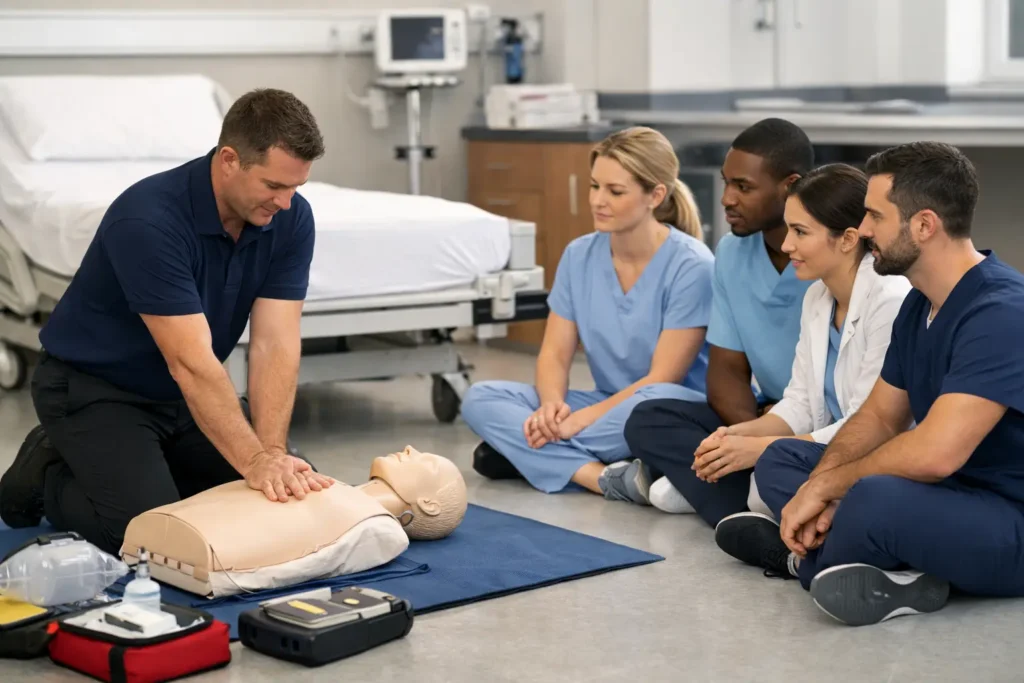
Onsite BLS training for clinics gives healthcare teams a practical way to build those skills in the setting where they will use them. Rather than sending employees to separate classes at different times and locations, clinics can train coordinated groups around their schedules, workflows, and emergency equipment. The result is not simply a completed course. It is a more capable response team.
Basic Life Support training is especially relevant in outpatient settings because clinical teams may be the first people available when a cardiac or respiratory emergency occurs. Even when a clinic is close to a hospital or emergency department, the first several minutes still matter. Early recognition, prompt activation of EMS, effective CPR, and AED use can make a critical difference.
Training as a group helps turn individual knowledge into team readiness. Front-desk personnel, medical assistants, nurses, providers, technicians, and administrative staff may all have different roles during an emergency. A shared course creates a common response framework: who calls 911, who retrieves the AED, who begins compressions, who directs responders to the correct entrance, and who manages the waiting area.
That coordination is hard to build when each person completes training separately. Onsite instruction gives teams the chance to ask questions that reflect their actual environment, such as how to access the building after hours, where an AED should be placed, or what happens if an emergency occurs in a treatment room.
A quality BLS course should provide hands-on practice, not just a review of slides or videos. Participants need repetition with the physical skills that are difficult to perform well under stress: chest compressions, ventilation when applicable, AED operation, and relief of choking.
For clinics, the strongest training experience also connects those skills to a real response sequence. Staff should understand how to quickly assess an unresponsive person, activate the emergency response plan, begin care, and transfer responsibility to arriving EMS professionals. Training should reinforce that an AED is designed to guide rescuers with clear prompts. Team members do not need to diagnose a heart rhythm before applying it.
The exact training needs can vary. A clinic with licensed clinical personnel may need a course aligned with professional credentialing requirements, while a smaller practice may be focused on preparing all staff to act quickly until EMS arrives. Staffing levels, patient population, specialty services, and state or employer policies can all affect the best approach.
Cardiac emergencies are not routine events for most clinic employees. That is precisely why practice is valuable. The goal is to reduce hesitation and make the first actions feel familiar.
In an onsite setting, instructors can identify common issues that are easy to miss in self-directed learning: compressions that are too shallow, pauses that last too long, uncertainty about AED pad placement, or confusion when several people attempt to lead at once. Correcting those details during practice helps participants leave with usable skills rather than passive awareness.
BLS training is most effective when the equipment staff are taught to use is ready, visible, and maintained. A clinic may have an AED cabinet on the wall, but readiness requires more than having a device in the building.
The AED should be placed where staff can retrieve it quickly, ideally without barriers such as locked doors, crowded storage areas, or uncertainty about who holds the key. Team members should know its location and understand whether it is intended for use on patients, visitors, or staff. In an emergency, it may be appropriate for any person who is unresponsive and not breathing normally, according to the device prompts and trained response procedures.
Ongoing AED program management is equally important. Pads and batteries have expiration dates. Cabinets, signage, and rescue accessories need periodic checks. A designated staff member should know how to document inspections, respond to device alerts, and arrange replacement supplies before a deadline becomes an emergency.
Square One Medical helps organizations bring training and AED program support into one coordinated preparedness plan. For a busy clinic, having a consistent partner for BLS instruction, AED placement guidance, and equipment maintenance can reduce administrative burden while keeping the response program active between certification dates.
Convenience is one of the clearest advantages of onsite training, but it requires thoughtful planning. Clinics cannot simply close operations for an entire day in many cases. The best format depends on the number of employees, patient volume, available space, and need for continuous coverage.
A small practice may train everyone in a single session before opening, after closing, or during a planned staff meeting. Larger clinics may benefit from staggered sessions so reception, clinical areas, and phones remain covered. Some organizations schedule training around lower-volume periods or dedicate an in-service day to safety topics.
The training room matters too. Participants need enough space to work on the floor with manikins and practice AED scenarios. A conference room, break room, or open clinical education area can work well when it allows the instructor to observe each participant and provide feedback.
Before scheduling, clinic leadership should confirm who needs certification, which credentialing standard applies, when current cards expire, and whether new hires or per-diem staff should be included. This prevents the common problem of holding a course only to discover that several essential team members were not scheduled.
Certification is a milestone, not the finish line. The clinics that respond most confidently are the ones that make emergency preparedness part of normal operations.
After training, assign clear roles and check that the AED, first aid supplies, emergency oxygen if used by the facility, and communication procedures are understood. A short tabletop discussion can be useful: If someone collapses in the lobby at 4:30 p.m., what does each person do? If the AED is used, who meets EMS outside? If an incident occurs during a busy clinic day, who communicates with waiting patients and family members?
These discussions do not need to be complicated. They simply reveal gaps before a real emergency exposes them. Revisit the plan when the clinic moves, remodels, adds staff, changes hours, or relocates the AED.
Onsite BLS training supports more than certification compliance. It gives clinic teams a chance to practice decisive action together, become familiar with their AED, and clarify what happens during a high-stress event. That preparation is especially meaningful for organizations trusted with the wellbeing of patients, families, and employees every day.
The next useful step is simple: walk your clinic as if an emergency were happening now. Confirm where the AED is, who can retrieve it, whether supplies are current, and whether every staff member knows their first action. A prepared team does not need a perfect script. It needs the confidence to start care without delay.