
A medical emergency does not wait for a convenient time, a fully staffed shift, or a scheduled safety meeting. Understanding employee CPR certification requirements helps organizations prepare the right people to act quickly while avoiding a common mistake: assuming one rule applies to every workplace.
For most employers, CPR certification is not universally required for every employee. Requirements can depend on the work performed, the industry, state and local regulations, licensing standards, contractual obligations, and the organization’s own emergency response plan. The practical goal is not simply checking a training box. It is ensuring that trained responders, accessible equipment, and clear procedures work together when seconds matter.
There is no single federal rule requiring every U.S. employee to hold CPR certification. However, some workplaces have more specific obligations. Child care providers, healthcare teams, lifeguards, school staff, security personnel, fitness professionals, and certain public safety roles may be subject to CPR or first aid training requirements through licensing agencies, professional standards, or state law.
Workplace conditions also matter. Occupational safety rules may require employers to make prompt first aid available when there is no nearby clinic, hospital, or infirmary available to treat injured employees. In those situations, employers may need adequately trained first aid responders. CPR training is often included because cardiac arrest can occur alongside workplace injuries, electrical incidents, heat illness, choking, or other emergencies.
Employers should review applicable federal, state, and local rules, along with industry-specific requirements. Legal counsel, insurance carriers, licensing authorities, and local emergency officials can help clarify obligations for a particular facility. A good preparedness program goes beyond the minimum standard when the facility size, public traffic, or risk profile calls for stronger coverage.
Start with your people and your environment. A small office with limited public access may need a different response plan than a manufacturing floor, school campus, church, warehouse, athletic facility, or police department. Consider the number of employees on each shift, how long it takes emergency medical services to arrive, the age and health needs of those served, and the hazards present in the building.
Training should cover enough employees to provide meaningful coverage during breaks, vacation periods, remote workdays, and turnover. Training only one volunteer per location may look sufficient on paper, but it leaves a serious gap if that person is absent or working elsewhere when an emergency occurs.
For many organizations, the best approach is to designate a response team rather than requiring every employee to certify. This team might include managers, safety coordinators, front-office staff, coaches, facilities personnel, security staff, and employees assigned across different shifts or building areas. The right number depends on the facility. What matters is that trained people can be identified and reached quickly.
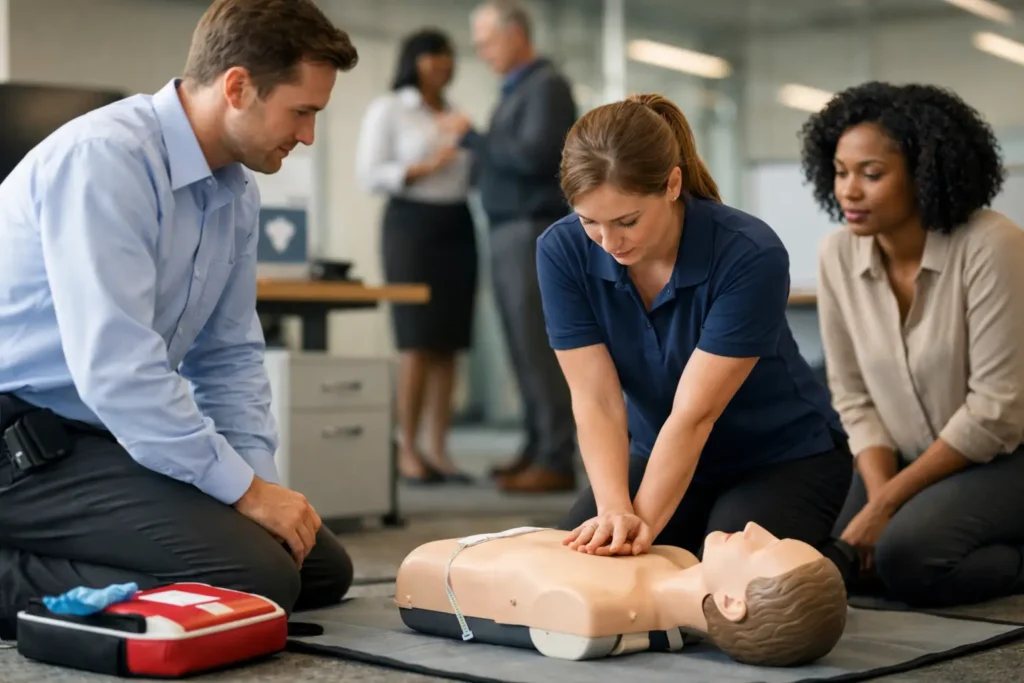
A recognized CPR, AED, and first aid course gives employees the skills to recognize an emergency, call 911, begin CPR, use an AED, and provide care until responders arrive. Courses may be designed for workplace responders, healthcare professionals, school personnel, or other groups with specific duties.
Hands-on practice matters. Employees need the opportunity to perform chest compressions, practice AED operation, and work through realistic scenarios. Online learning can be useful for knowledge preparation, but a course without skills evaluation may not satisfy a workplace policy, licensing requirement, or insurer’s expectations. Before scheduling, confirm which curriculum and credential your organization needs.
Most CPR certifications are valid for a limited period, commonly two years, though the required renewal cycle can vary. Keeping certification dates in a spreadsheet is better than relying on memory, but it can become difficult as staff grows. A centralized training calendar and renewal reminders reduce the chance that an entire response team expires at once.
CPR keeps blood moving, but an AED can deliver the treatment needed for certain sudden cardiac arrest rhythms. A strong workplace plan pairs trained responders with visible, accessible AEDs and a process for maintaining them.
AED placement should reflect how people actually move through the property. In many settings, placing an AED near a main entrance, gymnasium, cafeteria, assembly area, security desk, production floor, or central hallway can reduce retrieval time. Large buildings, multiple floors, separate campuses, and outdoor athletic areas may require more than one device. The goal is to make an AED available quickly, not merely to have one somewhere on the premises.
An AED program also requires ongoing attention. Pads and batteries expire. Cabinets, signage, and alarm functions need inspection. Teams need to know where devices are located, who calls 911, who retrieves the AED, and how an incident is documented afterward. State AED laws may include requirements related to maintenance, notification, medical oversight, or emergency response planning, so organizations should confirm the rules that apply where they operate.
Square One Medical helps organizations coordinate CPR and AED training with AED placement, equipment support, and ongoing program management. That one-partner approach can make it easier for safety leaders to maintain readiness across training dates, device locations, and expiring supplies.
Good records show more than who attended a class. They help leaders see whether the program is workable. Maintain current certification rosters, training dates, instructor or course details, AED inspection logs, equipment serial numbers, pad and battery expiration dates, and emergency response procedures.
Documented drills can be particularly useful for schools, churches, and larger workplaces. A brief scenario can reveal practical issues that a written policy misses: a locked AED cabinet, unclear directions to the device, a front desk employee who does not know the emergency address, or responders who are all assigned to the same shift. Correcting those gaps before a real emergency is the point of preparedness.
The strongest emergency response programs are simple enough to follow when people are frightened and time is short. Employees should know to call 911, begin CPR when appropriate, send someone for the AED, and meet emergency responders at the entrance. Supervisors should know who is trained and when renewals are due. Facility leaders should know that AED supplies are current and devices are easy to find.
Employee CPR certification requirements may begin with compliance, but readiness is the more meaningful standard. When training, AED placement, maintenance, and response roles are coordinated, an organization gives its people a clearer chance to help before professional responders arrive.