
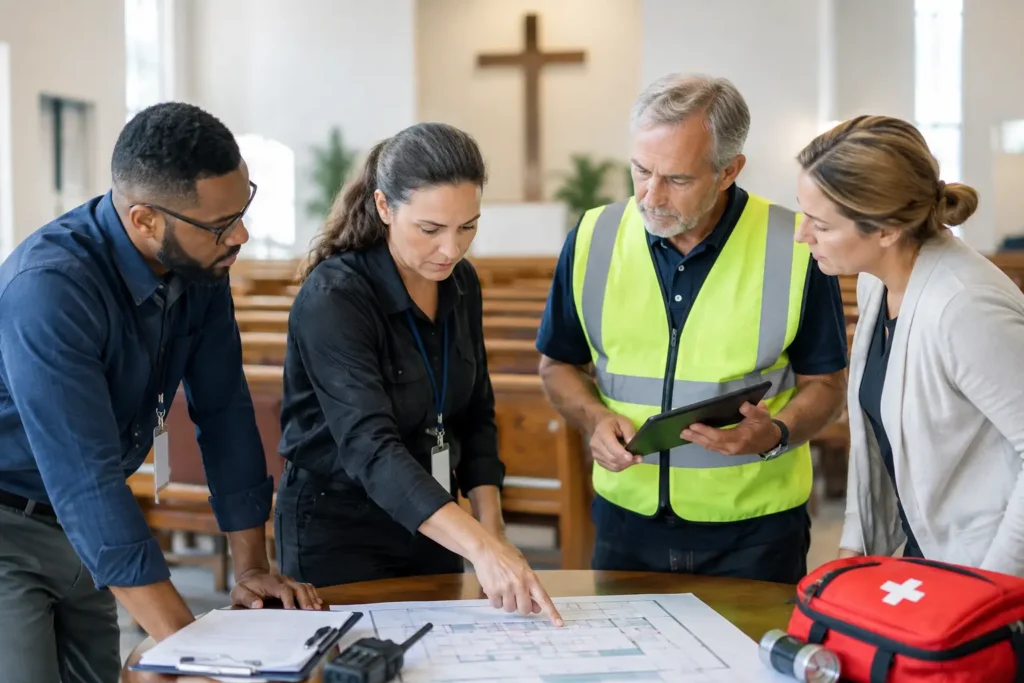
A Sunday service can bring together infants, older adults, volunteers, visitors, and staff in one busy building. That makes a church emergency preparedness guide more than a binder stored in an office. It is a practical plan for helping people recognize an emergency, communicate clearly, and take the first right steps until professional responders arrive.
Church leaders do not need to anticipate every possible event perfectly. They do need a response system that works during a crowded worship service, a weekday preschool pickup, a funeral, a youth event, or a community meal. The strongest plans are simple enough for trained people to use under pressure and specific enough to account for the church’s building, schedules, and congregation.
A useful plan starts with a realistic assessment, not a generic checklist. Walk the property during the times it is busiest. Consider where people enter, where children gather, which rooms are used by seniors, and how quickly someone could direct EMS to the right door.
For many churches, the immediate priorities include medical emergencies, sudden cardiac arrest, severe weather, fire, missing or vulnerable persons, and security incidents. The details will vary. A small rural church with one sanctuary has different needs than a multi-building campus with a school, gymnasium, and weekday programs.
Identify the people who can make decisions during an incident, but do not build a plan that depends on one person always being present. Assign backup leaders for services, classes, and events. Volunteers should know who has authority to call 911, who meets responders, who communicates with families, and who documents what occurred after the situation is stable.
Medical emergencies are among the most likely situations a church will face. A person may faint, experience a diabetic emergency, fall, choke, have a seizure, or show signs of stroke. Sudden cardiac arrest requires especially fast action because each minute without CPR and defibrillation affects the chance of survival.
Your response team should know how to call 911, begin care within their training, retrieve emergency equipment, and guide responders to the patient. A clear internal alert process matters. In a large building, simply shouting for help wastes valuable time. Radios, designated phones, or a defined group text protocol can help, provided the system is tested and used consistently.
CPR, AED, and first aid training should extend beyond one designated safety volunteer. Churches often rely on volunteers, and attendance can change from week to week. Train a cross-section of ushers, children’s ministry leaders, facilities staff, clergy, administrators, and event leaders. Their training should be current, and the team should practice the roles they would perform together.
An AED program is not complete when an AED is placed on a wall. The device must be visible, accessible, maintained, and supported by trained responders. A unit locked in an office or stored near a staff-only area may be too far away when a cardiac emergency happens in the sanctuary, fellowship hall, gym, or school wing.
Placement should be based on walking time, not just floor plans. In larger facilities, more than one AED may be needed to keep the device within quick reach of occupied areas. Consider major gathering spaces, outdoor athletic areas, and locations used during evening programs. Clearly marked cabinets and directional signs help a bystander or visiting volunteer find the AED without delay.
Every AED needs a documented inspection process. Pads and batteries expire, cabinets may need attention, and devices can be moved or blocked by furniture during routine building changes. Assign a responsible person and a backup to perform regular checks, retain records, and replace consumables before they expire. AED program management turns a piece of equipment into a dependable part of your emergency response capability.
A plan should be easy to locate and easy to follow. Keep a complete version with leadership, but create short role-specific instructions for ushers, children’s teams, office staff, and event coordinators. These should use plain language and identify the immediate actions that matter most.
For example, a medical response procedure should state who calls 911, who retrieves the AED and trauma kit, who begins CPR or first aid, who meets EMS, and how the area will be managed respectfully. A weather procedure should identify where people shelter, how classes are accounted for, and who monitors official alerts. Security procedures should emphasize observation, communication, and coordination with law enforcement rather than asking untrained volunteers to take unnecessary risks.
Include the following operational details in your written plan:
The goal is not to create paperwork for its own sake. Written procedures reduce hesitation and prevent confusion when people are stressed.
Church safety plans should account for people who may not know the building or understand the normal routine. Guests may not know where exits are. Young children may be frightened or separated from parents during an evacuation. Older adults and people with mobility, hearing, vision, or cognitive challenges may need additional assistance.
Assign children’s ministry leaders clear accountability procedures. They should know how to take attendance, move children safely, and reunite them with approved adults. Avoid relying solely on verbal instructions during a loud or chaotic event. Printed classroom rosters, simple status cards, and designated reunification locations can make accountability more reliable.
For congregants with mobility needs, identify practical evacuation support without making assumptions about what they need. Consider accessible exit routes, areas where assistance may be required, and which trained volunteers can help. This planning is most effective when it is handled respectfully and before an emergency occurs.
A plan that has never been practiced is difficult to trust. Still, drills should fit the setting. A full evacuation exercise may make sense for a school or large weekday program, while a tabletop discussion may be more appropriate for a worship team or small group of ushers.
Start by walking response leaders through a realistic scenario: a congregant collapses in the lobby after service, a tornado warning is issued during children’s classes, or smoke is reported near the kitchen. Ask what happens in the first minute, who communicates with whom, where equipment is located, and what could slow the response.
Practice often reveals small but meaningful problems, such as an AED cabinet blocked by a display, an outdated emergency contact list, or an entrance that EMS may struggle to identify. Correcting those issues is exactly why training and drills matter. Keep lessons learned brief, document changes, and revisit them when building layouts, staff, or programs change.
Emergency readiness is not a one-time project. Training expires, volunteers rotate, AED pads and batteries reach their replacement dates, and a church’s programs evolve. Review the plan at least annually and after any actual incident, drill, renovation, or major change in attendance.
A full-service partner can help churches coordinate CPR and AED training, appropriate equipment placement, and ongoing AED management so safety responsibilities do not fall entirely on one busy volunteer. Square One Medical helps organizations build practical response programs that connect trained people with ready equipment.
The most reassuring church emergency preparedness guide is one your people can carry out: call for help, begin care, bring the AED, direct responders, and support one another. When those actions are clear and practiced, your church is better positioned to serve its community when help is needed most.