
Now for a limited time, trade in your old AED for a generous rebate toward a new unit!
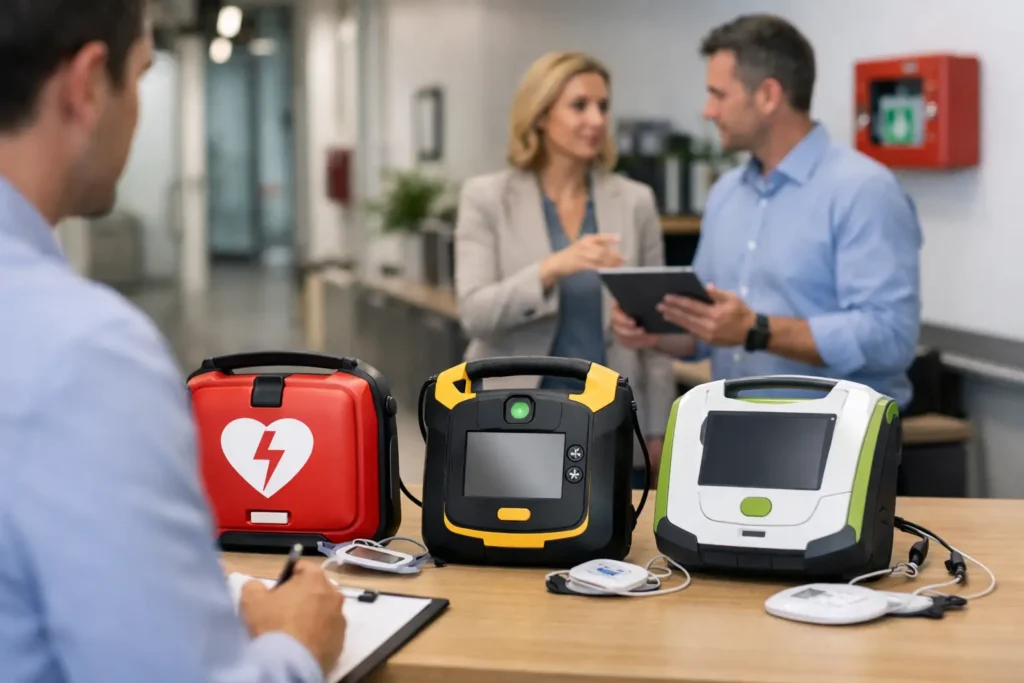
A sudden cardiac arrest plan can look complete on paper until someone asks a practical question: Who is checking the AED, replacing expired pads, training new staff, and confirming the unit is ready when it is needed? An AED service comparison should start there. For organizations, the right partner is not simply the one that provides a device. It is the one that helps make emergency readiness an ongoing, manageable part of facility operations.
Whether you oversee an office, school, church, manufacturing site, police department, or community facility, the goal is the same: place a working AED where people can reach it quickly and make sure trained responders know how to use it.
Comparing AED services by initial price alone can leave major gaps in a preparedness program. AEDs rely on accessories with scheduled replacement dates, including electrode pads and batteries. Cabinets, signage, alarm features, inspections, and documentation can also affect how quickly a team can respond and how easily a program can be managed.
A useful comparison evaluates the full lifecycle of the program. Ask what happens after placement. Will the provider help identify suitable AED locations? Can they support staff training at your facility? Do they provide reminders for expiring supplies and updates when equipment needs attention? Is there a clear process for ordering replacement items or adding devices as your organization grows?
The answers matter because AED readiness is not a one-time project. A device mounted in a hallway is only part of the solution. A maintained device, an informed response team, and a plan that employees can follow under stress are far more valuable.
AED models have meaningful differences in features, but service should be compared just as carefully. Some organizations need a straightforward placement with periodic assistance. Others need a broader program that covers multiple locations, rotating personnel, large campuses, or public-facing facilities.
The best location for an AED depends on where people gather, how far responders may need to travel, and how a facility operates. A school may need units near gyms, athletic fields, cafeterias, and high-traffic entrances. A church may need coverage for worship areas, fellowship halls, childcare spaces, and events. A manufacturing operation may need to consider shift patterns, large floor plans, noise levels, and physical hazards.
A service partner should help organizations think through accessibility, visibility, cabinet placement, and signage. An AED locked away in an office or positioned too far from likely emergencies may not support a fast response.
AED placement and CPR/AED training work together. Employees and volunteers should understand who calls 911, who retrieves the AED, who begins CPR, and what to expect when the device provides voice prompts. Hands-on training gives people a chance to practice before an actual emergency creates pressure.
When comparing services, consider whether training can be delivered onsite, whether scheduling works for multiple shifts or volunteer groups, and whether new staff can be trained as they join the organization. A provider that coordinates training and equipment can help create a more consistent response plan.
AED program management is often the difference between having equipment and maintaining readiness. Pads and batteries expire. Devices need regular visual checks. Cabinets may require inspection. Following an incident, the unit may need replacement pads, event documentation, and a return-to-service plan.
Look for a service approach that provides expiration tracking, reminders, equipment updates, and responsive support. Centralized management is particularly helpful for organizations with more than one device or more than one location. It reduces the risk that responsibility falls to a single employee who may change roles or leave the organization.
A strong provider should be able to give direct, practical answers. Start by asking how they assess your location and determine the number of AEDs needed. Then ask whether they support installation guidance, cabinets, wall signage, inspection processes, and replacement accessories.
Training questions are equally important. Find out which CPR/AED courses are available, whether classes can be conducted at your site, and how recertification can be organized. For schools, churches, and other organizations with volunteers, ask how training options can accommodate changing schedules and participant turnover.
Also ask what support is available after the initial setup. If an alert occurs, a pad expires, or your facility expands, you should know who to contact and what happens next. The right answer is not always the most elaborate service package. A small office may need a different level of support than a regional employer with several sites. What matters is that the support matches your operational reality and is easy to sustain.
Many AED programs lose effectiveness through ordinary oversights rather than a lack of good intentions. Equipment is installed but no one is assigned to check it. An AED is placed near an entrance but not near the areas with the highest activity. Staff receive training once, but new hires never receive the same instruction. Replacement supplies are ordered only after an expiration date has passed.
These gaps can be addressed with clear ownership and a routine schedule. Assign a program coordinator, while also designating a backup. Keep an internal record of AED locations, inspections, training dates, and responsible personnel. Review the emergency response plan after building changes, staff turnover, major events, or an actual emergency.
For public-facing organizations, it is also helpful to make AED locations visible to employees, volunteers, and regular visitors. In an emergency, people should not have to guess where the device is stored or whether they are allowed to use it. Modern AEDs are designed to guide users with clear prompts, but fast access still depends on preparation.
Managing CPR training, AED placement, equipment replenishment, and ongoing monitoring through separate providers can create unnecessary administrative work. A full-service partner can connect these pieces so decision-makers have a clearer view of their program and fewer details to track across vendors.
Square One Medical supports organizations with AED program guidance, hands-on CPR/AED training, equipment placement, and ongoing support for replacement supplies and readiness needs. That coordinated approach helps safety leaders focus less on managing individual tasks and more on building a response plan their teams can carry out.
The most useful AED service comparison is the one that leaves your organization with a plan that still works six months, two years, and one staff transition from now. Choose support that keeps equipment visible, maintained, and ready, while giving your people the confidence to act when every minute matters.