
Now for a limited time, trade in your old AED for a generous rebate toward a new unit!
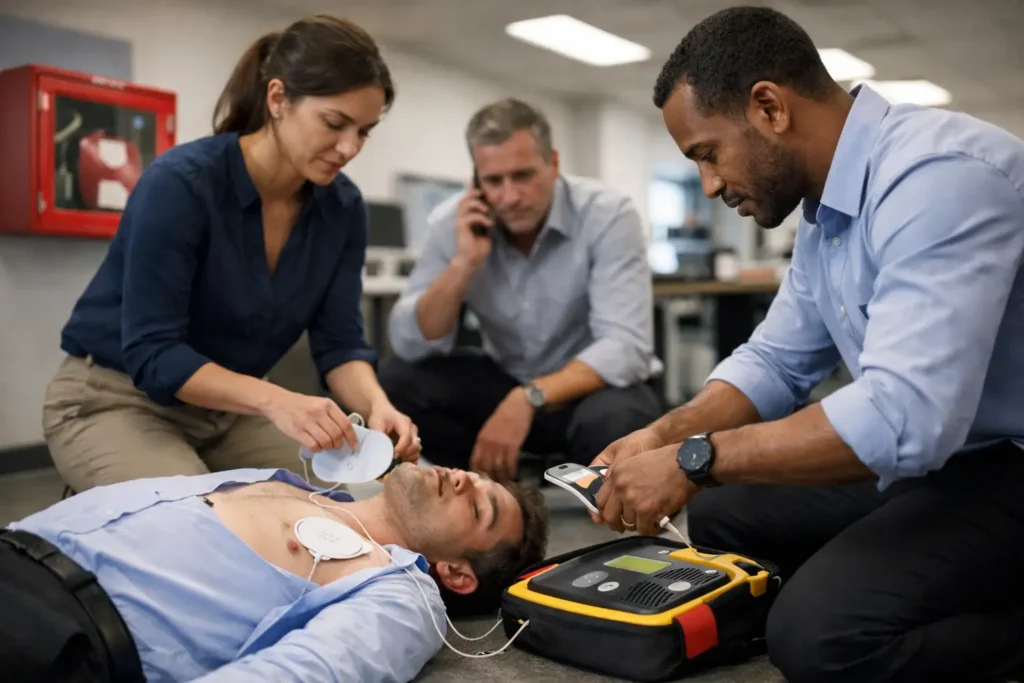
A sudden cardiac arrest response is not the time for employees, staff members, or volunteers to figure out where the AED is stored, who calls 911, or whether they can use the device. Learning how to conduct AED drills gives your organization a practical way to identify those gaps before an actual emergency puts lives at risk.
An effective drill is not a test designed to catch people making mistakes. It is a rehearsal that helps people act quickly, communicate clearly, and use the emergency equipment your organization has put in place. The goal is confidence built through realistic practice.
Before scheduling a drill, confirm that your written emergency response plan reflects the layout, staffing, and daily operations of your facility. A plan for a small office may be simple. A school campus, manufacturing floor, church campus, or multi-building workplace may require assigned response roles, communication procedures, and several AED locations.
At minimum, your team should know how to recognize a likely cardiac arrest: a person who is unresponsive and not breathing normally or is only gasping. The response should then move quickly: call 911, begin CPR, send someone for the AED, and use the AED as soon as it arrives.
Decide who will take responsibility for activating emergency services, retrieving the AED, directing responders to the scene, performing CPR, and meeting EMS outside. In a real event, one person may fill more than one role until help arrives. Still, assigning roles during drills prevents confusion and shows whether your coverage is adequate across shifts or during events.
Choose a scenario that reflects when and where people are actually present. An office may simulate a visitor collapsing in a conference room. A school can practice a response in a gymnasium or on an athletic field. A church may rehearse during a service, when hallways, entrances, and parking areas are busy.
Tell participants that a drill will occur within a defined time period, but avoid sharing the exact scenario with everyone involved. That balance protects psychological safety while allowing you to see how naturally the response plan works. Notify front-desk staff, security personnel, and building leadership in advance so no one mistakes the exercise for a real emergency.
Use a training manikin and training AED whenever possible. A training AED provides the same essential prompts as an operational device without delivering an electrical shock. Never attach pads from a live AED to a participant during a drill. If the drill involves your installed AED, limit the exercise to retrieval, inspection of the cabinet or carrying case, and verification of location and accessibility.
Start the scenario with a simulated collapse or a report that someone is unresponsive. Observe what happens without coaching immediately. Did someone check for responsiveness and normal breathing? Was 911 called promptly? Did the AED arrive quickly? Did someone begin CPR while another person retrieved the device?
The sequence matters, but so do practical details. Watch whether the AED route is blocked, whether staff can access the cabinet, and whether people know how to direct EMS to the right entrance. In larger facilities, the time required to bring the AED to the patient can reveal a placement issue rather than a training issue.
AED drills should produce useful findings, not just a sense that the team practiced. Assign an observer to record times and note obstacles. Begin timing when the simulated cardiac arrest is recognized and record when 911 is called, CPR begins, the AED arrives, pads are applied, and the first analysis prompt occurs.
You do not need to judge every participant like a certification skills test. Focus on whether the team can deliver the early links in the chain of survival without unnecessary delay. If an AED takes too long to reach an incident location, consider whether another unit, clearer signage, or a different placement strategy is needed.
Also evaluate communication. A responder calling, “You call 911. You get the AED,” is more effective than asking a group, “Can somebody call?” Closed-loop communication is especially valuable in busy schools, manufacturing settings, houses of worship, and public-facing facilities where several people may rush to help.
Hold a short debrief immediately after the exercise. Start by recognizing what went well. People are more likely to participate fully in future drills when the process feels constructive rather than punitive.
Then ask a few focused questions: What delayed the response? Was the AED easy to find and retrieve? Were roles clear? Did anyone encounter a locked door, missing key, poor signage, dead radio, or communication bottleneck? What would make the next response easier?
Turn the findings into assigned actions with deadlines. For example, an operations manager may need to relocate an AED cabinet, a safety coordinator may update the response plan, and an HR leader may schedule CPR/AED training for employees on a shift that lacked coverage. A drill only improves readiness when the lessons lead to changes.
Drills work best when they are part of a broader AED management program. A visible AED cabinet is only useful if the device is ready for use, the pads and battery are within their service dates, and the right people know its location.
Assign a program owner to perform and document routine inspections. Confirm that the AED status indicator shows readiness, the cabinet is accessible, response supplies are present, and replacement pads or batteries are ordered before they expire. Your organization should also update its plan after renovations, staffing changes, new equipment placement, or changes in facility use.
Training frequency depends on your organization’s risk profile, employee turnover, operating hours, and the number of trained responders available. Many organizations benefit from a brief AED response drill at least annually, with additional practice after major changes or when a drill identifies a serious gap. Short tabletop discussions can reinforce roles between hands-on exercises, but they should not replace physical practice retrieving and using a training AED.
The strongest AED programs do not rely on one confident employee or a binder that is rarely opened. They create a shared expectation that anyone can recognize an emergency, activate help, begin CPR, and bring the AED without waiting for permission.
Square One Medical helps organizations pair hands-on CPR/AED training with AED program support so equipment, people, and response procedures work together. A well-run drill gives your team something more valuable than a completed checklist: the ability to move with purpose when every minute matters.