
Now for a limited time, trade in your old AED for a generous rebate toward a new unit!
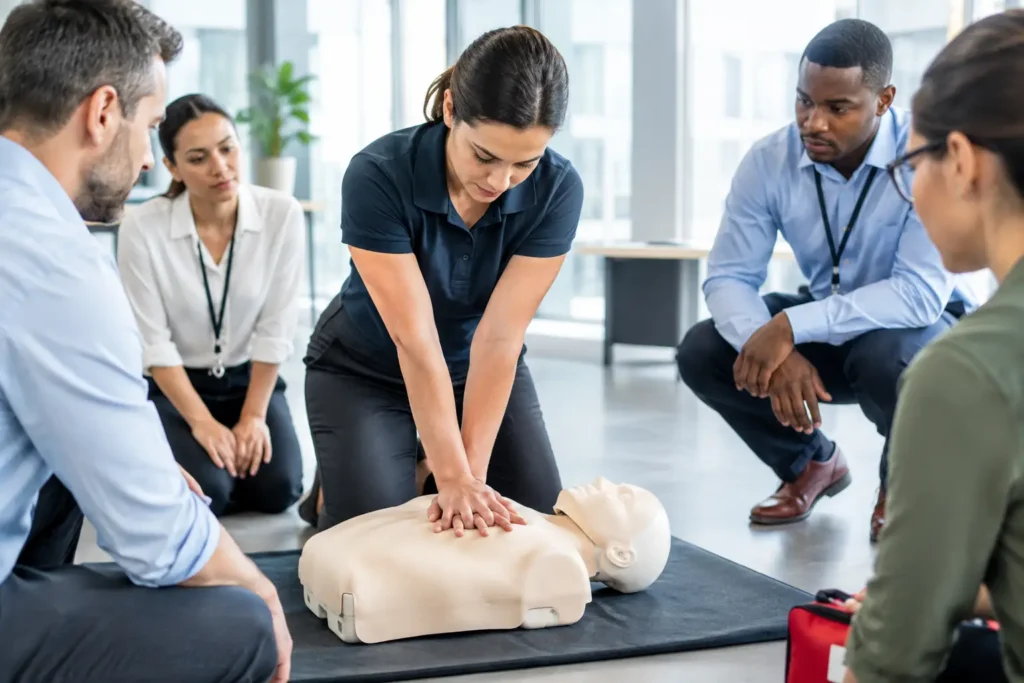
A medical emergency does not wait for the next safety meeting, a fully staffed shift, or a convenient time on the calendar. When a colleague, student, visitor, or congregant collapses, the people nearby need to recognize the emergency, call for help, begin CPR, and use an AED without delay. Choosing the best CPR courses for staff is therefore about more than checking a training requirement. It is about building a response your organization can carry out under pressure.
The right course depends on who your staff serves, the risks in your facility, and whether an AED is available. A small office may need a straightforward adult CPR/AED course for a designated response team. A school, church, fitness center, manufacturing operation, or public-facing facility may need broader coverage, including first aid, pediatric skills, bleeding control, or training across multiple shifts.
For most organizations, the strongest option is an instructor-led or blended course that includes meaningful hands-on practice. Staff should physically practice chest compressions, rescue breathing when applicable, AED pad placement, and the steps that follow a cardiac emergency. Watching a video can introduce the process, but it does not provide the same opportunity to build confidence with manikins, training AEDs, and instructor feedback.
A course should also fit the certification or compliance expectations that apply to your organization. Some employers, licensing bodies, insurers, school programs, and professional roles require credentials from a recognized training organization. Before scheduling, confirm which certification is required, who must hold it, and how often renewals are needed. This prevents a common problem: staff complete training that is useful but does not meet the organization’s documented requirement.
The best course is not always the longest course or the one with the most add-ons. It is the course that prepares the right people to respond to the emergencies most likely to occur in your setting.
For many workplaces, adult CPR/AED and first aid training is the practical foundation. It prepares staff to respond to sudden cardiac arrest, choking, breathing emergencies, severe bleeding, burns, fainting, diabetic emergencies, seizures, and other common incidents while professional help is on the way. Including AED instruction is especially valuable for organizations that have an AED onsite or are adding one to their safety program.
Schools, youth programs, and childcare-related settings may need pediatric CPR, AED, and first aid training. Churches and community organizations often benefit from training ushers, security volunteers, ministry leaders, coaches, and facility personnel who may be first on scene during services or events. Manufacturing, warehouse, and field teams may need a stronger first aid component because of the nature of workplace injuries and the distance from immediate medical care.
The goal is not to train every employee in every possible skill. It is to create adequate coverage. Consider different shifts, building areas, event schedules, vacation periods, and staff turnover. A single trained employee in one department is not a reliable emergency response plan.
Sudden cardiac arrest is time-sensitive. High-quality CPR helps maintain blood flow, while early defibrillation can be critical for a shockable rhythm. A course should teach staff to quickly assess the scene, activate 911 or the local emergency response process, begin compressions, retrieve the AED, and follow the device prompts.
Good training also addresses team response. One person can begin CPR while another calls 911 and sends someone for the AED. In a larger facility, staff should know who meets EMS, who brings the emergency equipment, and who communicates with the person in charge. These details may seem simple in a classroom, but they make a real difference when seconds matter.
Online learning can be convenient, particularly for policy review or knowledge-based coursework. But it has limits when the objective is to prepare staff to perform physical lifesaving skills. If your organization needs a recognized CPR certification, hands-on skills verification may be required. Even when it is not, practical evaluation is a valuable safeguard.
Blended learning can work well for busy teams. Employees complete an online knowledge portion at their own pace, then attend an in-person skills session. This format can reduce time away from operations while preserving the practice and feedback that make CPR and AED training more useful.
Fully onsite training is often the most efficient choice for organizations with a group of employees to certify. Staff train in a familiar setting, scheduling is centralized, and the instructor can discuss practical response considerations for the facility. For example, teams can identify the nearest AED, review access routes for EMS, and clarify who is responsible for emergency supplies.
When evaluating a provider, look beyond the course title. Ask whether the training includes current CPR and AED guidelines, hands-on practice, certification processing, clear roster management, and scheduling support. For organizations with multiple locations or recurring turnover, administrative support matters almost as much as the course itself.
An AED is designed to guide a responder through the process with clear voice and visual prompts. Still, staff are more likely to act quickly when they have seen and practiced with one before an emergency. CPR/AED training and AED placement should be managed together rather than as separate projects.
A complete AED program includes more than a device on a wall. The AED must be visible and accessible, with appropriate signage and a cabinet when needed. Pads and batteries must be within expiration dates. Staff should know its location, and new employees should be introduced to the emergency response process. Organizations should also consider where an AED is needed most, based on building layout, occupancy, activity level, and the time required to retrieve it.
AED program management helps keep those responsibilities from being forgotten after the initial installation. Routine readiness checks, expiration tracking, replacement planning, and equipment updates support a program that is prepared when it is needed. Training gives people the capability to respond; AED management helps ensure the equipment is ready to support them.
Before selecting a course, clarify these practical points with the training provider:
These questions move the conversation from a one-time class to a workable safety program. They also help decision-makers avoid fragmented planning, where one vendor handles training, another handles AED equipment, and no one is accountable for the overall response process.
CPR skills can fade when they are not used, and staff changes can quickly create gaps in coverage. Keep a current roster of trained employees, certification dates, training locations, and designated response roles. Schedule renewal planning well before certifications expire, especially if your organization has seasonal staffing, multiple departments, or a large number of employees.
It also helps to revisit your emergency plan after training. Confirm that the AED is easy to find, emergency phone numbers are current, first aid supplies are available, and staff understand how to direct EMS into the building. A short post-training review can reveal practical issues that a written policy misses.
Square One Medical helps organizations bring CPR, AED, first aid training, AED placement, and ongoing equipment readiness into one coordinated approach. The right course gives staff more than a credential. It gives them a clear next action when someone needs help – and that confidence is worth preparing for before the emergency occurs.