
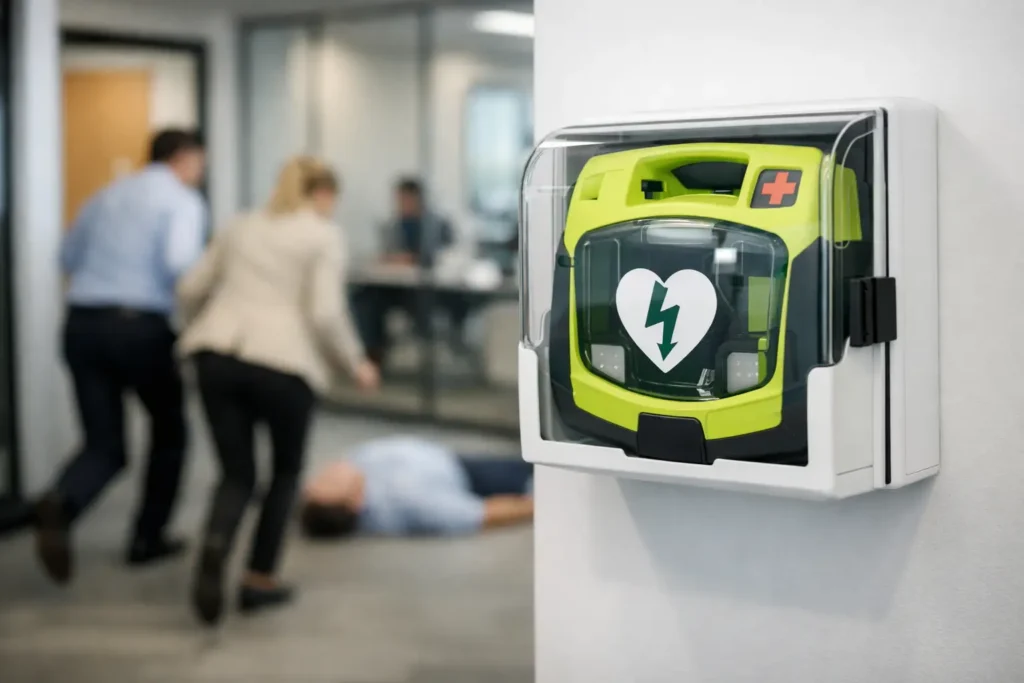
A cardiac emergency rarely happens in a convenient location. It may occur in a busy school gym, a warehouse aisle, a church lobby after services, or an office break room. Effective AED placement gives staff and visitors a clear path to lifesaving equipment when every minute matters – and helps an organization turn its AED investment into a response capability people can actually use.
A device placed in a locked office, behind a counter, or at the far end of a large property may technically be onsite, but it may not be accessible quickly enough. The goal is not simply to have an AED. The goal is to make it visible, reachable, maintained, and supported by trained responders.
When deciding where to place an AED, begin with the question: can someone retrieve it and return to the victim within about three minutes? That benchmark helps organizations look beyond where there is an empty wall or available outlet.
Walk the property as a visitor or employee would. Consider the distance between high-traffic areas, stairs, secured doors, elevators, and entrances. A large facility may need multiple AEDs, particularly when separate buildings, multiple floors, or expansive outdoor areas create barriers to quick access.
Placement should also reflect who is in the building and how they use it. A manufacturing facility may prioritize production areas, shipping and receiving, break rooms, and shift entrances. A school may need coverage near gyms, cafeterias, athletic fields, and main gathering spaces. Churches and community centers often benefit from accessible units near sanctuaries, fellowship halls, childcare areas, and recreation facilities.
The closest device is not always the best-placed device if people cannot find it. Choose locations that are central, easy to describe, and open during operating hours whenever possible.
An AED cabinet in a highly visible common area gives people a better chance of locating the device without losing valuable time. Hallways near main activity areas, reception zones, lobbies, and clearly marked shared spaces are often stronger choices than private offices or storage rooms.
Clear signage matters just as much as the cabinet location. Use standardized AED signs that can be seen from a distance and at key decision points, such as corridor intersections or entrances. If an AED is located around a corner or inside a large room, directional signs can reduce confusion during an emergency.
Accessibility also means considering the realities of your facility. Avoid placing a device where access depends on a single person having a key, badge, or code. Do not assume a receptionist, security officer, or facilities manager will always be present. If the AED is in an alarmed cabinet, make sure employees understand that opening it during a suspected cardiac emergency is appropriate.
For organizations with public-facing spaces, visibility reassures visitors that emergency readiness has been planned intentionally. It also gives trained staff a reference point during an urgent response.
No two AED programs should look exactly alike. The right number and location of devices depends on the size of the site, population, physical layout, and foreseeable risks.
For example, an office with one floor and a small team may need a different approach than a multistory distribution center operating around the clock. A school campus may need seasonal planning for athletic events and outdoor activities. A police department may need readily available AEDs in the station as well as equipment strategies for vehicles and field response.
Think about places where people exert themselves, gather in groups, or may be isolated from a central office. Gyms, athletic facilities, loading areas, assembly spaces, cafeterias, and parking or event areas deserve special consideration. So do locations occupied by higher-risk populations, including senior programs, medical offices, and community spaces serving adults with known health concerns.
The answer is not to place a device in every room. It is to identify the places where access could be delayed, then build coverage that reflects how your organization actually operates.
A location that works well at 10 a.m. on a weekday may be ineffective during an evening event. Churches, schools, recreation facilities, and community organizations should review who has access to each AED during weekends, after-hours programs, rentals, and large gatherings.
If multiple organizations share a building, clarify who is responsible for checking the AED, replacing supplies, and responding to cabinet alarms. Shared access can be valuable, but responsibility should never be unclear.
Proper AED placement is the first step, not the finish line. An AED needs adult pads, a working battery, routine readiness checks, and a documented plan for replacement before components expire. A cabinet, signage, and a clear inspection process help keep the device prepared for use.
Every organization should designate more than one person to oversee AED readiness. Staff turnover, vacations, and changing job duties can leave a program vulnerable when only one employee understands the equipment. A simple schedule for visual checks, status indicator review, and supply expiration tracking creates accountability without overburdening the safety team.
Training should connect directly to the device locations. During CPR and AED training, show employees where each unit is located and discuss who calls 911, who retrieves the AED, who begins CPR, and who meets emergency responders. A short, realistic discussion about your own facility can make training more useful than a generic response plan.
Square One Medical helps organizations bring these pieces together through hands-on training, AED program support, equipment, and ongoing readiness management. That coordinated approach can reduce the administrative burden on HR teams, safety coordinators, and facility leaders who are responsible for keeping a program current.
Facilities change. Departments move, construction blocks corridors, doors become secured, and events shift into new spaces. Review AED locations at least annually and whenever your layout, occupancy, or operations change.
A useful review includes a timed walk from high-traffic areas to the nearest AED, a check that signs remain visible, and confirmation that cabinets are not blocked by furniture, displays, or stored materials. Ask a few employees who were not involved in the original placement to point out the nearest AED. If they hesitate, your signage or communication may need attention.
The best AED placement is easy to explain, quick to reach, and backed by people who know what to do next. That preparation gives your team a stronger chance to respond with confidence when someone’s life depends on immediate action.