
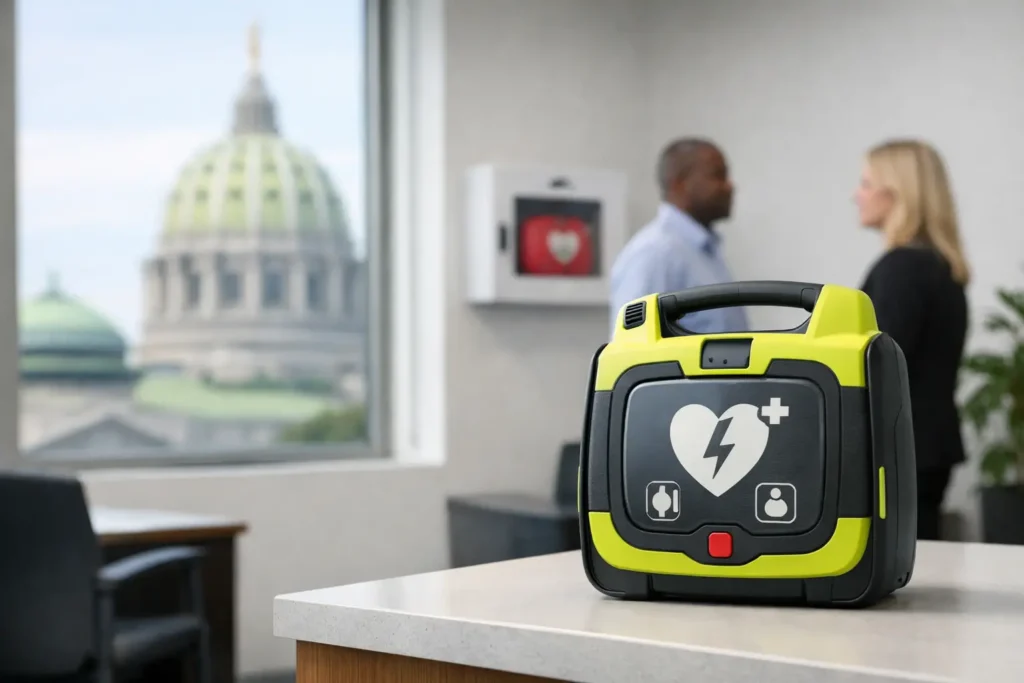
A cardiac emergency does not wait for a nurse, a safety director, or an ambulance to arrive. For Pennsylvania organizations, an automated external defibrillator is most effective when it is part of a planned response system: visible, maintained, understood by staff, and ready to be used in the first critical minutes.
This AED compliance guide for Pennsylvania is designed for the people responsible for that system, including school administrators, facility managers, HR teams, church leaders, and operations professionals. The goal is not simply to place a device on a wall. It is to create an AED program that supports a fast, confident response while meeting the requirements that apply to your organization.
Pennsylvania AED requirements are not identical for every organization. Schools, athletic venues, health clubs, healthcare settings, public facilities, and private workplaces can face different obligations under state law, local regulations, industry standards, insurer expectations, or internal safety policies. A building that is not specifically required to maintain an AED may still have a strong duty of care reason to establish a program, especially if it serves the public or hosts large groups.
That distinction matters. Compliance is not a one-size-fits-all checklist, and a cabinet on the wall does not automatically make an organization prepared. Before setting policy, confirm the rules that apply to your facility type, activities, occupancy, and location. Review current state requirements and any rules adopted by your governing body or local authority. Legal counsel or your risk-management team can help with questions specific to your organization.
Pennsylvania law provides liability protections in certain circumstances for people and entities that use or make AEDs available in good faith. Those protections generally depend on acting reasonably and following the applicable requirements. A well-managed program helps demonstrate that your organization took emergency readiness seriously.
AED placement is the first decision, not the last. The right location is one a bystander can reach quickly, identify easily, and access whenever the facility is open. In a large workplace, school campus, church, or recreation complex, a single device may not cover the entire property within a practical response time.
Start with a walk-through. Consider where people gather, where physical exertion occurs, and where access may be limited. Gyms, athletic fields, cafeterias, auditoriums, entrances, production floors, and areas serving older adults often deserve close attention. If a facility has multiple levels or separate buildings, calculate actual travel time rather than relying on a floor plan.
An AED should be placed in a clearly marked cabinet or wall location, protected from damage and extreme temperatures, and accessible without delays caused by locked doors, keys, or staff-only restrictions. For outdoor fields or remote buildings, environmental protection and after-hours access become part of the planning conversation.
A practical AED program addresses at least these five areas:
The most common AED program failure is not equipment failure. It is unclear responsibility. One employee assumes another department is checking the device, training records are stored in different places, and expired pads are discovered only after an incident or inspection.
Assign a primary AED program coordinator and a backup. Their role is to keep an accurate inventory, schedule inspections, coordinate training, document corrective action, and make sure leadership receives updates. For a school, this may involve the nurse, athletic director, facilities lead, and administration. For a workplace, it may involve safety, HR, operations, and site leadership.
The coordinator should know the exact number of AEDs, their locations, serial numbers, inspection status, and expiration dates. They should also know who can access replacement supplies and who has authority to approve service or equipment changes. This sounds administrative, but it is the foundation of readiness.
AEDs are designed to run self-tests, but they still need human oversight. A monthly visual inspection is a sensible baseline for many organizations, while manufacturer guidance and your own policies may call for additional checks. The person completing the inspection should verify that the device is present, accessible, undamaged, and showing a ready status indicator.
Inspect the cabinet, signage, rescue kit, pads, battery, and any required accessories. Confirm that pads and batteries are within their usable dates and that adult and pediatric response needs have been considered where children are regularly present. If an AED has been moved, deployed, or exposed to adverse conditions, inspect it immediately and restore it to service as soon as possible.
Documentation is as valuable as the inspection itself. Keep a simple log with the date, inspector, device status, supply expiration dates, and any corrective actions. Digital tracking can reduce missed deadlines, particularly for organizations managing several locations or a large number of devices. It also gives decision-makers a clear record of program oversight.
An AED is built for use by lay responders, and its voice prompts guide the user through the process. Still, people respond more effectively when they have practiced CPR, know where the device is located, and understand their organization’s emergency procedures.
Train designated responders in CPR and AED use through a recognized program, then broaden awareness throughout the facility. Staff who are not certified should still know how to call 911, send someone for the AED, direct emergency responders to the scene, and assist with crowd control. In a school or church, volunteers and event leaders may need the same orientation as full-time employees.
Training should reflect the environment. A manufacturing floor may need a response plan for large equipment and shift changes. A school should account for athletic events, visiting teams, and multiple buildings. A church may need a plan that works during weekend services, youth programs, and community events when office staff are not present.
Your emergency plan should define who calls 911, who retrieves the AED, who begins CPR, and who meets EMS at the entrance. Those roles can overlap in a small office, but they should still be discussed in advance. Seconds can be lost when everyone assumes someone else has made the call.
Where applicable, notify local emergency services or the appropriate dispatch system about AED locations. Requirements and preferred procedures can vary, so confirm the process with local authorities. Keep facility addresses, building entrances, gate codes, and directions available to staff who may need to guide responders.
After any AED use, remove the device from service until it has been checked, cleaned, and restocked according to manufacturer instructions. Preserve any event data as required by your policies and coordinate follow-up with leadership, medical professionals, and emergency responders.
A compliant AED program needs attention when your organization changes, not just when supplies expire. Renovations, new additions, changing enrollment, a growing workforce, or a move to a new facility can all affect placement and response times. Staff turnover also creates training gaps that are easy to miss.
Review the program at least annually and after any emergency, drill, facility change, or significant staffing shift. Ask practical questions: Can people still reach the AED quickly? Is the signage visible? Are trained responders available during every shift or event? Does the inspection record show recurring issues? The answers should shape the next round of improvements.
For organizations that want one partner for equipment, CPR/AED training, replacement supplies, and ongoing tracking, Square One Medical can help turn these moving pieces into a manageable program. The right support can reduce administrative burden without taking ownership away from the people who know the facility best.
Preparedness is built in ordinary moments: when an expiring pad set is replaced on time, when a new coach learns where the AED is located, and when a monthly inspection confirms the device is ready. Those routine actions give people a better chance when an emergency becomes real.