
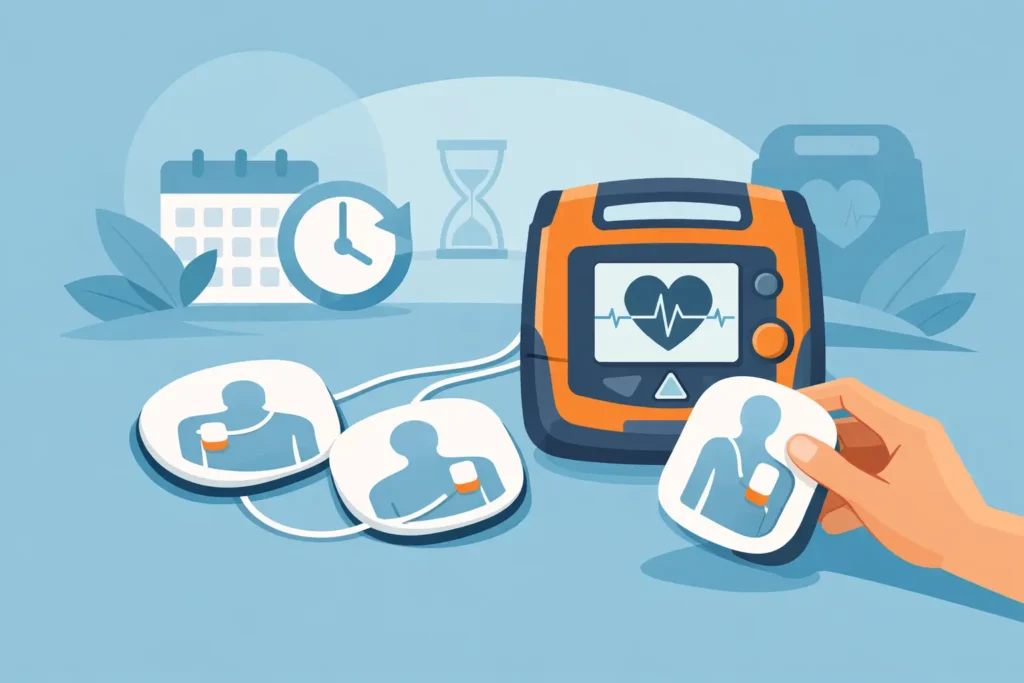
An AED can sit quietly on the wall for years, but its pads cannot. If you are responsible for emergency readiness in a workplace, school, church, or public facility, knowing how often replace AED pads is not a minor maintenance detail. It is part of making sure the device will work the moment someone collapses.
Most AED pad sets need to be replaced every 2 to 5 years, depending on the manufacturer and model. The exact expiration date is printed on the pad package, and that date is the one that matters. If your pads are past expiration, opened, dried out, damaged, or used during a rescue, they should be replaced right away.
For most organizations, the simplest answer is this: replace AED pads by the expiration date listed on the sealed package, and replace them sooner if they have been used or compromised. While that sounds straightforward, it helps to understand why AED pads expire in the first place.
The adhesive gel on the pads must stay in good condition so it can stick properly to the patient’s chest and deliver the shock as intended. Over time, that gel can dry out or lose effectiveness, even if the AED itself still powers on and passes self-tests. A device that looks ready may still be missing one of its most important working parts.
That is why pad replacement should never be based on guesswork or visual appearance alone. A sealed set can still be expired, and an AED cabinet inspection that skips the expiration date can create a false sense of readiness.
AED pads are single-use medical consumables. They are built for reliability, but they are not permanent. Heat, cold, humidity, and storage conditions can all affect longevity. In a climate-controlled office, pads may reach their full shelf life. In a warehouse, school gym, church vestibule, or police vehicle, temperature swings may put more stress on the package over time.
That does not always mean they expire earlier than the printed date, but it does mean regular inspection matters more in less controlled environments. If the packaging is peeling, punctured, or visibly damaged, replacement is the safer choice.
There is also a practical issue many organizations overlook: after a rescue, pads cannot be reused. Once they have been applied to a patient, they need to be replaced before the AED is put back into service. If your team has responded to an incident and no one orders new pads immediately, your program may be left exposed.
The brand and model of AED make the biggest difference. Some pads carry a shorter shelf life, while others are designed for longer-term storage. Adult pads and pediatric pads may also have different expiration timelines, so organizations that stock both need to track each set separately.
Usage patterns matter too. A school nurse’s office or athletic facility may reasonably expect more frequent AED checks because of heavier foot traffic and event use. A church or office building may go years without an emergency, but that does not reduce the need for tracking. In fact, low-use environments are often where expirations get missed because the device is rarely handled.
Your inspection process also shapes replacement timing in practice. If someone checks the AED monthly and logs pad expiration dates, replacements are usually routine. If inspections are informal, the odds of discovering expired pads after the fact go up quickly.
The most reliable approach is to treat pad replacement as part of your broader AED program, not a one-time purchase. Start with the manufacturer’s expiration date. Then build in a review schedule so your team sees that date well before it becomes a problem.
A monthly AED check is a strong standard for most facilities. During that check, confirm the status indicator shows the device is ready, make sure the pad package is sealed and intact, and note the expiration date. If the pads will expire within the next few months, order replacements before they lapse.
Many organizations do well with a 60- to 90-day lead time. That gives enough room for purchasing approvals, shipping, and internal handoff. It is especially helpful for schools, churches, and multi-site employers where supplies may sit in a purchasing queue.
One common mistake is assuming the AED battery and pads expire together. They often do not. Each consumable has its own timeline, and both need to be tracked separately.
Another is storing a spare set without recording its expiration date. Backup pads are smart to keep on hand, especially in high-traffic locations, but only if someone is monitoring those dates too. A spare set that quietly expires in a cabinet does not solve the problem.
Organizations also sometimes buy the wrong replacement pads for their device. AED pads are model-specific in many cases, so replacements should match the exact AED unit. This is one reason many safety coordinators prefer working with a supplier that also supports AED program management rather than ordering ad hoc when something expires.
Schools, churches, and workplaces all face the same basic rule: replace pads by the printed expiration date and immediately after use. Where they differ is in how easy it is to stay on top of that rule.
Schools often have several AEDs across campuses, athletic spaces, and administrative buildings. Churches may rely on volunteers who rotate responsibility. Workplaces may have AEDs in offices, warehouses, production floors, or company vehicles. In each case, the challenge is less about knowing the rule and more about building a dependable process.
That process can be simple. Assign ownership, perform routine inspections, keep a replacement record, and reorder before expiration. If your organization has multiple devices, centralizing that tracking can save time and reduce risk.
Even if the expiration date is months away, replace AED pads right away if they have been used in a rescue, if the package is open, if the seal is broken, if the pads are dried out or no longer adhesive, or if the packaging has visible damage. Any one of those issues can affect performance.
If you are ever unsure, caution is appropriate. AED readiness depends on small details being handled before the emergency happens, not during it.
For many organizations, the best habit is to pair training, equipment oversight, and replacement planning together. That makes AED compliance easier to manage and helps ensure the device on the wall is truly rescue-ready. A few minutes spent checking pad dates now can spare you from finding out too late that a critical piece of your emergency response plan had already expired.