
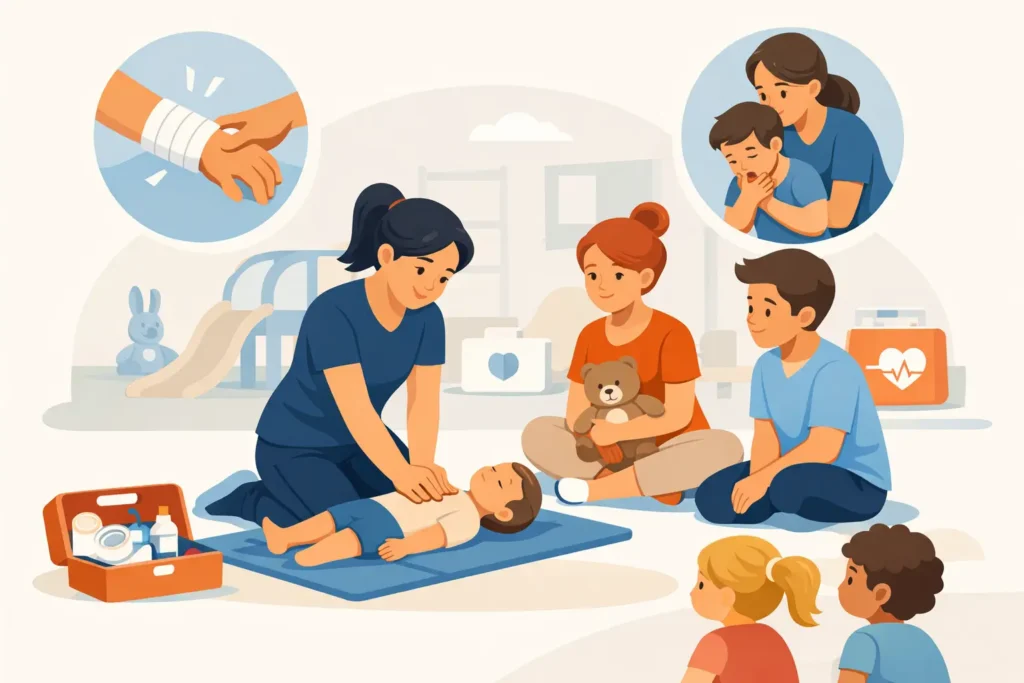
A toddler falls from a low climber, cries hard, then suddenly goes quiet. Another child is coughing at snack time and turns red. In daycare, emergencies rarely arrive with much warning. That is why pediatric first aid training for daycare staff is not just a licensing box to check. It is a practical part of protecting children, supporting staff, and reducing response time when seconds matter.
Daycare teams work in an environment where minor injuries are common and higher-risk medical events can happen without notice. Staff may need to respond to choking, allergic reactions, head injuries, seizures, breathing problems, or cardiac arrest before EMS arrives. The quality of that first response can shape what happens next.
Children are not just smaller adults. Their airways are narrower, their vital signs differ, and their distress can escalate quickly. A course built for general workplace first aid may cover useful basics, but daycare settings need child-focused instruction that reflects real situations staff face every week.
That includes recognizing when a child is in immediate danger versus when they can be monitored, knowing how to respond without creating panic, and understanding age-appropriate care. Infant choking response is different from care for a preschooler. So is CPR technique, airway support, and how to assess responsiveness.
There is also an operational reason this training matters. Parents trust daycare providers with the people most important to them. When your team is trained, equipped, and practiced, you are not only improving safety. You are building a stronger, more credible childcare program.
The right pediatric first aid training should go beyond a quick video or a generic online module. For daycare teams, hands-on practice is especially valuable because emergencies involving children are stressful and fast-moving.
At a minimum, training should cover infant and child CPR, choking response, bleeding control, burns, allergic reactions, seizures, head injuries, and how to recognize breathing or cardiac emergencies. Staff should also learn when and how to activate 911, how to communicate with parents after an incident, and how to document what happened.
AED awareness belongs in that conversation too. Some childcare operators assume automated external defibrillators are only relevant in large schools or adult workplaces. That is a mistake. While pediatric cardiac emergencies are less common, they do happen. An AED can also be used in an emergency involving a parent, visitor, contractor, or staff member on site.
For many daycare centers, the best approach is not just training staff in CPR and first aid, but also placing an AED on site and making sure the team knows exactly where it is, how to use it, and how to maintain it. Modern AEDs are designed to guide rescuers with clear voice prompts, and pediatric pads or settings can support age-appropriate use when needed.
A certified team is important, but certification by itself does not create readiness. Daycare operators should think in terms of a response system.
That means asking practical questions. Is there a stocked first aid kit that matches the risks in your facility? Are emergency contacts current and easy to access? Is medication storage organized? If you have an AED, are the pads and batteries in date? Does your staff know who calls 911, who meets EMS at the door, and who stays with the other children?
This is where many centers run into trouble. They invest in training, then assume the job is done for two years. In reality, skills fade, staff changes happen, and equipment expires. A stronger model is ongoing preparedness that includes refresher practice, equipment checks, and a simple plan everyone understands.
Not every course is a good fit for daycare staff. Some are designed for healthcare professionals and go deeper than most childcare teams need. Others are too broad and leave out child-specific scenarios.
Look for training that is clearly built around infant and child response, includes hands-on skill evaluation, and addresses the realities of a group childcare setting. Onsite training is often the best choice for daycare programs because it reduces scheduling headaches and allows instructors to tailor examples to your environment.
It also helps to work with a provider that can support more than the class itself. If the same partner can help you evaluate AED placement, supply first aid equipment, manage AED maintenance, and track expirations, your preparedness program becomes easier to sustain. For administrators already juggling staffing, licensing, and parent communication, that kind of support matters.
AEDs deserve more attention in childcare settings than they often get. Cardiac arrest is not the most common daycare emergency, but it is one of the most time-sensitive. Early CPR and rapid defibrillation are critical links in the chain of survival.
An AED on site supports a broader safety plan. It protects children with known or unknown heart conditions, and it protects adults in the building as well. In a daycare center, that could include teachers, aides, office staff, delivery personnel, grandparents at pickup, or parents attending an event.
Placement matters. An AED should be easy to reach, clearly marked, and not locked away in a place only one person can access. Staff should know where it is and practice retrieving it quickly. The best equipment plan also includes monitoring pad and battery expiration dates, replacing used supplies promptly, and keeping pediatric-capable accessories available if appropriate for the device.
For centers with multiple rooms or larger campuses, AED placement may need more thought. The goal is simple: make it possible to get the device to a victim fast. That is where guidance from an experienced training and equipment partner can help avoid guesswork.
A lot of childcare programs have the right intentions but uneven execution. One common gap is relying on one or two trained employees instead of ensuring coverage across shifts, classrooms, and breaks. Another is failing to prepare for turnover. If a trained lead teacher leaves, readiness can disappear overnight.
There is also the problem of equipment without ownership. A center may have a first aid cabinet or even an AED, but no one is assigned to inspect it. Months later, supplies are missing or expired. That is not a training issue. It is a management issue.
The strongest daycare programs treat emergency readiness as part of daily operations, not as an isolated compliance task. They schedule training before certifications lapse. They review response roles. They inspect emergency supplies. They make preparedness visible and routine.
Some daycare directors hesitate to schedule more comprehensive training because they worry it will overwhelm staff or make parents anxious. Usually, the opposite happens. Good training reduces anxiety because people know what to do. It turns a vague fear of emergencies into a clear response process.
Parents are generally reassured when they learn a center takes pediatric emergencies seriously, trains its team well, and equips the facility appropriately. Staff benefit too. In a high-responsibility environment like childcare, confidence matters. People perform better under pressure when they have practiced the right skills.
If your daycare is reviewing its safety plan, this is a smart place to start: make sure pediatric first aid training matches the realities of your setting, then support it with the equipment and program management that keep readiness from slipping over time. When children are counting on the adults in the room, preparation needs to be real, not assumed.