
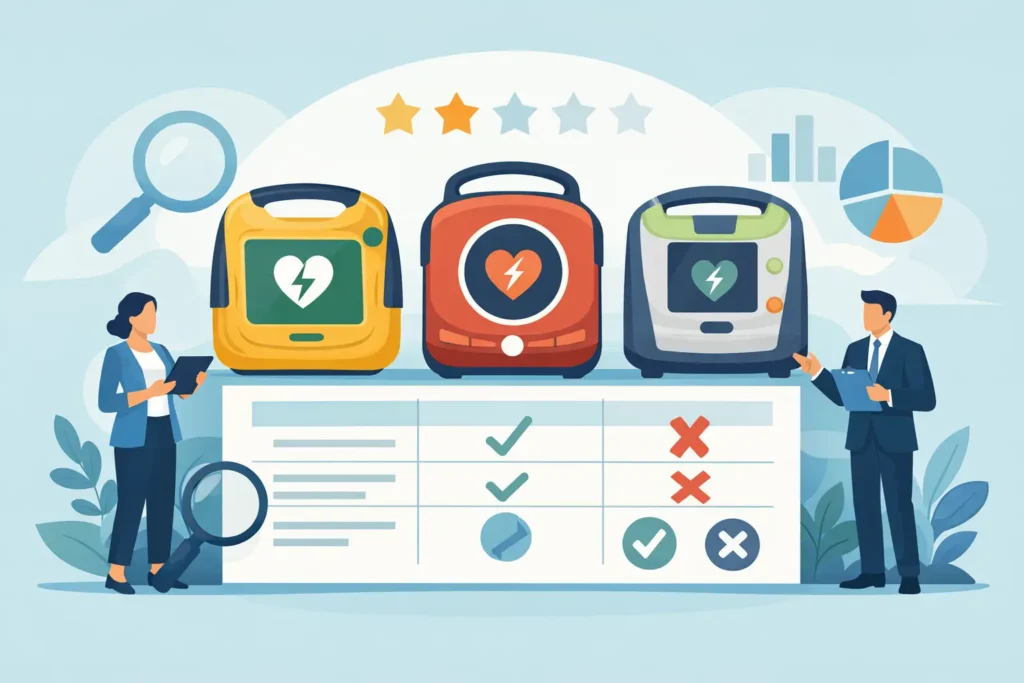
When an organization starts shopping for an AED, the first question is rarely technical. It is usually practical: which device will be easiest for our people to use when stress is high and seconds matter? That is why any useful AED brands comparison has to go beyond product specs and focus on real-world readiness.
For employers, school leaders, church administrators, and facility managers, the right AED is not simply the one with the longest feature list. It is the one that fits your environment, supports your response plan, and stays ready over time without creating unnecessary maintenance headaches.
A lot of buyers begin by comparing price. That makes sense, but it is only part of the picture. The better comparison looks at ease of use, electrode pad design, CPR feedback, durability, maintenance requirements, and long-term support.
Ease of use matters because most AEDs are purchased for lay responders, not clinicians. Clear voice prompts, simple visual cues, and intuitive pad placement can make a real difference during a cardiac emergency. Some brands are especially strong in guided rescue support, while others lean more heavily on rugged construction or compact design.
Maintenance is just as important. Pads and batteries expire. Software may need updates. Status indicators need to be checked. If a device is affordable upfront but difficult to track over the life of the program, the total cost and compliance burden may be higher than expected.
ZOLL is often a strong fit for organizations that want support during the rescue, not just a shock if needed. Many buyers know the brand for its Real CPR Help technology, which provides feedback on compression depth and rate. For workplaces, schools, and churches where responders may have limited experience, that guidance can build confidence.
ZOLL devices also tend to be appealing for organizations that value program support and straightforward maintenance workflows. The trade-off is that buyers should still match the model to the setting. A small office may not need the same device profile as a police department or athletic facility.
Philips AEDs are widely recognized and often chosen for their simple operation and strong reputation in public access settings. They are commonly viewed as approachable devices for non-clinical users, which can be attractive for offices, houses of worship, and community organizations.
The main consideration is long-term service strategy. As with any brand, buyers should look closely at replacement pad costs, battery life, and support availability. A familiar name is helpful, but ongoing readiness is what matters most.
Cardiac Science devices are often selected for durability and rescue guidance. Some organizations appreciate their visibility and straightforward prompts, especially in settings where multiple staff members may share response responsibility.
These units can be a practical choice for schools, recreation spaces, and larger facilities, but the best fit depends on how your team is trained and how the AED program will be managed. A durable device is valuable, but only if consumables and oversight are handled consistently.
Defibtech is frequently considered by buyers looking for operational simplicity. Many decision-makers like the brand because it can be easy to understand and deploy across standard public access locations.
This can make it attractive for churches, smaller businesses, and community sites that want a dependable AED without overcomplicating the purchase. Even so, a simpler device should still be reviewed in the context of training, cabinet placement, and replacement schedule management.
HeartSine units are often noted for compact size and portability. That makes them worth considering for mobile teams, smaller campuses, coaches, and environments where storage space is limited.
Portability is a real advantage, but it is not the only one that matters. Buyers should also consider how the device will be stored, who is expected to use it, and whether the maintenance model fits the organization. A compact AED that gets tucked away in an obscure spot is less helpful than a larger one placed where people can reach it quickly.
In offices, warehouses, manufacturing sites, and commercial buildings, the best AED choice usually comes down to visibility, ease of use, and maintenance support. If your workforce changes shifts, includes non-medical staff, or spans a large building, simplicity matters. Guided prompts and program management support often carry more value than niche features.
Schools need to think about both daily campus access and higher-risk events such as sports, assemblies, and after-hours activities. An AED in the nurse’s office may not be enough. Placement strategy often matters as much as brand selection.
For these environments, many buyers prioritize a device that is easy for trained staff, coaches, and administrators to use under pressure. Pediatric capability, visibility, and response planning are all part of the decision.
Churches often have volunteers, varied attendance patterns, and mixed-age populations. In these settings, the right AED is usually one that feels approachable and can be supported without a complex medical infrastructure.
A practical buying decision includes not only the unit itself, but also cabinet placement, signage, and staff or volunteer training. The goal is not to own an AED. The goal is to have one that people can find, trust, and use.
Law enforcement and public safety agencies may need more mobility and ruggedness, especially when AEDs are assigned to vehicles or field teams. In these cases, environmental durability and transport considerations play a larger role.
That does not mean every tactical setting needs the same device. It means the buying process should reflect actual use conditions rather than a generic public access checklist.
A smart AED brands comparison includes what happens after purchase. That is where many organizations either build a reliable program or end up with expired pads, missed checks, and equipment that no one feels responsible for.
Ongoing support can include expiration tracking, replacement reminders, program reviews, trade-in planning, and help with AED placement. For many organizations, this is the difference between checking a box and creating a response system that can hold up in a real emergency.
This is also why working with a training and equipment partner can make the process easier. When CPR training, AED sales, and program management are aligned, decision-makers spend less time coordinating vendors and more time improving readiness.
If you are choosing between brands, start with your environment, not the catalog. Think about who will respond, how often the area is occupied, where the AED will be placed, and who will manage consumables over time.
Then compare brands through that lens. The best option may be the one with stronger CPR feedback, the one with simpler operation, or the one backed by better support after the sale. There is no single winner for every organization, which is exactly why a careful comparison matters.
An AED purchase should leave your team feeling more prepared, not more confused. If the device fits your setting and the support behind it is solid, you are not just buying equipment. You are building a response plan people can rely on when it counts.