
Now for a limited time, trade in your old AED for a generous rebate toward a new unit!
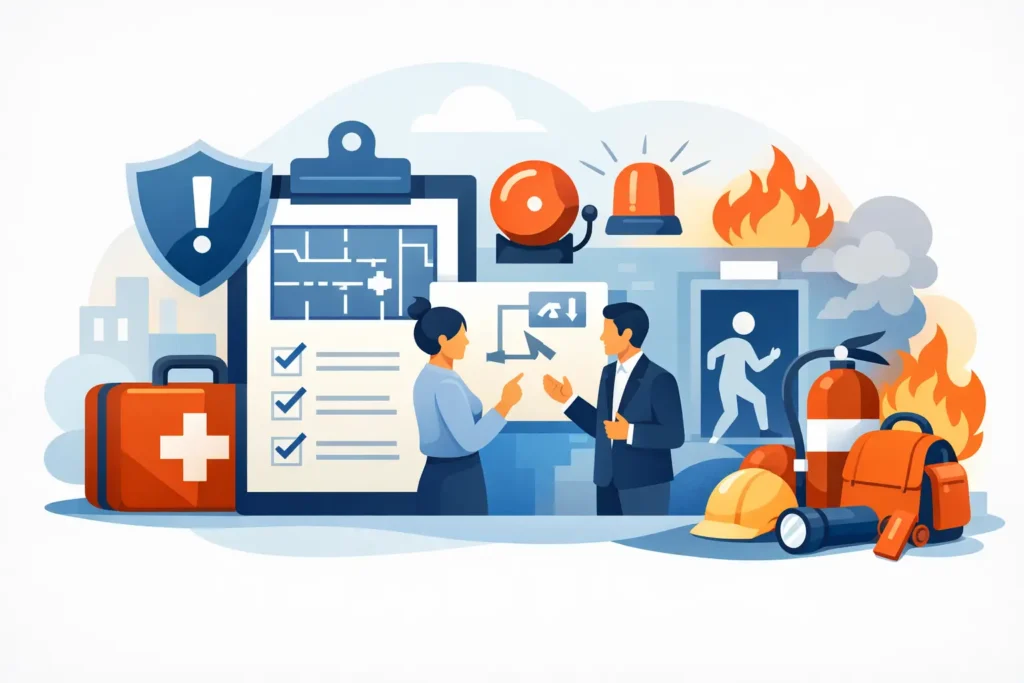
A medical emergency at work rarely arrives with warning. It happens in the middle of a shift, during a staff meeting, on a loading dock, in a school office, or in a church lobby. If you need to build workplace emergency response plan systems that people can actually follow under stress, the goal is not a thick binder on a shelf. The goal is a clear, practiced response that helps your team act fast, use the right equipment, and get professional care on the way.
A good plan answers a few urgent questions before an emergency ever happens. Who calls 911? Who retrieves the AED or trauma kit? Who starts CPR or first aid? Where does the ambulance enter the building? How will responders get through locked doors or large campuses quickly?
That sounds simple, but many organizations have gaps between policy and real-world response. A plan may mention first aid, yet no one has confirmed whether supplies are stocked, whether the AED pads are current, or whether staff on the second floor know where the device is mounted. In a real event, those gaps cost time.
The strongest plans are practical. They match your building layout, staffing levels, risk profile, and the people you serve. An office with 20 employees has different needs than a manufacturing floor, a school campus, a church with children’s programming, or a police facility with public access areas.
Start with a site-specific risk review. Look at the emergencies most likely to occur in your setting, including sudden cardiac arrest, choking, severe bleeding, falls, allergic reactions, overdose incidents, and weather-related evacuation or shelter situations. If your team works with the public, children, older adults, or physically demanding jobs, your risk picture changes.
Next, map the response. Walk the building and identify where an emergency is most likely to happen and how long it would take to reach equipment. AED placement matters here. In cardiac arrest, every minute counts, so the device needs to be easy to find and fast to access. A locked office, cluttered storage room, or poorly marked cabinet can turn a good purchase into a bad deployment.
Then assign roles by function, not by hope. Someone should be responsible for activating EMS, someone for meeting responders, someone for beginning care, and someone for crowd control or directing staff and visitors. In smaller workplaces, one person may hold more than one role. That is fine, as long as the plan reflects reality and backup coverage exists for absences, vacations, and turnover.
One of the most common mistakes is treating training and equipment as separate projects. They are not. If your staff is CPR and AED trained but the AED is outdated, hard to access, or missing supplies, response breaks down. If you buy excellent equipment but no one feels confident using it, response still breaks down.
Your emergency response plan should pair people, equipment, and process. That means CPR and AED training for the right team members, first aid training where appropriate, and equipment that matches your setting. For many organizations, that includes AEDs, replacement pads and batteries, cabinets, signage, first aid supplies, trauma kits, and in some facilities, overdose response cabinets.
It also means deciding what level of readiness you want. Some sites need broad staff awareness with a smaller trained response team. Others, especially schools, churches, manufacturing sites, and public-facing facilities, benefit from wider hands-on training because the nearest responder may not be the designated responder.
If you are going to build workplace emergency response plan policies around cardiac events, AED strategy deserves special attention. Sudden cardiac arrest can happen to employees, customers, parents, visitors, students, parishioners, or contractors. The device should be placed where it can be retrieved and applied quickly, not where it looks convenient on a floor plan.
Placement depends on building size, traffic flow, stair access, security restrictions, and whether your organization has multiple structures or large outdoor areas. A single AED near the front desk may be enough for a small office. It may be completely inadequate for a warehouse, school campus, athletic facility, or church with separate wings.
You also need a maintenance process. Pads and batteries expire. Status indicators need to be checked. Accessories go missing after drills or incidents. An AED program works best when someone is clearly assigned to inspections, documentation, and replacement scheduling. This is where AED program management becomes valuable, especially for organizations that do not want compliance and readiness tracking to fall through the cracks.
Even a well-written plan should be tested. Tabletop discussions are useful, but short live drills are what expose delays and confusion. You may find that staff are unsure which entrance EMS should use, that the AED cabinet alarm startles people into freezing, or that after-hours teams do not know where supplies are kept.
Run drills at different times and in different parts of the facility. Include new hires and part-time staff when possible. Keep the scenario focused and realistic. The goal is not to embarrass anyone. It is to make response smoother before a real emergency forces the issue.
After each drill, make a few corrections quickly. Update phone trees, improve signage, relocate equipment, or clarify assignments. Small changes often create the biggest gains in speed and confidence.
Your plan should be written down, easy to access, and simple enough to follow under pressure. Long documents full of generic language tend to get ignored. A better approach is a short master plan supported by quick-reference instructions, maps, equipment locations, and role assignments.
For example, your front office may need one set of instructions, while a warehouse supervisor or school nurse needs another. The core response should stay consistent, but the details can be tailored by area. This makes the plan more usable without making it more complicated.
It is also smart to review the plan at least annually, and sooner if you move equipment, change layouts, add new programs, or experience an incident. Emergency readiness is not static. Buildings change. Teams change. Risks change.
Many organizations delay emergency planning because it feels like a large project. In reality, the hardest part is getting started. Once your roles, equipment, training schedule, and inspection routine are in place, maintaining the program becomes much more manageable.
That is why decision-makers often prefer a single partner who can help with both training and equipment. Coordinating CPR and AED instruction, AED placement, replacement consumables, and ongoing readiness support through one source reduces administrative friction and makes follow-through more likely.
If your team is unsure where to begin, start with three questions. Do we have the right equipment in the right locations? Do the right people know what to do? Can we prove the program is current and ready today, not just on paper?
A workplace emergency response plan is not there to impress an auditor or fill a policy folder. It is there for the day someone collapses, bleeds heavily, stops breathing, or needs immediate help before EMS arrives. When your plan is practical, your equipment is ready, and your people have trained for the moment, you give them something that matters more than policy – a real chance to respond well.