
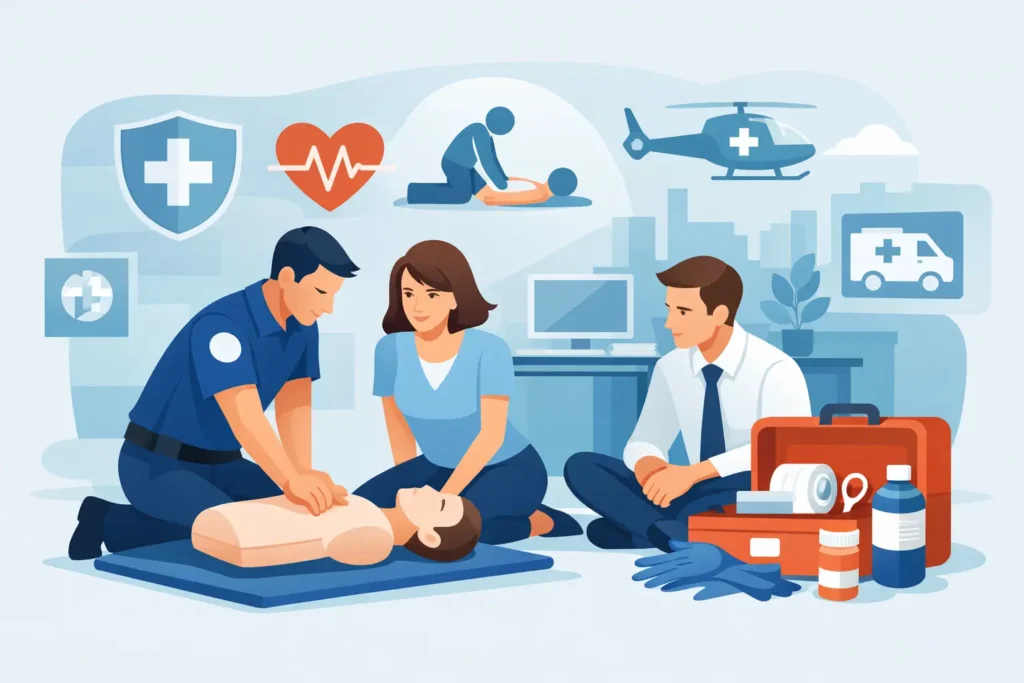
A recordable injury is stressful enough. It gets worse when the nearest trained responder is off shift, the first aid kit is missing key supplies, or no one knows whether an AED is even on site. That is why workplace first aid training requirements matter far beyond a compliance checkbox. They shape how quickly your team can respond, how confidently staff act under pressure, and how prepared your facility is when minutes count.
For most employers in the US, the starting point is OSHA. But OSHA does not give every business the same one-size-fits-all rule. The real answer depends on your work environment, your hazards, how quickly outside emergency medical services can reach you, and whether your organization has chosen to place AEDs and build a stronger internal response program.
OSHA requires employers to make medical and first aid personnel available for advice and consultation on workplace health issues. In practical terms, that means every employer needs a plan for prompt first aid. If there is no infirmary, clinic, or hospital in near proximity to the workplace, a person or people must be adequately trained to render first aid.
That phrase – near proximity – is where many organizations need to slow down and think carefully. OSHA generally interprets it based on whether emergency care can arrive quickly enough for the type of injuries that could occur at your site. A low-hazard office in a dense urban area may have a different first aid staffing need than a warehouse, manufacturing plant, church campus, school, or police facility where severe bleeding, cardiac arrest, falls, or equipment injuries are realistic risks.
So the requirement is not just, Do we have a trained person somewhere in the company? It is, Can trained help reach the injured person quickly enough, during the hours and in the areas where work is actually happening?
A front office, a distribution center, and a maintenance shop should not all be evaluated the same way. Workplace first aid training requirements are driven by hazard exposure, staffing patterns, shift coverage, building layout, and response time.
In a lower-risk setting, employers often designate a reasonable number of staff members to complete first aid and CPR/AED training so coverage exists during normal operations. In higher-risk environments, more trained responders may be needed across departments, shifts, and physical locations. If your team works in large facilities, separate wings, campuses, loading areas, or field settings, distance inside the site matters just as much as distance from the nearest hospital.
This is also where many organizations underestimate turnover and absenteeism. A program that looks adequate on paper can fail in real life if the only trained employee is on vacation, in a meeting, or works only day shift. Requirements may not spell out an exact ratio for every workplace, but dependable coverage is still the standard you should build toward.
First aid training is not most useful when it is generic. It is most useful when it reflects the injuries and medical emergencies your team could reasonably face. That usually includes basic first aid, CPR, AED use, choking response, bleeding control, shock, burns, fractures, and medical emergencies such as seizures or diabetic events.
For some workplaces, trauma response deserves more attention than a basic class alone can provide. Manufacturing, construction-adjacent operations, schools with athletic programs, houses of worship with large gatherings, and law enforcement settings may benefit from stronger bleeding control preparation and trauma kit placement in addition to standard first aid instruction.
Hands-on practice matters too. A staff member who has physically opened an AED, placed pads, and practiced scenario-based response is far more likely to act quickly than someone who only watched a video months ago.
A common point of confusion is whether first aid training automatically means CPR and AED training are also required. Legally, that depends on the workplace and the governing standards that apply. Operationally, though, separating them is often a mistake.
Cardiac arrest can happen in offices, schools, churches, gyms, warehouses, and public-facing facilities. When an AED is on site, staff should be trained to use it confidently. An AED without trained responders is not a preparedness program. It is a device on a wall that people may hesitate to touch during the exact moment it is needed.
That is why many organizations pair first aid training with CPR/AED certification for designated responders, supervisors, front desk staff, coaches, security personnel, facilities teams, and others likely to be first on scene. If your building serves the public, hosts events, or supports large groups, AED placement and AED program management become even more important.
Training alone is only half the picture. OSHA also expects appropriate first aid supplies to be readily available. What counts as appropriate depends on your hazards. A small administrative office may need a very different kit than a manufacturing floor, school district transportation department, or church campus with childcare and sports programming.
The same logic applies to AEDs. While not every workplace is explicitly required by federal law to install one, many organizations choose AED placement because it improves response capability, reduces confusion, and supports a stronger duty-of-care standard. In some environments, state laws, local rules, or industry expectations may also influence AED decisions.
Once an AED is installed, readiness becomes an ongoing responsibility. Pads and batteries expire. Cabinets and signage must stay visible. Devices should be inspected on schedule. Teams need to know who manages post-event reporting, replacement supplies, and coordination after use. This is where AED program management becomes valuable. It turns a one-time purchase into a maintained response system.
If OSHA asks about your program after an incident, you want more than verbal assurances. Keep training records, certification dates, attendance rosters, equipment inspection logs, AED maintenance records, and supply replacement history.
Documentation helps you show that your response plan is active, not theoretical. It also makes retraining easier and reduces the chance that certifications lapse quietly in the background. For multi-site employers, schools, churches, and larger facilities, centralized tracking is often the only practical way to keep preparedness from becoming inconsistent.
The best approach is to assess your site the way an emergency would unfold, not the way an org chart looks. Ask how long it would take for a trained responder to reach an injured person in each area. Consider what emergencies are most likely, what the highest-consequence event would be, and whether your current staff coverage reflects evenings, weekends, events, and seasonal changes.
Then look at equipment placement. Is your first aid kit located where injuries actually happen? Is your AED positioned so a responder can retrieve it quickly without crossing a large building? In schools, churches, and public facilities, is it accessible during games, services, meetings, and community events, not just during office hours?
This evaluation often reveals that compliance and readiness are not the same thing. A technically minimal plan may still leave dangerous response gaps.
The first is assuming 911 replaces internal preparedness. EMS is essential, but for severe bleeding, choking, or sudden cardiac arrest, the first few minutes belong to the people already there.
The second is training too few people. A thin bench creates coverage gaps fast. The third is treating AED ownership like a finished task rather than an ongoing program. Devices need oversight, consumables need replacement, and staff need refreshers.
Another mistake is using generic kits and training for high-risk environments. A facility with machinery, athletics, public events, or large campuses usually needs a more tailored response setup.
A practical program usually includes designated responders trained in first aid, CPR, and AED use, plus clearly placed equipment and a simple internal response plan. It should account for shift coverage, public access areas, and the most likely emergencies in your environment.
For many organizations, working with one partner for training, AED selection, placement guidance, supplies, and ongoing management makes implementation much easier. Square One Medical supports that kind of end-to-end approach, especially for employers that want training and equipment aligned instead of managed through separate vendors.
The goal is not just to satisfy a requirement. It is to make sure someone on your team can recognize an emergency, reach the right equipment fast, and respond with enough confidence to help until EMS arrives.
When you evaluate workplace first aid training requirements that way, the question changes. It is no longer, What is the minimum we can do? It becomes, What would we want in place if the next emergency happened here this afternoon?