
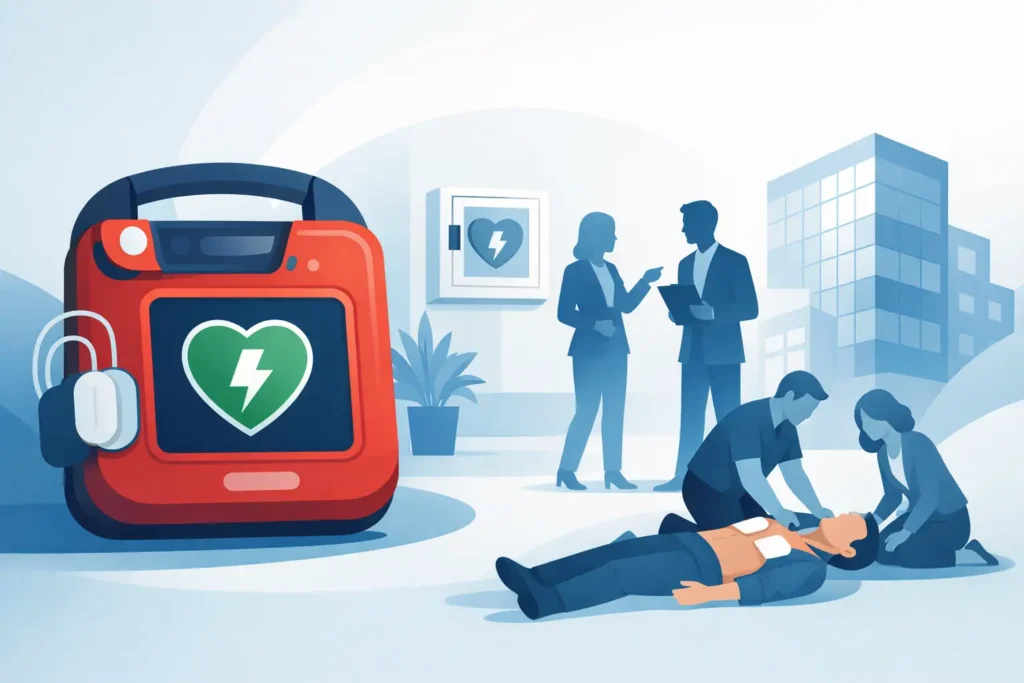
A medical emergency in an office rarely looks dramatic at first. Someone collapses in a break room, a visitor goes down in the lobby, or an employee becomes unresponsive after a meeting. In those first few minutes, having the right AED for office building use can make a life-saving difference.
For office managers, HR leaders, facilities teams, and safety coordinators, the question is usually not whether an AED matters. It is how to choose one, where to place it, and how to make sure it is actually ready when needed. That is where many workplace safety plans fall short. Buying a device is one step. Building a reliable response program is what protects people.
Sudden cardiac arrest can happen in any workplace, including offices with relatively low physical risk. Employees may have underlying heart conditions, visitors may have no known medical history, and stress, age, and health factors do not disappear because the setting is professional and climate-controlled.
An AED gives bystanders a way to respond before EMS arrives. These devices are designed to analyze heart rhythm and provide clear voice or visual prompts. Modern units are built for lay responders, which means a trained office employee can act quickly without needing advanced medical credentials.
The timing matters. Defibrillation is most effective when delivered within the first few minutes of collapse. In a large office building, those minutes can disappear fast if the device is on the wrong floor, locked in a manager’s office, or missing key supplies. That is why office AED planning should focus on real access, not just checking a compliance box.
The best AED for one office is not always the best fit for another. A small professional suite with 15 employees has different needs than a multi-floor corporate building with hundreds of staff, conference rooms, and daily visitor traffic.
Start with ease of use. In most office settings, the first person to respond will not be a medical professional. The AED should provide simple, calm prompts and guide the rescuer through each step. Clear electrode placement diagrams, automatic self-testing, and visible readiness indicators also matter because they reduce hesitation and help confirm the unit is operational.
Durability is another factor, even indoors. Office AEDs do not face the same conditions as manufacturing floors or athletic fields, but they still need to handle daily building life. Temperature changes near entrances, accidental bumps, and occasional relocation all happen. A reliable cabinet and clear signage can protect the device while making it easy to spot.
Then there is support after the purchase. Pads and batteries expire. Accessories go missing. Staff turnover affects training readiness. For many organizations, the stronger long-term decision is not simply choosing a respected AED brand. It is choosing a partner who can help with program management, replacement reminders, and ongoing support.
A good device in the wrong place can be almost as limiting as no device at all. When evaluating AED placement in an office building, think in terms of response time and traffic patterns.
The goal is to reach a victim quickly, retrieve the AED, and begin care without losing valuable minutes. In a small office, one centrally located unit may be enough. In a larger building, especially one with multiple floors or separate wings, more than one AED is often the better choice.
Lobbies, reception areas, break rooms, near elevators, and other common spaces are often strong placement options because they are visible and accessible. If your building has a gym, cafeteria, training center, or large conference area, those spaces deserve special attention. High-occupancy areas and places where people may be alone for periods of time should be part of the conversation.
Avoid putting an AED in a locked room or behind barriers that slow access. A cabinet can be alarmed and secured, but the device still needs to be reachable by regular staff during business hours and after-hours operations if the building remains occupied.
There is no universal answer. It depends on square footage, number of floors, employee count, visitor volume, and building layout. A compact office may reasonably operate with one unit. A multi-tenant or multi-floor property may need several to support timely response.
This is one of those areas where a walkthrough is more useful than a guess. Counting heads alone does not tell you how long it takes to reach the far end of the building, navigate elevators, or respond during a crowded event. Practical placement planning should match the way the space is actually used.
AEDs are designed to help non-medical responders, but training still improves confidence and speed. In an office emergency, hesitation is common. People worry about doing the wrong thing, hurting the victim, or taking charge in front of coworkers. Hands-on CPR and AED training reduces that delay.
Office teams do not need every employee certified for the workplace to be safer, but they do need enough trained responders across departments, shifts, and floors. HR, front desk staff, managers, facilities personnel, and safety team members are often strong candidates. In some offices, building security or tenant coordinators should be included as well.
Training is also where the response plan becomes real. Staff should know where the AED is, who calls 911, who begins CPR, and who meets EMS at the entrance or elevator. Those details sound simple until an actual emergency happens. Practicing them ahead of time is what makes the response feel organized rather than chaotic.
One of the biggest misconceptions about office AEDs is that once installed, they take care of themselves. While modern units perform self-checks, every AED still needs routine oversight.
Pads and batteries have expiration dates. Rescue kits should be stocked. Status indicators should be checked regularly. After any use, the unit may need new supplies, data review, and a return-to-ready process. Without a maintenance plan, an office can easily end up with an AED on the wall that looks prepared but is not.
That is why AED program management has become so important for workplaces. A managed approach helps organizations track consumables, document inspections, schedule replacements, and stay current without relying on one busy staff member to remember everything. For offices with multiple locations, this becomes even more valuable.
Many decision-makers start this process because they are thinking about risk. That is reasonable. They want to protect employees and visitors, but they also want to understand liability, state requirements, and internal policy expectations.
The specifics vary by state and workplace type, so there is rarely a one-size-fits-all answer. Some organizations have stronger requirements based on public access, staffing model, or industry expectations. Others are not strictly required to install an AED but choose to do so because it strengthens workplace safety and emergency readiness.
The practical approach is to think beyond the minimum. An AED program should include the device itself, placement strategy, responder training, maintenance documentation, and a clear response process. That creates a more defensible, more useful system than simply purchasing equipment and hoping for the best.
Most office leaders can choose an AED model in a short meeting. The harder questions come after that. Who will monitor expirations? Who schedules refresher training? What happens if the office moves, expands, or adds another floor? Who makes sure the device is ready six months from now, not just on installation day?
That is where a full-service partner becomes more valuable than a basic product transaction. Square One Medical supports organizations with AED selection, placement guidance, CPR and AED training, and ongoing management support so the program stays usable over time. For offices trying to simplify safety operations, having equipment and training under one roof often saves time and reduces gaps.
If you are evaluating an AED for office building safety, the strongest decision is usually the one that fits your space, your people, and your ability to maintain readiness. A well-placed, well-supported AED gives your team more than equipment on the wall. It gives them a real chance to act when every minute counts.
The best time to sort out placement, training, and maintenance is before anyone needs help.