
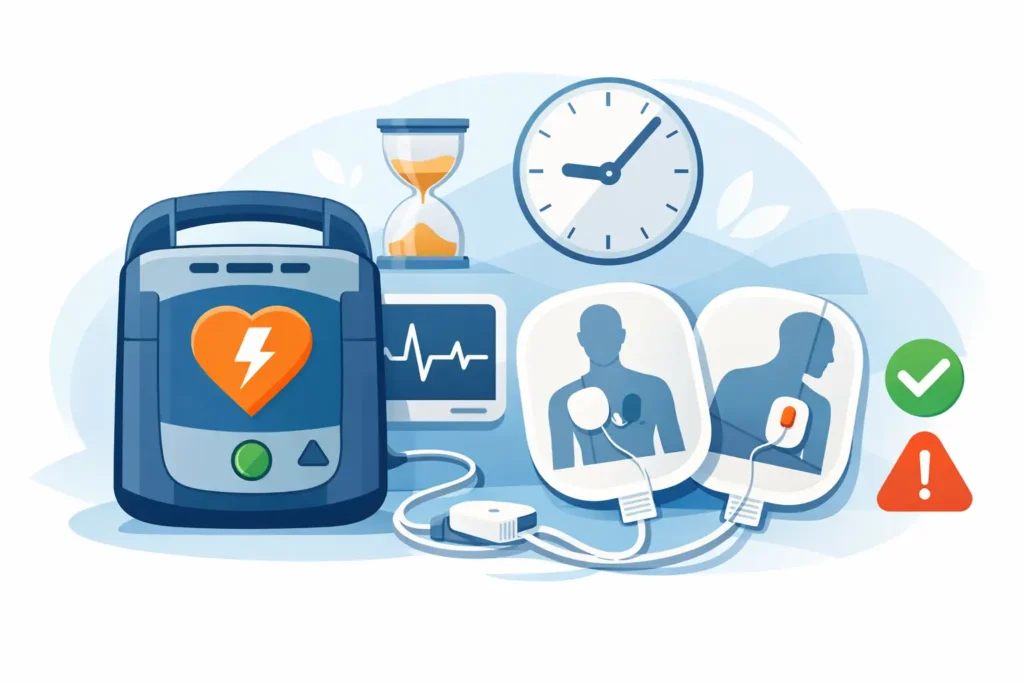
An AED can sit quietly on the wall for months or years, but the moment it is needed, every part of it has to work without hesitation. That is why aed replacement pads deserve more attention than they usually get. Pads are not a small accessory. They are the patient connection point that allows the device to analyze heart rhythm and, if needed, deliver a shock.
For schools, offices, churches, gyms, and public facilities, expired or incompatible pads can turn a well-intended AED program into a risky gap in readiness. The good news is that pad replacement is straightforward when it is built into a regular maintenance process.
AED pads are single-use components with adhesive gel and embedded conductive material. Over time, that gel can dry out, packaging can degrade, and the pads may no longer adhere properly to the chest. If the pads do not make solid contact, the AED may not be able to assess the patient accurately or deliver therapy as intended.
This is one of the most common issues in neglected AED programs. A facility may have invested in a quality AED and cabinet, trained staff, and posted signage, but if the pads are expired, the system is not truly response-ready.
There is also a compliance side to this. Many organizations track AED readiness as part of workplace safety, school health planning, or risk management. Replacing pads on time is a basic but important part of showing that the device is maintained according to manufacturer recommendations.
Most pads need to be replaced by their printed expiration date, even if they have never been opened or used. That date matters because the adhesive and conductive materials have a shelf life. Once it passes, reliability becomes uncertain.
Pads also need replacement immediately after any rescue use. Even if the AED only analyzed the patient and did not deliver a shock, the pads should not be reused. They are designed for one patient, one event.
There are a few other situations where replacement may be necessary before the expiration date. If the package is torn, punctured, wet, or separated at the seal, the pads should be taken out of service. The same applies if they were stored in extreme heat or cold outside the manufacturer’s recommended range.
Sometimes the issue is obvious, and sometimes it is not. During a routine AED check, look for an approaching expiration date, damaged packaging, missing pads, or a mismatch between the pads and the AED model. If your device supports both adult and pediatric use, confirm that the correct pad type is stocked for your response plan.
This is where organizations often run into trouble. A replacement set may look similar, but AED pads are not universally interchangeable. Brand, model, and intended patient type all matter.
The safest approach is to match replacement pads exactly to the AED manufacturer and model. Some devices use pads with integrated rescue sensors, CPR feedback functions, or specific connectors. Others require separate pediatric pads or a child key depending on the system.
For a buyer managing multiple facilities, it helps to keep a clear equipment record that lists each AED model, serial number, battery type, and pad expiration date. Without that, reordering becomes more error-prone, especially across school campuses, church buildings, or larger workplaces.
There is also a practical trade-off between standardization and legacy equipment. If your organization has several different AED brands across locations, replacement logistics get harder. Standardizing where possible can simplify training, inspections, and consumable replacement. If you are working with older units, it may be worth comparing the cost of ongoing pad and battery replacement against upgrading to a newer platform.
A monthly visual inspection is a strong baseline for most organizations. That check does not need to be complicated. Confirm the AED status indicator shows ready, make sure the pads are present and sealed, and verify the expiration date has not passed.
For higher-traffic environments or programs with multiple devices, a more formal tracking system is usually worth it. Manual logs can work, but they are easy to forget when responsibilities shift between departments or staff members. Program management support or expiration tracking helps reduce missed replacements and last-minute rush orders.
AED pads should be stored with the device and kept within the temperature and humidity range specified by the manufacturer. This matters more than many teams realize. A warehouse, unconditioned gym lobby, church vestibule, or vehicle can expose supplies to temperature swings that shorten usable life.
If your AED is mounted in an area that gets unusually hot or cold, review whether the cabinet, storage location, or equipment setup is still appropriate. Placement decisions affect not only accessibility, but long-term reliability.
After any AED deployment, pad replacement should be part of the reset process before the device goes back into service. That usually includes installing new pads, checking battery status, verifying the readiness indicator, restocking any response kit items, and documenting the event.
This is where having a support partner helps. After a stressful incident, many organizations are not thinking about part numbers or post-use inspections. They are focused on their staff, students, patient, or community member. A clear process keeps the AED from being returned to the wall only partially restored.
Replacing pads on schedule is a small operating expense compared with the consequences of failure during an emergency. That failure may mean delayed treatment, increased liability exposure, and a loss of confidence in the organization’s safety planning.
At the same time, overbuying is not always the answer. Pads have expiration dates, so stocking excessive inventory can create waste. The better approach is to keep the right quantity on hand for your program size, response risk, and replacement cycle.
For many organizations, this comes down to a simple question: do you want to manage AED consumables as occasional purchases, or as part of an ongoing readiness plan? The second option is usually more dependable, especially for schools, churches, manufacturers, and multi-site employers.
AED readiness works best when pad replacement is not treated as a one-off task. It should be part of a larger program that includes staff training, device placement, monthly checks, battery monitoring, and post-incident support.
That is especially true for organizations responsible for multiple buildings or large public populations. A school district, church network, or employer with several facilities benefits from a consistent process that makes expirations visible before they become a problem. Square One Medical supports many organizations in exactly this area by helping connect training, equipment, and ongoing AED management into one practical system.
A good AED program does not depend on remembering at the last minute. It depends on simple routines, the right supplies, and a plan that keeps lifesaving equipment ready for the day it is needed.