
Now for a limited time, trade in your old AED for a generous rebate toward a new unit!
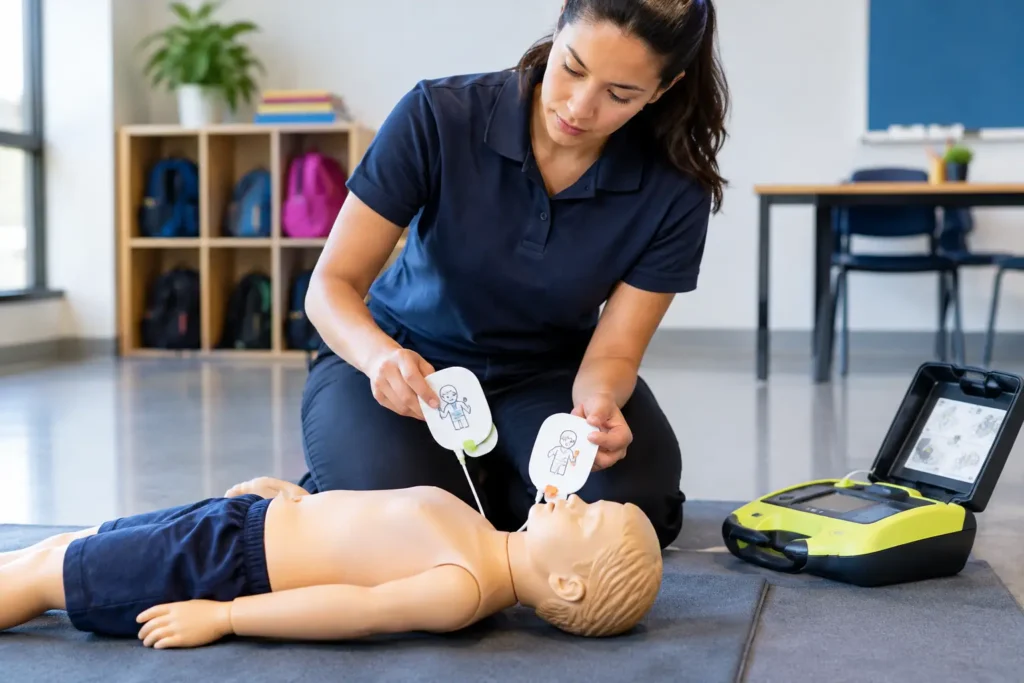
A student collapses during recess, a visiting child has a medical emergency at a school event, or a young athlete suddenly becomes unresponsive. In those first minutes, staff need equipment that is ready and a response plan they can follow. So, can schools use pediatric pads? Yes. Schools can and often should include pediatric AED pads or a pediatric energy attenuator in their AED program, particularly when they serve younger children.
The right setup depends on the AED model, the age and size of the students served, the location of each device, and the school’s emergency response procedures. Pediatric pads are not simply an accessory to store in a cabinet. They are a planned part of making an AED usable for the people who may need it.
An automated external defibrillator, or AED, analyzes a person’s heart rhythm and can advise or deliver a shock when appropriate. Pediatric pads are designed to reduce the energy delivered by a compatible AED for younger patients. Depending on the AED manufacturer, this may be handled through dedicated pediatric electrode pads, a pediatric key, or another attenuation system.
For school planning purposes, pediatric pads are generally intended for children younger than 8 years old or weighing less than 55 pounds. Adult pads are generally used for patients age 8 and older or weighing 55 pounds or more. Staff should follow the prompts and instructions for the specific AED installed at their facility, because pad compatibility and setup vary by model.
The AED itself makes the rhythm analysis. Pediatric pads do not require staff to diagnose the child or decide whether a shock is needed. Their job is to recognize an emergency, call 911, begin CPR, retrieve the AED, and follow the device’s prompts.
Yes, provided the pediatric pads or attenuator are approved for that specific AED model and are maintained as part of the school’s AED program. A school should never assume that pads from one brand or model will work with another. Using the correct manufacturer-approved consumables protects device performance and gives responders clear, reliable instructions during a stressful event.
Schools serving preschool, elementary, or mixed-age populations have a strong practical reason to keep pediatric capability available. Districts with several campuses may choose different configurations based on who is present at each site. An elementary school may place pediatric-capable AED supplies with every unit. A high school may still maintain pediatric capability when younger siblings, youth camps, community programs, or elementary-age visitors regularly use the facility.
There is no one-size-fits-all placement plan. The goal is to make sure the right equipment can reach a victim quickly, without creating confusion about where pediatric supplies are stored or whether they fit the AED.
A missing pediatric pad should never stop a responder from using an AED on a child in cardiac arrest. Emergency guidelines support using adult AED pads when pediatric pads or an attenuator are not available. Fast CPR, early AED use, and activation of emergency medical services remain the priority.
For very small children, pad placement may need to be adjusted so the pads do not touch. The diagrams on the pad package and AED prompts should guide the responder. Depending on the child’s size and the pad instructions, one pad may be placed on the chest and one on the back. This is another reason hands-on CPR and AED training is valuable for school staff, coaches, nurses, and designated response teams.
Adding pediatric pads to a cabinet is not enough. Schools need a system that keeps the device, pads, people, and procedures ready together. The operational details are where many AED programs become vulnerable.
Start by identifying the population at each building and during after-hours use. Consider students, summer programs, athletic events, family nights, community renters, and visiting children. Then review where AEDs are located and how long it takes a trained responder to retrieve one from common areas such as playgrounds, gyms, cafeterias, auditoriums, and athletic fields.
A workable school AED plan should address at least these four areas:
AED program management can reduce the burden on a school nurse, facilities director, or administrator who is already managing many responsibilities. A documented inspection schedule, device registry, expiration calendar, and post-incident process turn good intentions into a repeatable readiness program.
Pediatric pads are most useful when the AED can be reached quickly. A device locked in an office after school or placed far from a playground may not support a timely response. Schools should evaluate travel time, not just the total number of AEDs on campus.
For many facilities, high-priority locations include main entrances, gymnasiums, cafeterias, nurse’s offices, playground access points, athletic areas, and spaces used for assemblies or community events. Large campuses may need units in more than one building or portable coverage for outdoor activities. The right number depends on the layout, enrollment, population age, available staff, and local response times.
Schools also need to decide who can access the AED. Cabinets should be visible, clearly marked, and available whenever students and visitors are present. If an alarmed cabinet is used, staff should understand that opening it during a suspected cardiac emergency is the correct action, not a reason to hesitate.
CPR and AED training gives staff confidence, but school response plans work best when training reflects the building’s actual environment. During a drill, teams should know who calls 911, who retrieves the AED, who meets EMS, who begins CPR, and who manages the other students nearby.
Include pediatric scenarios in training for elementary staff, early learning teams, coaches, and personnel who oversee youth programs. Staff do not need to memorize every possible clinical situation. They do need to understand how to turn on the AED, attach the appropriate pads, avoid touching the patient during analysis, and follow the prompts.
For multi-building districts, consistent equipment and procedures can make training easier. When AED models, cabinet setups, inspection routines, and response roles vary widely from one campus to another, staff may lose valuable seconds trying to orient themselves. Standardization is often a practical safety advantage.
Before finalizing AED coverage, administrators should ask whether each AED supports pediatric treatment, whether the correct pediatric supplies are on hand, and whether the supplies are within expiration. They should also confirm that staff know where the AEDs are located and that the emergency plan accounts for after-hours programs.
It is also wise to review state and district requirements, medical oversight expectations, and policies for AED maintenance and incident reporting. Requirements can vary, and a school’s legal or administrative obligations may extend beyond having a device mounted on the wall.
Square One Medical helps organizations pair AED equipment, pediatric-ready supplies, staff training, and ongoing program support so preparedness remains manageable over time. For schools, the best AED program is one that staff can use confidently on the youngest child, the oldest student, and every visitor in between when every second matters.