
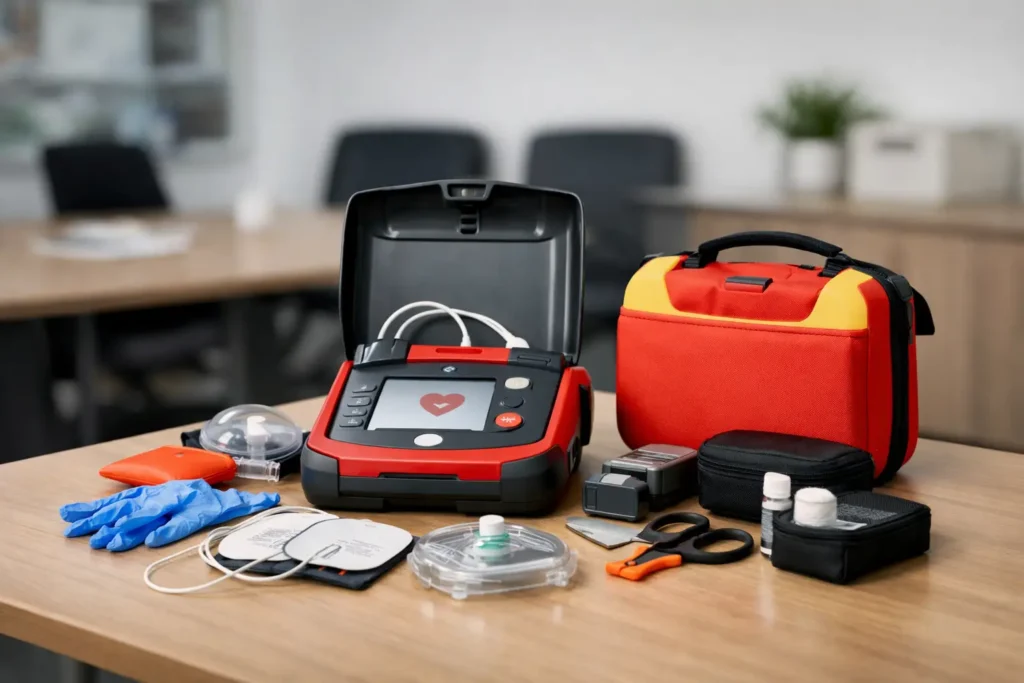
An AED can be visible, mounted, and powered on yet still fall short in an emergency if the supplies around it are incomplete or expired. This best AED accessories checklist helps safety leaders confirm that each AED is truly ready for use, not simply present in the building. For workplaces, schools, churches, athletic facilities, and public-facing organizations, readiness comes down to the device, its accessories, its location, and the people assigned to maintain it.
An AED program should begin with the equipment required to deliver a shock safely and quickly. Some accessories are essential for every location, while others depend on the population served, the building layout, and whether the AED may be used during sports, field trips, or community events.
Every AED needs a current, compatible set of adult electrode pads. Pads are single-use items, so they must be replaced after a cardiac arrest response, training use, or when the expiration date is reached. The pad package should be sealed and easy to access, with no damage from heat, moisture, or improper storage.
Pads are specific to the AED model. An organization should not assume pads from another manufacturer or AED model will work. Keep the correct replacement pads identified in your AED records so a replacement can be ordered promptly when needed.
The battery powers the AED’s self-tests and provides the energy needed during a rescue. Like pads, batteries have a defined service life and should be tracked by expiration date or recommended replacement interval. A device that shows a warning light, chirps, or displays a service message requires attention right away.
A spare battery can be appropriate for high-traffic locations, large campuses, remote facilities, or programs with multiple AEDs. It is not a substitute for routine inspections. The installed battery must remain current and properly seated at all times.
A rescue kit should be stored with or immediately beside the AED. It gives responders the basic supplies needed to prepare a person’s chest and use the AED pads effectively. At a minimum, the kit should include gloves, trauma shears, a razor, an absorbent towel or gauze, and a CPR breathing barrier.
Gloves protect both the responder and the person receiving care. Shears allow clothing to be removed quickly. A razor may be needed when chest hair prevents pads from adhering. A towel helps dry a wet chest, which matters when an incident occurs near a pool, athletic field, kitchen, or outdoors in poor weather. These are small items, but they can prevent avoidable delays.
Organizations that serve children should confirm how their AED supports pediatric use. Depending on the AED model, this may mean keeping pediatric electrode pads with the unit or having a device with a pediatric mode or setting. Schools, day care facilities, youth sports organizations, churches with children’s programs, and recreation centers should address this during AED program planning rather than during an emergency.
The right approach depends on the AED model and the ages of people commonly present. Pediatric accessories also expire, so they need the same inspection and replacement process as adult pads.
The best location for an AED is one a responder can reach quickly, recognize immediately, and access without searching for a key or asking for permission. The accessories around the AED play a major role in making that possible.
A protective cabinet or wall bracket keeps the AED visible and gives the program a consistent home for the device and rescue kit. Cabinets are particularly useful in common areas, hallways, gyms, lobbies, and other public spaces. A carry case may be more appropriate for teams that move between buildings, events, athletic venues, or vehicles.
The choice depends on the setting. A locked cabinet can protect equipment but may slow response if the key is not immediately available. In most public-access AED programs, immediate access should be the priority. If a cabinet includes an alarm, staff should understand that the alarm is meant to alert nearby people, not discourage AED use.
Clear signage reduces the time spent locating an AED. A wall sign above the unit is helpful, but directional signs are often just as important in larger facilities. Place them at hallway intersections, entrances, elevators, stairwells, and gathering areas where a responder may need guidance.
Signs should remain visible after renovations, furniture changes, seasonal displays, or new equipment installations. Include AED locations on facility maps, emergency action plans, new employee orientation materials, and event planning documents.
An AED program needs a simple way to document routine checks. An inspection tag on or near the cabinet can work for a single device, while a centralized AED management log is usually better for organizations with multiple sites or units. Record the inspection date, the person completing it, the AED status indicator, pad and battery expiration dates, and any corrective action needed.
This is where many programs become difficult to manage. It is easy to install an AED, but expiration dates can be missed when responsibility is unclear or a staff member changes roles. Assign primary and backup AED coordinators, and use a consistent reminder process. Square One Medical can help organizations pair equipment support with AED program management so these recurring tasks do not become an afterthought.
Accessories alone do not create an effective response program. A prepared organization also makes sure employees and volunteers know what happens when someone collapses. Staff should know who calls 911, who brings the AED, who starts CPR, and who meets responding EMS personnel at the entrance.
CPR and AED training gives designated responders the confidence to act, but the AED itself is designed to provide voice prompts that guide users during a rescue. Training should still reflect the realities of the facility. A school may need plans for a crowded gymnasium. A church may need coverage for weekend services and children’s programs. A manufacturing facility may need responders across shifts and large work areas.
Consider these four program checks alongside the physical accessory checklist:
Not every facility needs duplicate supplies at every AED. The decision should be based on response risk and operational realities. A small office with one centrally located AED may only need the installed pads, battery, and rescue kit, plus a reliable process for replacing items before they expire. A large school, sports complex, distribution center, or multi-building campus may benefit from spare pads and batteries held in a known, controlled location.
Spare accessories are especially valuable when replacement shipping could create a gap in readiness after an AED is used. They can also support locations where the AED may be exposed to frequent activity, weather changes, or high-volume public use. The trade-off is that every spare item adds another expiration date to track. A smaller, well-managed inventory is better than a large supply cache that no one monitors.
The strongest AED programs do not rely on one annual review. They build short monthly checks into normal operations, assign ownership, and respond quickly to status alerts. After an AED is used, conduct a post-event review, replace all single-use accessories, and verify that the device is returned to service as soon as possible.
A prepared AED station sends a clear message to employees, students, visitors, and families: this organization has planned for the moment when seconds matter. Start with one documented inspection, correct any missing accessories, and give the people nearest to the AED the training and confidence to use it.