
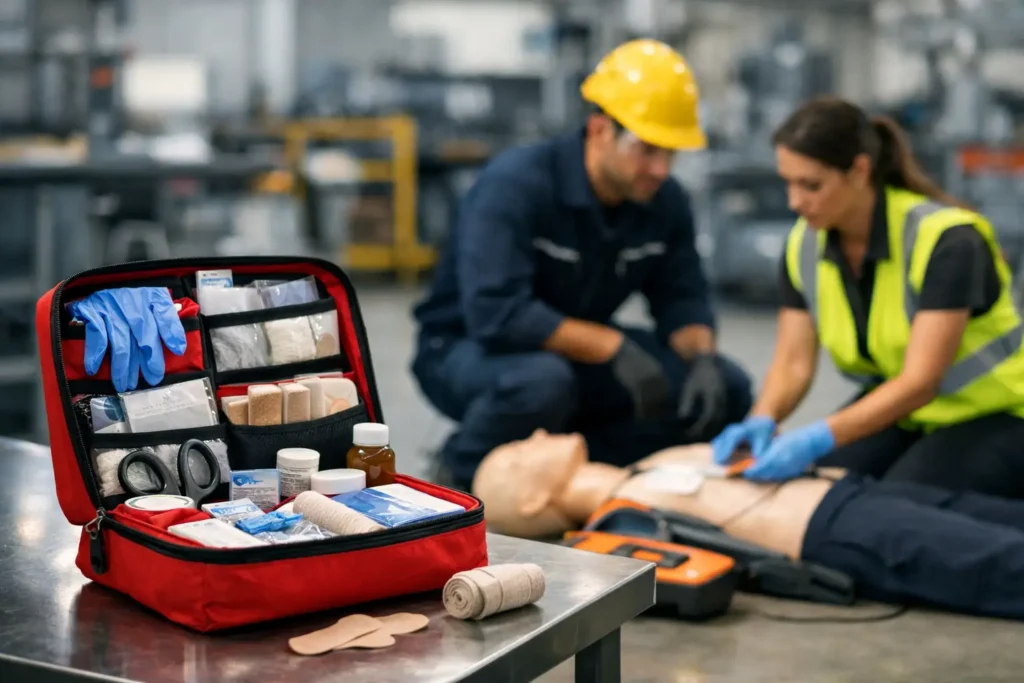
A forklift strike, crush injury, severe laceration, chemical splash, or sudden cardiac arrest will not wait for the safety committee’s next meeting. A manufacturer first aid program gives each shift a practical, rehearsed way to respond while professional help is on the way. It is not simply a cabinet on a wall. It is a coordinated system of trained people, accessible equipment, clear communication, and routine oversight.
For manufacturers, the details matter. Large production floors, loud equipment, shift changes, temporary workers, and separated work areas can all slow an emergency response. A program that looks adequate on paper can fail if the nearest AED is locked in an office, the trauma kit is empty, or no one on the night shift knows who is trained to help.
The best first aid program begins with a site-specific assessment, not a generic supply list. Walk the facility with operations, maintenance, HR, and safety personnel. Look at where injuries are most likely to occur and how long it would take a responder to reach each area.
Consider the work being performed, including machinery use, welding, powered industrial trucks, loading docks, electrical rooms, confined spaces, chemicals, and elevated work. Also consider the workforce itself. A plant with multiple shifts needs coverage beyond standard business hours. A facility with contractors or frequent visitors needs emergency procedures that do not rely on everyone knowing the building.
This assessment should guide the number and locations of first aid kits, trauma supplies, eyewash resources, and AEDs. It should also help leadership review applicable OSHA requirements and local emergency response expectations. The goal is not to place equipment everywhere without a plan. The goal is to make lifesaving resources available where people can reach them quickly.
In an emergency, response time is often the deciding factor. That is especially true for sudden cardiac arrest, where early CPR and defibrillation can dramatically improve the chance of survival. An AED program should be part of the larger first aid strategy, with devices positioned so responders can retrieve one without crossing a large plant floor or navigating multiple secured doors.
Placement should reflect real movement patterns, not just a facility map. Main entrances, break rooms, production areas, warehouse zones, fitness areas, and high-traffic corridors may all be appropriate locations. In a large or multi-building operation, one AED at the front desk is rarely enough.
Visibility is equally important. AED cabinets and signage should be easy to identify, and employees should know that an AED is intended for use by ordinary trained responders. Modern AEDs provide clear voice prompts, but confidence still comes from hands-on practice and a workplace culture that encourages people to act.
A complete AED program also includes a designated coordinator, registration or notification steps where required, routine readiness checks, and replacement planning for pads and batteries. An AED that cannot be located, has expired supplies, or has not been checked is not a dependable part of the emergency plan.
Certification training is most effective when it matches your staffing reality. A single group of trained employees may be sufficient in a small office, but manufacturing environments usually require broader coverage. Identify trained responders across departments, shifts, and physically separate areas. Account for vacations, overtime, turnover, and the possibility that a designated responder is offsite when an incident occurs.
CPR, AED, and first aid training should give employees the chance to practice skills, not just watch a presentation. Responders need to recognize cardiac arrest, call 911, begin quality CPR, retrieve the AED, and work together until EMS arrives. They should also understand how to control severe bleeding, respond to shock, and use the available first aid resources appropriately.
Emergency drills can reveal gaps that training rosters miss. For example, a drill may show that radio communication does not reach the loading dock, the AED cabinet is blocked by stored materials, or a supervisor does not know how to direct EMS to the correct entrance. These are operational issues, and they are far easier to correct before a real emergency.
A basic first aid kit has a role in every facility, but it may not be enough for a manufacturing setting. Supplies should reflect the hazards identified during the assessment and should be located where incidents are likely to occur. A kit stored only in an administrative office will not help a maintenance technician working at the far end of the plant.
For many facilities, the program may include standard first aid kits, bleeding control or trauma kits, burn care supplies, eyewash resources, and personal protective equipment for responders. The exact mix depends on the operation. A metal fabrication facility, food processing plant, and distribution warehouse have different risk profiles, even if they employ a similar number of people.
Avoid treating supplies as a one-time project. Bandages get used, gloves disappear, and trauma items can be removed during minor incidents. Establish a simple inspection schedule and assign ownership. A checklist can confirm that cabinets are accessible, seals are intact, supplies are within date, and replacement items have been ordered before a gap develops.
A clear response plan should answer a few urgent questions: Who calls 911? Who meets EMS? Who brings the AED or first aid equipment? Who communicates with leadership? In a loud manufacturing environment, employees may need radios, overhead paging, or another defined method to summon help.
Post the facility address, key access instructions, and emergency contact information where responders can find them quickly. If the site has multiple entrances, identify the best EMS access point and make sure security, supervisors, and trained responders understand the process. For rural facilities or large campuses, this detail can save valuable minutes.
The plan should also address documentation and follow-up after an incident. An event review is not about assigning blame. It is an opportunity to restock equipment, support employees, identify process improvements, and confirm that the program performed as intended.
The strongest programs remain visible after the initial rollout. Review responder coverage when staffing changes. Check AED status indicators and consumable expiration dates. Revisit placement when production lines move, facilities expand, or new hazards are introduced.
Many organizations benefit from working with one partner for training, AED program management, equipment placement, and ongoing supply support. Square One Medical helps employers bring these pieces together so preparedness does not become another disconnected administrative task.
A well-run first aid program sends a clear message to employees: their safety is planned for, not assumed. Start with the risks closest to your operation, give every shift the tools and confidence to respond, and keep the program ready for the moment it is needed most.